A tire shop receipt does more work than most retail slips: it is the proof behind mileage warranties, road-hazard claims, free-rotation promises, and insurance reimbursements after a flat. This example shows the full anatomy — each tire listed with its size and price, the installation charges, and the fee lines every shop adds — so you can read yours or rebuild a lost one.
Tire Shop Receipt
Add custom logo
Edit line items
Choose payment method
Add/remove elements
Customize business information
Choose font
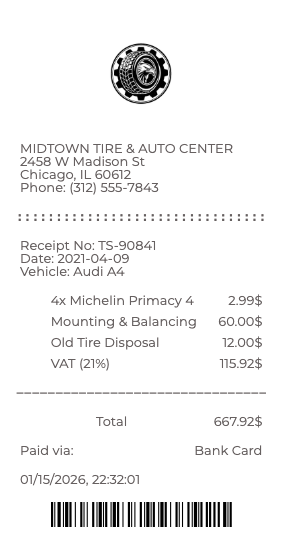
What’s on a Tire Shop Receipt
Shop name, address, and invoice number
Customer and vehicle — year, make, model, and usually the mileage at service
Each tire on its own line — brand, model, and size (for example 225/65R17), quantity, and price per tire
Installation charges — mounting and balancing, valve stems or TPMS service kits
Tire disposal or environmental fee for the tires coming off
Road-hazard coverage, if purchased, listed per tire
Alignment or flat-repair lines when performed
Tax, total, and payment method
Why a New Tire Receipt Matters for Warranty Claims
Tire warranties live and die on this receipt. A mileage warranty claim needs the purchase receipt showing the tire model and the vehicle mileage on install day, plus rotation records along the way — no receipt, no proration. Road-hazard coverage works the same: the claim starts with the receipt line showing you bought it, tied to the specific tire being replaced. Even a manufacturer defect claim asks when and where the tire was purchased. Keep the receipt with the vehicle records for the life of the set; a photo of it stored in your phone is the minimum.
Lost Tire Receipts: Discount Tire, Walmart, Costco Reprints
The big chains can usually reprint. Discount Tire, Walmart’s tire centers, and Costco tie purchases to your phone number or membership, so a store can pull the original invoice years later — one reason chain purchases are easier to warranty than cash buys at an independent shop. Independent tire shops keep invoices in their own systems; call with the approximate date and the vehicle, and most can re-issue a copy. If the shop has closed or the record is gone, a rebuilt receipt from your own documentation plus the card statement is the fallback for your files.
Used Tire and Flat Repair Receipts
Used tire receipts should add two things a new-tire receipt does not need: the remaining tread depth (in 32nds of an inch) and a note that the tire was sold as-is unless the shop offers its own short guarantee — that line is what separates an honest used-tire sale from a later argument. Flat-repair receipts matter mostly for reimbursement: fleet drivers, rideshare drivers, and anyone with roadside coverage files them, so the receipt should name the repair method (plug or patch), the tire position, and the vehicle. Both are one-line documents at many shops; ask for the detail anyway.
One more habit worth keeping: photograph any tire receipt before it leaves the shop. Thermal paper fades in a glovebox within months, and the phone copy is what warranty desks end up reading anyway.
Related auto service receipts: see also our wheel alignment receipt guide and our brake service receipt guide.
Create a Tire Shop Receipt
Our generator rebuilds a tire shop receipt with the full anatomy — vehicle and mileage, each tire with brand, size, and price, mounting and balancing, disposal fee, road-hazard line, tax, and total — as a clean PDF for warranty files, expense reports, or replacing a faded thermal slip.
Use it responsibly: recreate only purchases that actually happened, with real amounts. Submitting a fabricated tire receipt for a warranty claim, insurance reimbursement, or expense report is fraud.
Vehicle files usually hold more than tires — see the car maintenance receipt, car wash receipt, and gas receipt pages.
Frequently asked questions
Everything you need to know about the product and billing.
What should a tire shop receipt include?
The shop’s details, the vehicle and its mileage, each tire with brand, model, size, and price, mounting and balancing charges, disposal fees, any road-hazard coverage, tax, and the total with payment method.
Why do I need my tire receipt for a warranty claim?
Mileage warranties prorate against the purchase date, tire model, and install mileage on the receipt, and road-hazard claims start from the coverage line on it. Without the receipt most shops cannot process either.
Can Discount Tire, Walmart, or Costco look up my tire receipt?
Usually yes — chain tire centers tie purchases to your phone number or membership and can reprint the original invoice in store. Independent shops can often re-issue from their records if you give the date and vehicle.
What is the disposal or environmental fee on my tire receipt?
The charge for legally recycling the tires you replaced. Most states regulate scrap-tire handling, and shops pass the processing cost through as a small per-tire fee.
What should a used tire receipt show?
Everything a new-tire receipt shows plus the remaining tread depth and the sale terms — as-is or with the shop’s limited guarantee. That detail protects both buyer and seller.
Do I need a receipt for a flat tire repair?
If anyone reimburses you — an employer, a fleet, roadside coverage — yes. Ask for the repair method, tire position, and vehicle on the receipt, not just an amount.