A brake service receipt documents work on a safety-critical system, which gives it two jobs a routine service slip does not have: it proves a specific repair for warranty and resale, and it records what was replaced versus merely inspected. This page covers what a brake receipt shows, how by-axle pricing works, and why the pads-versus-rotors distinction matters.
Brake Service Receipt
Add custom logo
Edit line items
Choose payment method
Add/remove elements
Customize business information
Choose font
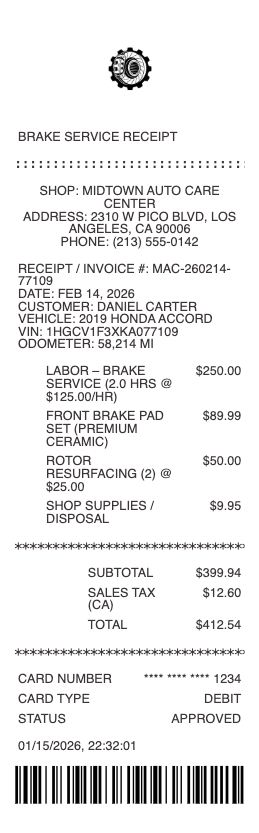
What’s on a Brake Service Receipt
Shop name and the vehicle — make, model, and mileage at service
The inspection findings — pad thickness, rotor condition, fluid state
Parts replaced — pads, rotors, calipers, hardware, brake fluid — by axle
Labor, usually a flat rate per axle or job
Which axle(s) — front, rear, or both, since they wear and are priced separately
Any warranty on pads or the work
Total and payment method
By-Axle Pricing and What Actually Got Done
Brakes are priced and serviced by axle, and reading that is the key to the receipt. Front brakes usually wear faster than rear, so a bill may cover one axle or both, and “brake job” can mean very different work: just pads, or pads and rotors, or a full job with calipers and fluid. The receipt should say exactly which — because a pads-only job and a pads-plus-rotors job are very different prices, and a common upsell dispute is being charged for rotors that could have been resurfaced or were still in spec. The inspection findings on the receipt (measured pad thickness, rotor runout) are what justify what was replaced, so they matter as much as the parts lines.
Warranties, Safety, and the Inspection
Because brakes are safety-critical, the service carries specifics worth keeping. Many shops and chains offer a warranty on brake pads — sometimes a lifetime pad guarantee where you pay only labor on future replacements — and the receipt is what activates it, so it is genuinely worth filing. A brake inspection is frequently free and generates a documented finding even when no work is done; that record is useful as a baseline and as proof the system was checked. For a leased or fleet vehicle, brake work is expected maintenance the receipt substantiates, and for resale, documented brakes reassure a buyer that a safety system was properly maintained. Keep the receipt at least as long as any pad warranty runs.
Expenses, Fleets, and Getting a Copy
Brake service lands on expense and maintenance records for business and fleet vehicles, where it is deductible upkeep and the itemized receipt is the substantiation, and for leased cars, where wear-item maintenance is the lessee’s responsibility and the receipt proves it was done. The by-axle, parts-and-labor breakdown is what an approver or a lease-return inspector checks — a lump total does not show whether rotors were replaced or resurfaced. For a lost receipt, the shop keeps the service record tied to the vehicle and mileage and can reprint it, useful when a pad warranty claim surfaces months later. File brake receipts with the vehicle’s maintenance history rather than loosely.
Related auto service receipts: see also our exhaust repair receipt guide and our wheel alignment receipt guide.
Create a Brake Service-Style Receipt
Our generator rebuilds a brake service receipt — shop and vehicle with mileage, inspection findings, parts by axle, labor, any pad warranty, and total — as a clean PDF for warranty, fleet, or resale records when the original is lost.
Use it responsibly: document real brake work at true amounts. Fabricating brake receipts — to fake maintenance on a lease return, a warranty, or a fleet claim — is fraud, and misrepresenting safety work is especially serious. For genuine service, the shop keeps the record tied to your vehicle and can reissue it.
Frequently asked questions
Everything you need to know about the product and billing.
What should a brake service receipt include?
The shop and vehicle with mileage, the inspection findings (pad thickness, rotor condition), the parts replaced by axle (pads, rotors, calipers, fluid), labor, which axles were serviced, any pad warranty, and the total.
Why are brakes priced by axle?
Front and rear brakes wear at different rates and are serviced separately, so a bill may cover one axle or both. The receipt should state which, since front-only and all-around jobs are very different prices.
What is the difference between a pads-only and pads-plus-rotors brake job?
A pads-only job replaces just the friction pads; a fuller job also replaces or resurfaces rotors and may include calipers and fluid. They cost very differently, so the receipt should specify exactly what was done.
Was I overcharged if rotors were replaced?
Not necessarily — but rotors can sometimes be resurfaced or may still be in spec. The inspection findings on the receipt (rotor measurements) are what justify replacement, so check them against the parts charged.
Do brake pads come with a warranty?
Often — many shops offer a pad warranty, sometimes a lifetime guarantee where you pay only labor on future replacements. The receipt is what activates it, so keep it for as long as the warranty runs.
Do I need brake receipts for a leased or fleet vehicle?
Yes — brake work is expected maintenance the lessee or fleet owner must document. The itemized, by-axle receipt substantiates it for lease returns, deductible upkeep, and resale.