An American Express receipt records a payment on a card that works differently from most: Amex is both the issuer and the network, its card numbers run 15 digits instead of 16, and several of its cards attach real benefits — purchase protection, extended warranty — that only pay out if you kept the receipt. This page explains what an Amex transaction shows, why the closed-loop model matters, and how the receipt unlocks the card’s protections.
American Express Receipt
Add custom logo
Edit line items
Choose payment method
Add/remove elements
Customize business information
Choose font
What’s on an American Express Receipt
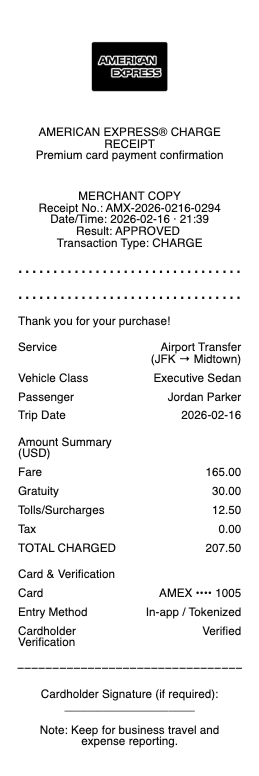
The merchant, amount, date, and time
The card ending — Amex numbers are 15 digits, and receipts often show the last five
An authorization/approval code
The entry method — chip, contactless, or online
The cardmember name, on some formats
A reference number for statement matching and disputes
Tip and total lines, on restaurant and service receipts
The Closed Loop — Issuer and Network in One
Visa and Mastercard are networks: thousands of different banks issue the cards, and the network just moves the transaction between them. American Express runs a closed loop — it typically issues the card, processes the transaction, and settles with the merchant itself, one company end to end. That shape explains several things you notice as a cardholder. Amex sets its own merchant pricing, historically higher than the networks’ — which is why a minority of merchants still don’t take Amex, and why asking “do you accept American Express?” remains a real question. It also means Amex sees the whole transaction, which powers detailed statements and a dispute process cardholders generally rate as strong. And the 15-digit card number (versus 16 for Visa/Mastercard) is the small telltale of the different system — it’s why receipts and forms sometimes treat Amex as its own format, often printing the last five digits.
Charge Cards, Credit Cards, and Membership Rewards
Amex built its reputation on the charge card — pay the balance in full every month, with no preset spending limit and no revolving interest — a different instrument from a credit card’s carry-a-balance model. Today’s Amex lineup includes both: traditional charge-style products (the Green, Gold, and Platinum families, now with flexible pay-over-time features) and true credit cards, many carrying annual fees that fund their perks. Purchases earn Membership Rewards points on eligible cards — the points ecosystem that transfers to airline and hotel partners — though points appear on your statement, not the paper receipt. For expense tracking, Amex’s statements are famously itemized, and business cardmembers get year-end summaries that categorize a whole year of spending. The receipt remains the per-transaction proof; the statement is where Amex’s closed-loop data shows its worth.
Purchase Protection, Extended Warranty — Keep the Receipt
Here’s why an Amex receipt is worth filing rather than tossing: several Amex cards carry built-in protections that require it. Purchase Protection on eligible cards can repair, replace, or reimburse an eligible item that’s accidentally damaged or stolen within roughly 90 days of purchase. Extended Warranty can add up to an extra year on top of an eligible manufacturer’s warranty. Both are claims processes, and both ask for documentation — typically the itemized receipt plus the statement showing the charge (warranty claims also want the original warranty terms). Terms, caps, and eligibility vary by card and change over time, so check your card’s guide — but the practical rule is constant: for anything valuable bought on an Amex, keep the receipt with the warranty papers. The benefit you paid an annual fee for is only claimable if the paperwork survived.
Related card payment receipts: see also our Debit Card receipt guide and our Credit Card receipt guide.
Create an American Express Receipt
Our generator reproduces a card-payment receipt in the Amex style — merchant, amount, date, card ending, and authorization code — as a clean PDF when a faded or lost original needs a legible stand-in for an expense report, a protection claim file, or your records.
Use it responsibly: recreate only real transactions you actually made, with true amounts. Fabricating a card receipt to support a false purchase-protection or warranty claim, invent an expense, or dispute a legitimate charge is fraud — American Express holds the authoritative transaction record for every charge on its network and verifies claims against it. American Express is a trademark of its owner; this tool is not affiliated with it and is for legitimate record-keeping only.
Frequently asked questions
Everything you need to know about the product and billing.
What does an American Express receipt show?
The merchant, amount, date, and time, the card ending (Amex numbers are 15 digits, receipts often show the last five), an authorization code, the entry method, sometimes the cardmember name, a reference number for statement matching, and tip/total lines on service receipts.
Why do Amex cards have 15 digits instead of 16?
American Express runs its own card format as a closed-loop system — it’s the issuer and the network in one. The 15-digit number is the telltale of that separate system, and it’s why receipts and payment forms sometimes treat Amex as its own card type.
What does it mean that Amex is a closed-loop network?
Unlike Visa and Mastercard, which are networks for cards issued by thousands of banks, Amex typically issues the card, processes the transaction, and settles with the merchant itself. That’s why it sets its own merchant pricing — the reason some merchants don’t accept Amex — and why its statements and disputes draw on end-to-end data.
What’s the difference between an Amex charge card and credit card?
A charge card is paid in full every month with no preset spending limit and no revolving interest — the model Amex built its name on. A credit card lets you carry a balance. Today’s Amex lineup includes both, with pay-over-time features blurring the old line.
What is Amex Purchase Protection?
A benefit on eligible cards that can repair, replace, or reimburse an eligible item accidentally damaged or stolen within roughly 90 days of purchase, up to the card’s caps. Claims require documentation — typically the itemized receipt and the statement showing the charge.
How does Amex Extended Warranty work?
On eligible cards it adds up to an extra year to an eligible manufacturer’s warranty. To claim, you’ll need the receipt, the statement, and the original warranty terms — which is exactly why receipts for valuable Amex purchases are worth filing with the warranty papers.