A credit card receipt is the sale slip you get when a card payment is approved — it shows the merchant, the amount, an authorization code, and a masked card number showing only the last four digits. This guide explains every field on a credit card receipt, why the full card number is never printed, whether a store can look up your receipt using the card, and how businesses track credit card receipts for expenses.
Credit Card Receipt
Add custom logo
Edit line items
Choose payment method
Add/remove elements
Customize business information
Choose font
What's on a credit card receipt
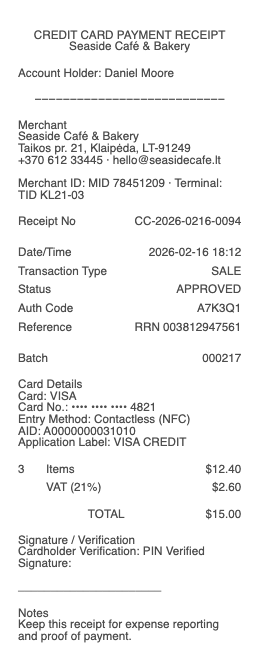
A credit card sale slip is deliberately sparse for security, but it always includes:
Merchant name & date/time — who charged you and when.
Masked card number — only the last four digits appear (for example ************1234); PCI DSS rules prohibit printing the full number.
Card type & entry method — Visa, Mastercard, Amex or Discover, and whether it was chip, tap, or swipe.
Authorization / approval code — the code the bank returned when it approved the charge.
Amount, tip line & total — the sale amount, an optional tip line, and the final total.
Merchant vs customer copy — the merchant copy (historically signed) stays with the seller; the customer copy is yours.
Why your full card number isn't on the receipt
Under PCI DSS security rules, a credit card receipt may show only a truncated card number — typically just the last four digits — and must never print the full number or the expiration date on the customer copy. That's why every receipt reads like ************1234. The signature line is also largely a relic: since 2018 the major networks (Visa, Mastercard, Amex, and Discover) made signatures optional for most chip and contactless transactions, so many receipts no longer ask for one at all.
Can a store look up a receipt using your credit card?
Often, yes. Many large retailers — including Walmart, Home Depot, Target, Kohl's, Marshalls, and HomeGoods — can search a purchase using the card you paid with plus the approximate date, then reprint the receipt for a return or an expense record. Walmart and Home Depot in particular have well-known receipt-lookup tools for card purchases. The catch: it only works for the exact card that was used, and time limits apply (commonly 90 days to a year depending on the store). That's a good reason to pay returnable purchases on one consistent card.
Tracking business credit card receipts for expenses
For a business or corporate card, receipts are the backbone of expense reporting and tax deductions. The IRS generally expects a receipt for any business expense of $75 or more, and most company card policies require one for every charge regardless of amount. Because thermal card slips fade quickly, businesses increasingly photograph or scan receipts into an expense app and match them to each card transaction. Keeping the itemized receipt, not just the card slip, matters here too — the slip proves the amount, but the itemized receipt proves what was actually bought.
Related payment receipts: see also our debit card receipt guide and our PayPal receipt guide.
Credit card receipt templates and copies
If a card slip has faded or gone missing, our credit card receipt template and generator reproduces a clean copy — merchant, date, masked card number, authorization code, amount, tip, and total — formatted the way a real sale slip is, so you can keep a legible record or rebuild an expense file.
For legitimate record-keeping only. Never use it to fabricate a charge you didn't make or to misrepresent a transaction; recreating a receipt for a purchase that didn't happen is fraud. Reproduce only your own genuine card payments.
When the card slip has to prove something, the proof of purchase receipt and return receipt pages explain what counts.
Frequently asked questions
Everything you need to know about the product and billing.
Why does a credit card receipt only show the last four digits?
PCI DSS security rules require card numbers to be truncated on receipts — typically only the last four digits appear, and the full number and expiration date must not be printed on the customer copy. This protects you if the receipt is lost or thrown away.
Can a store look up my receipt with my credit card?
Many large retailers can — Walmart, Home Depot, Target, Kohl's, Marshalls, and HomeGoods among them — by searching the card you paid with plus the date. It only works for the exact card used, and stores apply time limits (often 90 days to a year).
What is the authorization code on a credit card receipt?
It's the approval code the card issuer returns when it authorizes the charge. It confirms the bank approved that specific transaction and helps identify the payment if there's ever a dispute.
Do I still need to sign a credit card receipt?
Usually not. Since 2018 Visa, Mastercard, Amex, and Discover made signatures optional for most chip and contactless payments, so many merchants no longer print or require a signature line.
Do businesses need to keep credit card receipts?
Yes. The IRS generally expects a receipt for business expenses of $75 or more, and most company card policies require one for every charge. Keep the itemized receipt, not just the card slip, since the slip shows only the amount and not what was purchased.
What's the difference between the merchant copy and the customer copy?
The merchant copy stays with the seller (historically the one you signed); the customer copy is yours to keep. Both show the same masked card number and total.