A debit card receipt records a purchase paid straight from your checking account — the money leaves right away, not on a monthly bill. That single difference from a credit card shapes everything on the slip: the pending hold, the PIN-or-signature choice, the cash-back-at-register line, and why a debit dispute works differently. This page explains what a debit receipt shows and how to read it.
Debit Card Receipt
Add custom logo
Edit line items
Choose payment method
Add/remove elements
Customize business information
Choose font
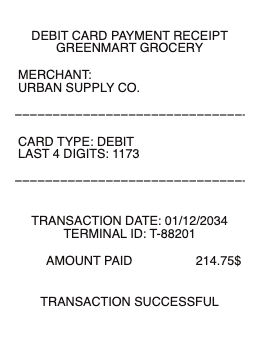
What’s on a Debit Card Receipt
Merchant name, date, and time
The amount, plus any cash back taken at the register
Last four digits of the card — the rest is masked
“Debit” and the network — a PIN debit or a signature/Visa-Mastercard debit run
Approval/authorization code and a reference number
“Debit Tend” or account-type line showing checking was charged
A tip line on signature debit at restaurants (not on PIN debit)
Debit vs Credit — Same Card Shape, Different Money
A debit card looks like a credit card and often runs on the same Visa or Mastercard network, but the receipt reflects a very different transaction. Debit pulls funds immediately from your checking account — there is no grace period and no bill, so the money is gone at approval, not owed later. Overspend and you hit your balance or overdraft, not a credit limit. That is why a debit purchase can post a temporary hold (common at gas stations, hotels, and restaurants) that briefly exceeds the final amount before settling. The receipt’s “debit” marker and account-type line tell you checking was tapped directly — useful when you reconcile, because the charge lands in your bank balance the same day rather than on a statement weeks out.
PIN vs Signature, and Cash Back at the Register
Debit runs two ways, and the receipt shows which. A PIN debit authorizes with your PIN, often clears faster, and is the only path that lets you take cash back at checkout — a line unique to debit that a credit receipt never carries. A signature debit runs over the card network like a credit charge, may add a tip line at restaurants, and can post that temporary hold. Cash back appears as a separate amount added to your purchase total, and it is worth checking, because it comes straight out of your account. For anyone tracking spending, distinguishing the purchase amount from cash back on the receipt keeps your records straight — they settle together but are not the same thing.
Holds, Disputes, and Getting a Copy
Because debit spends real money instantly, a wrong charge hits harder than on credit — the funds are already out of your account while you dispute. Debit fraud protection exists but works differently from credit’s, so keeping the receipt matters: it is your proof of the correct amount against a duplicate charge or a hold that did not drop off. A pending hold should release to the final amount within a few days; the receipt shows what the total should be. Your bank’s online or mobile statement lists every debit transaction with its date, merchant, and reference, and most banks let you view or download an itemized record. For reimbursement or bookkeeping, that statement line plus the register receipt together document the purchase, the cash back, and the account charged.
Related payment receipts: see also our credit card receipt guide and our Apple Pay receipt guide.
Create a Debit Card Receipt
Our generator reproduces a debit card sales receipt — merchant, date, amount, cash back, masked last four, and approval code — as a clean PDF for an expense report or your own records when you need a legible copy.
Use it responsibly: recreate only real purchases with their true amounts. Fabricating a debit receipt to inflate an expense claim, fake proof of payment, or mislead anyone is fraud — the authoritative record is your bank’s transaction history, which shows every debit and can be verified. This tool is for legitimate record-keeping only.
Frequently asked questions
Everything you need to know about the product and billing.
What does a debit card receipt show?
The merchant, date, and time; the amount plus any cash back; the last four digits of the card; whether it ran as PIN or signature debit; an approval code and reference; and an account-type line showing checking was charged directly.
How is a debit card receipt different from a credit card one?
Debit pulls money immediately from checking with no grace period or bill, so the receipt may show a temporary hold and a cash-back line. Credit defers payment to a statement. The “debit” marker shows your bank balance was tapped the same day.
Why is there a hold on my debit card that’s more than the receipt?
Gas stations, hotels, and restaurants place a temporary authorization hold that can exceed the final amount. It should release to the receipt total within a few days. The receipt shows what the actual charge should settle to.
What is cash back on a debit card receipt?
An amount of cash the cashier gives you, added to your purchase total and pulled from your checking account. It appears only on PIN debit, as a separate line, so check it against the goods total — they settle together but differ.
What’s the difference between PIN and signature debit?
PIN debit authorizes with your PIN, often clears faster, and allows cash back at checkout. Signature debit runs over the Visa or Mastercard network like a credit charge, may add a restaurant tip line, and can post a temporary hold.
How do I get a copy of a debit card receipt?
Your bank’s online or mobile statement lists every debit with its date, merchant, and reference, and most banks let you view or download an itemized record. Keep the register receipt too, as proof of the amount and any cash back.