An appliance repair receipt documents fixing a refrigerator, washer, dryer, dishwasher, or oven — and its defining feature is the diagnostic fee that comes before the fix, plus the warranty question that decides who pays. This page covers what the receipt shows, how the diagnostic-fee-toward-repair model works, and how manufacturer versus repair warranties change the bill.
Appliance Repair Receipt
Add custom logo
Edit line items
Choose payment method
Add/remove elements
Customize business information
Choose font
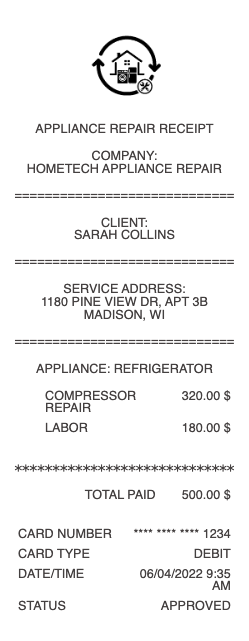
What’s on an Appliance Repair Receipt
Repair company name and technician, with the service date
The appliance — type, brand, model, and often the serial number
The problem diagnosed and the repair performed
Diagnostic/service-call fee — usually charged first
Parts — the specific component replaced, with its price
Labor — flat-rate by job or hourly
Warranty status — in-warranty, out-of-warranty, or covered by a home warranty — and the total
The Diagnostic Fee — and When It Goes Toward the Repair
Appliance repair almost always starts with a diagnostic or service-call fee: the technician charges to come out and identify the fault, and that fee is billed whether or not you proceed. The common practice — and the thing to confirm and check on the receipt — is that this fee is applied toward the repair if you go ahead, so you are not paying twice. If you decline the repair (often because a fix costs more than the appliance is worth), you still owe the diagnostic fee, and the receipt should show it as a standalone charge. Reading whether the diagnostic was credited against the repair total is the single most useful check on an appliance repair bill.
Parts, Labor, and the Repair-or-Replace Call
The body of the bill is parts plus labor. The part is the specific failed component — a pump, a compressor, a control board, a heating element — priced individually, sometimes with a markup, and labor is usually a flat rate for the defined job rather than hourly. This structure feeds the classic repair-or-replace decision: when the parts-and-labor total approaches the cost of a new appliance, a technician will often say so, and the receipt (or the declined-repair quote) documents that advice. Keeping the itemized breakdown matters because it shows exactly which part was replaced — essential if the same part fails again under the repair warranty.
Warranties: Manufacturer, Repair, and Home Warranty
Three warranty situations change who pays and why the receipt matters. Under a manufacturer warranty, an in-warranty repair may cost you nothing but still generates a receipt proving the service occurred — keep it. Out of warranty, you pay, and the repair shop typically provides its own warranty on the part and labor for a period, activated by that receipt if the fix fails. And a home warranty or protection plan may cover the repair minus a service fee, with the receipt as the claim record. In every case the receipt — with the appliance model, the part replaced, and the date — is the document that substantiates the coverage. Landlords also file appliance repair receipts as deductible rental maintenance.
Related home service receipts: see also our Roofing receipt guide and our Cleaning Service receipt guide.
Create an Appliance Repair-Style Receipt
Our generator rebuilds an appliance repair receipt — company and technician, appliance make/model, the fault and repair, diagnostic fee, parts, labor, warranty status, and total — as a clean PDF for warranty, rental, or personal records when the original is lost.
Use it responsibly: document real repairs at true amounts. Fabricating appliance repair receipts — to claim a warranty, a home-warranty payout, or a landlord expense that did not happen — is fraud. For a genuine repair, the shop keeps the record and can reissue it, which is the correct document for any warranty claim.
Frequently asked questions
Everything you need to know about the product and billing.
What should an appliance repair receipt include?
The company and technician, the appliance type/brand/model (and often serial), the problem and repair, the diagnostic fee, the parts replaced, labor, the warranty status, and the total.
Does the diagnostic fee go toward the repair?
Usually yes — if you proceed with the repair, the diagnostic or service-call fee is commonly applied to the repair total so you don’t pay twice. If you decline, you still owe the diagnostic fee as a standalone charge. Check the receipt to confirm it was credited.
Why is my appliance repair itemized into parts and labor?
The failed component is priced individually, and labor is usually a flat rate for the defined job. The breakdown shows exactly which part was replaced — essential if it fails again under the repair warranty.
What warranty comes with an appliance repair?
Out-of-warranty repairs typically include the shop’s own warranty on the part and labor for a period, activated by the receipt if the fix fails. In-warranty and home-warranty repairs generate a receipt as proof of service and the claim record.
How does the receipt help the repair-or-replace decision?
When parts and labor approach the cost of a new appliance, the technician will often advise replacing. The itemized receipt or declined-repair quote documents that advice and what a repair would have cost.
Can landlords deduct appliance repair receipts?
Yes — appliance repairs on rental property are generally deductible maintenance, and the itemized receipt with the appliance and repair details is the substantiation.