A cleaning service receipt documents residential or commercial cleaning — a one-time deep clean, a recurring weekly visit, or a move-out turnover — and how it reads depends heavily on which. Because cleaning is often tied to a lease, a landlord, or a business expense, the receipt is the proof that decides deposits, deductions, and recurring billing. This page covers what it shows across those situations.
Cleaning Service Receipt
Add custom logo
Edit line items
Choose payment method
Add/remove elements
Customize business information
Choose font
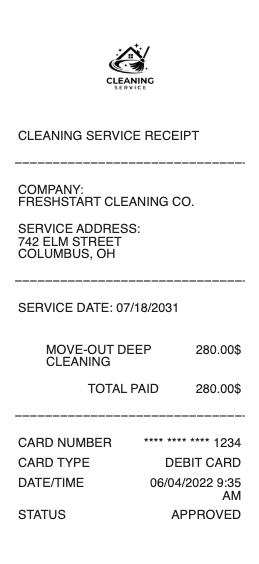
What’s on a Cleaning Service Receipt
Cleaner or company name — and whether they are insured/bonded, which professional services note
Service address and date, and residential vs commercial
The service type — standard, deep, or move-in/move-out clean
Pricing basis — flat per visit, hourly, or by size (square footage, bedrooms/bathrooms)
Frequency — one-time, or recurring weekly/biweekly/monthly
Extras — inside oven, inside fridge, windows, laundry — and whether supplies were included
Tip, total, and payment method
One-Time, Recurring, and Move-Out Cleans
The service type drives everything on the receipt. A standard clean is routine upkeep; a deep clean — usually the first visit or a periodic reset — costs more for the extra scope; and a move-in/move-out clean is the most involved and most consequential, because it is tied to a security deposit. Recurring service is often discounted versus one-time and may run on a subscription with a per-visit rate, so the receipt shows either a single visit or a period’s billing. Extras like inside the oven or fridge, interior windows, and laundry are add-ons that change the total. Reading the service type and what was included is how you know whether the price and the scope matched.
Move-Out Cleans and Security Deposits
The highest-stakes cleaning receipt is the move-out clean, because it sits between a tenant and a security deposit. A tenant who pays for a professional end-of-tenancy clean keeps the receipt as proof the property was left clean, countering a landlord’s cleaning deduction. A landlord who cleans after a tenant uses the receipt to justify a deposit deduction — a documented, itemized cleaning bill is far more defensible than a vague charge. Either way, the itemized receipt showing a move-out or deep clean, the address, and the date is the evidence a deposit dispute is resolved against, which is why both sides should insist on one for turnover cleaning.
Business Expenses, Recurring Billing, and Records
Cleaning is a routine business expense — offices, retail, short-term rentals between guests — and the receipt or invoice is the deductible record, often recurring monthly with terms for commercial contracts. Short-term rental hosts expense turnover cleaning per booking and may pass a cleaning fee to guests, making the receipt part of the listing’s accounting. For recurring residential service, the receipt trail documents a household expense and, where a cleaner is engaged regularly, may intersect with household-employment considerations. For a lost receipt, an established cleaning company keeps client records and reissues them; an individual cleaner may not, so keep the slip — especially the move-out one, which you may need weeks later when the deposit is settled.
Related home service receipts: see also our Appliance Repair receipt guide and our Pest Control receipt guide.
Create a Cleaning Service-Style Receipt
Our generator rebuilds a cleaning receipt — company or cleaner, service address and type, pricing basis and frequency, extras, and total — as a clean PDF for deposit, rental, or business records when the original is lost.
Use it responsibly: document real cleaning at true amounts. Fabricating cleaning receipts — to claim a deposit was earned, justify a deduction that did not happen, or invent a business expense — is fraud. For genuine service, the cleaning company keeps the record and can reissue it, which is what a deposit dispute is checked against.
Frequently asked questions
Everything you need to know about the product and billing.
What should a cleaning service receipt include?
The cleaner or company (and whether insured/bonded), the service address and date, the service type (standard, deep, or move-out), the pricing basis (flat, hourly, or by size), the frequency, any extras, and the total.
What is the difference between a standard, deep, and move-out clean?
A standard clean is routine upkeep; a deep clean covers extra scope, usually the first visit or a periodic reset; a move-out clean is the most thorough and is tied to a security deposit. Each is priced differently, and the receipt should name which.
How does a cleaning receipt help with a security deposit?
A tenant’s move-out cleaning receipt is proof the property was left clean, countering a landlord’s deduction. A landlord’s cleaning receipt justifies a deduction with an itemized bill. It is the evidence a deposit dispute is resolved against.
Is recurring cleaning cheaper than a one-time clean?
Often yes — recurring weekly, biweekly, or monthly service is usually discounted versus a one-time clean, sometimes on a subscription with a per-visit rate. The receipt shows a single visit or a billing period.
Can I expense cleaning services?
For offices, retail, and short-term rentals, cleaning is a deductible business expense the receipt or invoice substantiates, often recurring monthly. Personal home cleaning generally is not deductible.
How do short-term rental hosts use cleaning receipts?
Hosts expense turnover cleaning per booking and often pass a cleaning fee to guests, so the receipt is part of the listing’s accounting and substantiates the cleaning fee charged.