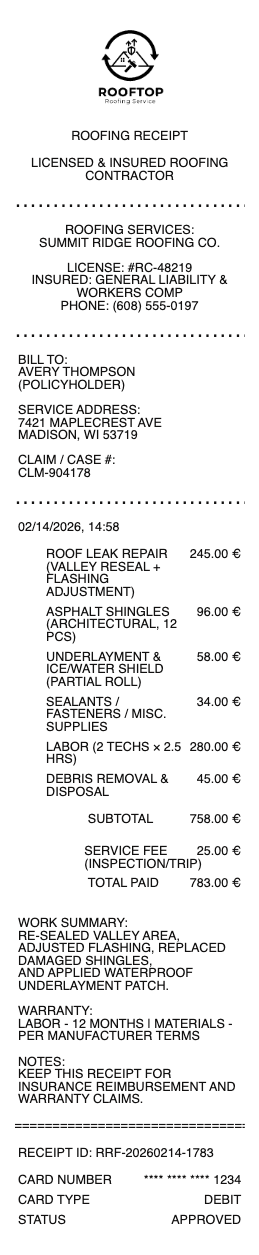
A roofing receipt shows proof of payment for roof repairs or replacement. It is commonly used for insurance documentation, property maintenance records, and warranty claims. Roofing receipts usually include repair scope, materials, labor, and total paid.
Roofing Receipt
Add custom logo
Edit line items
Choose payment method
Add/remove elements
Customize business information
Choose font
What's on a Roofing Invoice & Receipt
A roofing receipt — usually issued as a detailed roofing invoice — is a high-value document, because a roof is a big-ticket job often tied to an insurance claim or a warranty. A complete one shows:
Contractor details and licence number — the roofing company's name, address and, in states that licence roofers, the contractor licence number.
Customer and property address — who the work was for and the building it was done on.
Scope of work — tear-off of the old roof, new shingles, underlayment, flashing, drip edge and ridge vent, itemised so nothing is ambiguous.
Materials — the shingle type (3-tab or architectural) and brand, and the quantity in squares (one square = 100 square feet).
Labour, permit and totals — labour, any permit fee, sales tax and the grand total, with the payment method or financing.
Warranty — the workmanship warranty and the manufacturer's shingle warranty, which buyers and insurers both look for.
A roofing invoice for an insurance claim
After storm or hail damage, a roofing invoice for insurance is what turns an estimate into a paid claim. Homeowner's insurers want a contractor's invoice that itemises the scope — tear-off, materials in squares, labour and any code-required upgrades — and matches the adjuster's estimate for a roof replacement. A clear, detailed invoice speeds approval and supports supplements if hidden damage is found once the old roof is off. Keep the final invoice with your claim file and your closing documents; it proves the work was done, at what cost, and under what warranty. Because this is insurance paperwork, accuracy matters — the invoice should reflect the real scope and price of work that was actually performed.
For roofers: writing a clear invoice
If you run a roofing business, a professional roofing invoice wins trust and gets you paid faster. List your company and licence number, break out the scope line by line, and state materials in squares with the shingle brand and type so the customer and any insurer can see exactly what they're buying. Separate labour from materials, show the permit fee, and spell out both the workmanship warranty and the manufacturer's coverage. A roof repair invoice can be simpler than a full replacement, but the same clarity applies. Consistent, itemised invoices reduce payment disputes and give homeowners the document they need for insurance, resale and their own records.
Keeping your roofing receipt for warranty and resale
For a homeowner, the roofing receipt is proof of one of the most expensive improvements you'll make. Manufacturer shingle warranties and workmanship guarantees are only enforceable if you can show the invoice with the date, materials and contractor, so file it somewhere safe. When you sell, a documented new roof is a strong selling point, and buyers' inspectors will ask when it was done and by whom — the receipt answers both. If your original faded or was misplaced, ask the contractor for a duplicate first; when you need a clean itemised copy and only have partial records, reconstruct it from the real job details so your warranty and resale file stays complete.
Related home service receipts: see also our Locksmith receipt guide and our Appliance Repair receipt guide.
Free roofing invoice & receipt generator
Our roofing invoice generator builds a clean, itemised document with every field in place — contractor and licence details, property address, scope of work, materials in squares, labour, permit, warranty and total — and downloads as a print-ready PDF, PNG or JPG in under a minute, no account required. Use this roofing receipt template to bill a job, to give a customer a copy for their insurer, or to replace a receipt you lost for your warranty file. Please use it responsibly and lawfully: create invoices only for work that genuinely took place, at its real scope and price — never to inflate a bid, fabricate storm damage, or support an insurance claim for work that wasn't performed.
Related receipts: contractors also use our plumber receipt, locksmith receipt, and pest control receipt templates.
For the broader job file, see the contractor receipt and landscaping receipt examples as well.
Frequently asked questions
Everything you need to know about the product and billing.
What should a roofing invoice include?
The contractor's name and licence number, the property address, an itemised scope (tear-off, shingles, underlayment, flashing, ridge vent), materials in squares with the shingle type and brand, labour, permit fee, tax, total, and the workmanship and manufacturer warranties. That detail is what insurers and buyers expect.
How do I use a roofing invoice for an insurance claim?
Submit a contractor's invoice that itemises the scope, materials in squares, and labour so it matches the adjuster's estimate for the roof replacement. Keep it in your claim file; it documents that the work was done, at what cost, and under what warranty.
What is a "square" on a roofing invoice?
A square is a roofing unit equal to 100 square feet of roof area. Materials and labour are often quoted per square, so a roof described as "24 squares" covers about 2,400 square feet.
What's the difference between a roof repair and replacement invoice?
A repair invoice covers a limited fix — a few shingles, flashing or a leak — while a replacement invoice covers a full tear-off and new roof with materials in squares. Replacements are larger and more likely tied to an insurance claim.
How do I get a copy of a lost roofing receipt?
Ask the roofing contractor for a duplicate first, since they keep job records, and use your card or loan documents to corroborate the amount. If you need a clean itemised copy for your warranty file, reconstruct it from the real job details.
Can I use this generator legitimately?
Yes — for roofers billing real jobs and homeowners replacing a lost receipt for a job that actually happened. It is not for inflating a bid, fabricating storm damage, or supporting an insurance claim for work that wasn't performed.