A battery replacement receipt documents a new car battery — and it has two quirks that surprise people: a refundable core charge for handing back the old battery, and a two-part warranty that determines whether a future failure costs you nothing or a prorated amount. This page covers what the receipt shows and why the warranty terms on it are worth reading closely.
Battery Replacement Receipt
Add custom logo
Edit line items
Choose payment method
Add/remove elements
Customize business information
Choose font
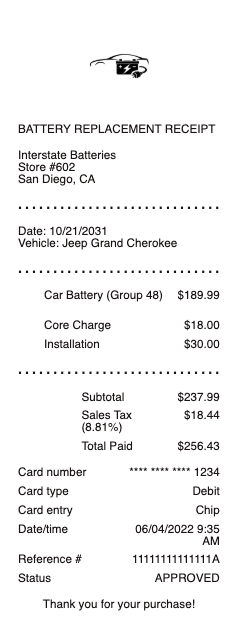
What’s on a Battery Replacement Receipt
Retailer or shop — an auto parts store, dealer, or service center
The vehicle and the date
The battery — brand, group size, and cold-cranking amps (CCA), which must match the vehicle
Core charge — a refundable deposit, credited back when you return the old battery
Installation — often free with purchase, or a labor line
Warranty terms — the free-replacement period and the prorated period
Total and payment method
The Core Charge — Why It’s on the Receipt Twice
The core charge confuses first-time buyers. It is a refundable deposit — commonly $10–$25 — added to encourage you to return the old battery for recycling, since lead-acid batteries are hazardous and valuable to recycle. If you bring the old battery in at purchase, the core charge is waived or immediately credited, so it may appear and then reverse on the same receipt. If you take the new battery and return the old one later, the receipt shows the charge, and a second receipt or credit shows the refund when you bring the core back. Reading the core line prevents thinking you were overcharged — it is a deposit, not a fee, and you get it back.
The Two-Part Warranty: Free Replacement vs. Prorated
Car battery warranties are the reason to keep this receipt, and they come in two parts. The free-replacement period (say, the first 2–3 years) means a failed battery is swapped at no cost. After that, a longer prorated period gives a partial credit toward a new battery based on how much of the warranty remains — so a battery that fails in year 4 of a 5-year prorated warranty earns only a fraction of its price back. The receipt with the purchase date and warranty terms is what activates either, and battery warranties are date-based, so a claim needs proof of when you bought it. Losing the receipt often means losing the free replacement. Keep it in the glovebox with the battery’s life.
Group Size, Testing, and Records
A battery is not one-size-fits-all: the group size and CCA on the receipt must match the vehicle’s requirement, and installing the wrong one causes fit or performance problems — so the receipt documents that the correct battery was fitted. Most sellers offer free battery testing, and a test result (a failed battery, a weak charge) may appear on the receipt as the reason for replacement, useful under warranty. For a business or fleet vehicle, the battery receipt is a deductible maintenance record, and for resale, a recent dated battery is a small selling point the receipt proves. For a lost receipt, national parts chains tie the purchase to your account or phone number and can look up the warranty — one reason buying batteries from a chain simplifies later claims.
Related auto service receipts: see also our vehicle inspection receipt guide and our AutoZone receipt guide.
Create a Battery Replacement-Style Receipt
Our generator rebuilds a battery receipt — retailer and vehicle, battery brand/group/CCA, core charge, installation, warranty terms, and total — as a clean PDF for warranty, fleet, or resale records when the original is lost.
Use it responsibly: document real purchases at true amounts. Fabricating battery receipts — to claim a warranty replacement or a core refund you are not owed — is fraud. For a genuine purchase, national chains keep the record tied to your account, which is what a warranty claim is checked against.
Frequently asked questions
Everything you need to know about the product and billing.
What should a battery replacement receipt include?
The retailer and vehicle, the battery brand, group size, and CCA, the core charge, the installation (free or labor), the warranty terms (free-replacement and prorated periods), and the total.
What is the core charge on a battery receipt?
A refundable deposit — commonly $10–$25 — added to encourage returning the old battery for recycling. If you bring the old battery in at purchase it is waived or credited; otherwise you get it back when you return the core later.
How do car battery warranties work?
In two parts: a free-replacement period where a failed battery is swapped at no cost, then a longer prorated period giving a partial credit based on remaining warranty. Both are date-based and activated by the receipt.
Why do I need to keep my battery receipt?
Battery warranties are date-based, so a claim needs proof of when you bought it. Losing the receipt often means losing the free replacement, so keep it in the glovebox for the battery’s life.
Does the battery group size on the receipt matter?
Yes — the group size and CCA must match the vehicle’s requirement, or you get fit or performance problems. The receipt documents that the correct battery was fitted.
Can a store look up my battery warranty without the receipt?
Often — national parts chains tie the purchase to your account or phone number and can look up the warranty, one reason buying from a chain simplifies later claims. Keeping the receipt is still simplest.