A vehicle inspection receipt proves a car passed a state-required safety or emissions check — and unlike most auto receipts, its main job is regulatory: it is what a state ties to registration renewal. This page covers what the receipt shows, the difference between safety and emissions inspections, and why the pass certificate matters more than the fee.
Vehicle Inspection Receipt
Add custom logo
Edit line items
Choose payment method
Add/remove elements
Customize business information
Choose font
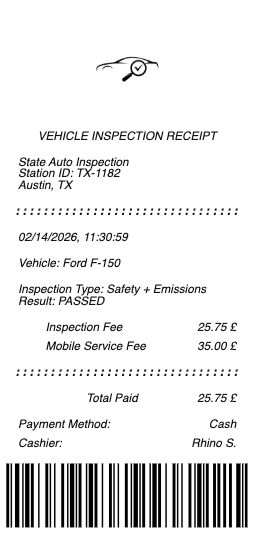
What’s on a Vehicle Inspection Receipt
Licensed inspection station and inspector, with the state or authority
The vehicle — VIN, plate, make/model, and the odometer reading
Inspection type — safety, emissions/smog, or a combined check
Result — pass or fail, with any items that failed noted
The certificate or sticker number issued on a pass
Expiration date — when the next inspection is due
The inspection fee (often state-capped) and payment method
Safety vs. Emissions Inspections
What the inspection actually checks varies by state, and the receipt names the type. A safety inspection examines brakes, lights, tires, steering, wipers, and horn — the roadworthiness basics — and issues a pass or a list of items to fix. An emissions (smog) inspection tests tailpipe output and, on modern cars, reads the OBD-II system for fault codes and readiness, ensuring the vehicle meets air-quality standards. Some states require both, some one, some neither, and requirements often depend on the vehicle’s age and county. The receipt records which was performed and the result, which is what a registration office and a used-car buyer both check.
Why the Certificate Matters: Registration and Renewal
The inspection receipt’s real value is the pass certificate, because most states that require inspection tie it to registration renewal — you cannot renew your tags without a current passing inspection on file. The receipt and its certificate or sticker number are the proof, and the expiration date on it tells you when the clock runs out. A failed inspection generates a receipt too, listing what must be repaired; after the fix you return for a re-inspection, often free or discounted within a set window, and the passing receipt is what finally clears registration. Keep the passing receipt until the next inspection cycle, since it is the document that proves you are road-legal.
Fees, Exemptions, Fleets, and Records
Inspection fees are usually capped by the state and modest, so the receipt is less about the money than the record. Some vehicles are exempt — new cars for a few years, and electric vehicles from emissions testing (having no tailpipe) in many states — and the registration paperwork reflects that rather than an inspection receipt. For fleets and businesses, inspection receipts are compliance records proving every vehicle is legally operable, and for a used-car sale, a current passing inspection reassures the buyer and is sometimes required to transfer registration. For a lost receipt, the inspection station and often the state’s system retain the record, but keeping your copy is simplest. File it with the registration documents.
Related auto service receipts: see also our battery replacement receipt guide and our brake service receipt guide.
Create a Vehicle Inspection-Style Receipt
Our generator rebuilds an inspection receipt — station and vehicle with VIN, inspection type and result, certificate/sticker number, expiration, and fee — as a clean PDF for registration, fleet, or resale records when the original is lost.
Use it responsibly and firmly: an inspection receipt certifies a vehicle is legally roadworthy, so fabricating a pass — faking a safety or emissions certificate to register an unfit or non-compliant vehicle — is fraud that endangers people and carries serious legal consequences. Only a licensed station can issue a valid inspection; recreate a receipt only to replace a lost copy of a genuine pass.
Frequently asked questions
Everything you need to know about the product and billing.
What should a vehicle inspection receipt include?
The licensed station and inspector, the vehicle with VIN and odometer, the inspection type (safety, emissions, or both), the pass/fail result with any failed items, the certificate or sticker number, the expiration date, and the fee.
What is the difference between a safety and emissions inspection?
A safety inspection checks brakes, lights, tires, steering, and other roadworthiness basics. An emissions (smog) inspection tests tailpipe output and reads the OBD-II system for faults. States require one, both, or neither, often depending on vehicle age and county.
Do I need a passing inspection to renew my registration?
In most states that require inspection, yes — you cannot renew your tags without a current passing inspection on file. The receipt and its certificate number are the proof, and the expiration date shows when the next is due.
What happens if my vehicle fails inspection?
You get a receipt listing the items to repair. After fixing them, you return for a re-inspection — often free or discounted within a set window — and the passing receipt is what clears your registration.
Are any vehicles exempt from inspection?
Often — new cars for a few years and electric vehicles from emissions testing (no tailpipe) in many states. The registration paperwork reflects the exemption rather than an inspection receipt.
How much does a vehicle inspection cost?
Fees are usually capped by the state and modest. The receipt matters far more as the compliance record — the pass certificate tied to registration — than for the small fee.