A body shop receipt documents work on a vehicle’s body and paint — and it covers far more than accident repair. Plenty of body-shop jobs are out-of-pocket cosmetic work: a dented door, a scuffed bumper, a rust spot, a repaint. That’s the key difference from an insurance collision claim, and it shapes the receipt. This page explains what a body shop receipt shows, its distinctive line items, and how cash cosmetic work differs from an insurance job.
Body Shop Receipt
Add custom logo
Edit line items
Choose payment method
Add/remove elements
Customize business information
Choose font
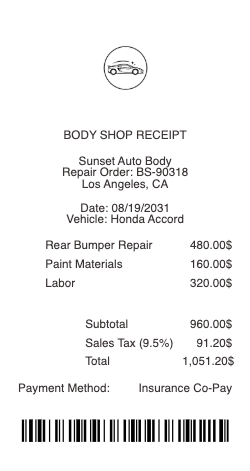
What’s on a Body Shop Receipt
The shop and vehicle — make, model, color, and often the VIN
The work — dent repair, panel/bumper, refinish/paint, rust, or restoration
Body labor and paint labor, often at different hourly rates
Paint and materials, usually its own line
Parts — panels, trim, clips — with OEM or aftermarket noted
The paint color code used for matching
Total, tax, warranty terms, and whether it’s cash or insurance
Body Labor, Paint Labor, and "Paint & Materials"
Body-shop receipts have a line structure that surprises people used to mechanical repair. Body labor (straightening, fitting panels, prepping) and paint (refinish) labor are frequently billed at different hourly rates, and both appear separately. Then there’s a distinctive line: “paint and materials” — the primer, base coat, clear coat, thinners, tape, and sandpaper — usually calculated as a set amount per refinish hour or a percentage, rather than itemized bottle by bottle. That’s a normal, industry-standard way to charge for consumables, not padding. Parts are listed with whether they’re OEM (from the manufacturer) or aftermarket, which affects both cost and fit. Reading body labor, paint labor, paint-and-materials, and parts as separate lines is how you understand a body-shop bill — the paint side is a real, separately-priced craft, which is why refinishing even a small area isn’t cheap.
Cash Cosmetic Work vs an Insurance Job
This is what most distinguishes a body-shop receipt from a collision-insurance claim: a large share of body work is paid out of pocket for cosmetic reasons — a parking-lot dent, a keyed panel, curb rash, faded clear coat, or prepping a car for sale — with no insurance involved. For these cash jobs, the shop’s estimate and receipt are simply your record of what you paid, and you’re free to choose the shop and the extent of the work. An insurance job runs differently — it flows through a claim, an adjuster or estimate, your deductible, and the insurer’s parts and labor guidelines. The same shop does both, but the paperwork differs: a cash cosmetic receipt is a straightforward customer bill, while an insurance repair ties to a claim number and estimate. Knowing which kind you have tells you what the receipt is for — a personal record, or part of an insurance file.
Paint Matching, Warranty, and Records
A few more body-shop specifics. Paint matching is central: the shop pulls your vehicle’s paint color code (from a door-jamb sticker or the VIN) and often blends the new paint into adjacent panels so the repair is invisible, which is why an estimate may include neighboring panels. The color code on the receipt is a useful record for any future touch-up. Warranty: reputable body shops warranty their workmanship and paint — often a lifetime workmanship guarantee for as long as you own the car — and the receipt is your proof to claim it if paint later peels or a repair fails, so keep it. For resale, documentation of quality body work can reassure a buyer, while for a business or fleet vehicle the repair is a deductible expense. To get a copy, shops keep records by vehicle or customer and can reprint. The itemized receipt — work, paint code, and warranty — is the document worth keeping for years.
Related auto service receipts: see also our collision repair receipt guide and our AutoZone receipt guide.
Create a Body Shop Receipt
Our generator produces a clean body shop receipt — shop and vehicle, itemized body and paint labor, paint and materials, parts, and total — as a PDF when you need a legible copy for your records, a warranty claim, or a business expense file.
Use it responsibly: recreate only real work that was actually performed, with its true amounts. Fabricating a body shop receipt to inflate or support a false insurance claim, misrepresent repairs, or claim a warranty you’re not owed is fraud — the repairing shop’s own records and the insurer’s estimate are the authoritative source, and insurers investigate body-repair claims. This tool is for legitimate record-keeping only.
Frequently asked questions
Everything you need to know about the product and billing.
What does a body shop receipt show?
The shop and vehicle (make, model, color, often VIN), the work (dent, panel/bumper, refinish, rust, or restoration), body labor and paint labor at their respective rates, a paint-and-materials line, parts with OEM or aftermarket noted, the paint color code, and the total with warranty terms.
What is the "paint and materials" line on a body shop receipt?
A charge for consumables — primer, base and clear coat, thinners, tape, sandpaper — usually calculated per refinish hour or as a percentage rather than itemized individually. It’s a standard industry way to bill for paint supplies, not padding.
Why are body labor and paint labor billed separately?
They’re different crafts, often at different hourly rates: body labor covers straightening, fitting, and prep, while paint (refinish) labor covers spraying and finishing. Body-shop receipts show them as separate lines, which is why the paint side adds real cost.
How is a cash body-shop job different from an insurance repair?
A cash cosmetic job — a dent, curb rash, a repaint — is paid out of pocket with no insurer involved, and the receipt is simply your record. An insurance repair flows through a claim number, an estimate, your deductible, and the insurer’s guidelines, so the paperwork ties to a claim.
What is a paint color code and why is it on the receipt?
Your vehicle’s specific paint code, pulled from a door-jamb sticker or the VIN, used to mix a matching color — often blended into adjacent panels so the repair is invisible. It’s on the receipt as a useful record for any future touch-up or repair.
Do body shops offer a warranty?
Reputable shops warranty their workmanship and paint, often with a lifetime workmanship guarantee for as long as you own the vehicle. The receipt is your proof to claim it if paint later peels or a repair fails, so keep it — it’s the document a warranty claim needs.