A collision repair receipt documents auto body work after an accident — and it is almost always tangled up with an insurance claim, which makes it one of the most detail-heavy vehicle receipts. The estimate, the parts type, the deductible, and the labor hours all matter, because an insurer, an adjuster, and sometimes a lienholder are all reading it. This page covers what it shows and how insurance shapes the bill.
Collision Repair Receipt
Add custom logo
Edit line items
Choose payment method
Add/remove elements
Customize business information
Choose font
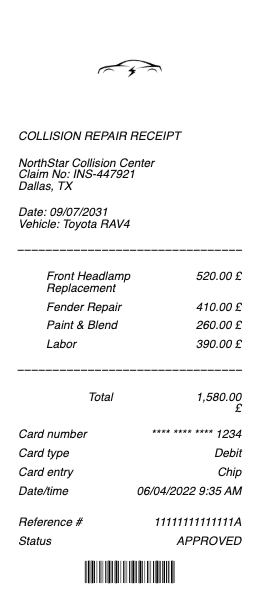
What’s on a Collision Repair Receipt
Body shop name and the vehicle — year, make, model, and VIN
Claim and estimate number, and the insurer, when a claim is involved
The damage and repairs — panels, structural work, refinishing
Parts — flagged as OEM, aftermarket, or recycled/LKQ, which affects cost and quality
Labor hours — body, paint, and frame, at the shop’s posted rate
Paint and materials, and any sublet work (glass, alignment, calibration)
Deductible, insurer payment, and your out-of-pocket total
Insurance, Estimates, and Supplements
Most collision repairs run through insurance, and the receipt tracks a specific flow. It starts with an estimate; once the shop opens the vehicle and finds hidden damage, it files a supplement for the additional work, so the final receipt often exceeds the first estimate — legitimately, and documented line by line. Your deductible is the part you pay; the insurer pays the rest directly to the shop or to you. Shops in an insurer’s direct repair program (DRP) bill the carrier directly with agreed rates. The receipt shows the split between insurer payment and your deductible, which is exactly what you verify — you should owe your deductible, not the whole repair, on a covered claim.
OEM vs. Aftermarket Parts, and Total-Loss
The parts line is where quality and cost meet, and it belongs on the receipt explicitly. OEM parts come from the vehicle maker; aftermarket parts are third-party equivalents, often cheaper; recycled/LKQ parts are used originals — and insurers frequently specify aftermarket or recycled to control cost, which you can sometimes contest. The receipt should state which was used, important for warranty and resale. The other insurance concept the receipt may reflect is total loss: when repair cost approaches the vehicle’s value, the insurer may total it instead of repairing, and no repair receipt is issued — a settlement is. Knowing the parts type and whether betterment (a charge for wear-item upgrades) was applied is how you read a collision bill accurately.
Deductibles, Records, and Resale
Keep the collision repair receipt for longer than the repair, because it follows the car. It proves the deductible you actually paid for your records and any subrogation refund if the other driver was at fault and the insurer recovers costs — you may get your deductible back, tracked against this receipt. It documents the repair quality and parts for the vehicle history, which affects resale value and a future buyer’s inspection. And it substantiates any diminished-value claim, where a properly repaired car is still worth less for having been in an accident. For a business or leased vehicle, the receipt is also the expense and lease-return record. File it with the vehicle documents, not loosely.
Related auto service receipts: see also our body shop receipt guide and our windshield repair receipt guide.
Create a Collision Repair-Style Receipt
Our generator rebuilds a body-shop receipt — shop and vehicle/VIN, claim and estimate details, itemized repairs, parts type, labor hours, deductible and insurer split, and total — as a clean PDF for insurance, records, or resale documentation when the original is lost.
Use it responsibly and firmly: collision repair receipts feed insurance claims, so fabricating or inflating one — padding damage, faking a repair, or misstating a deductible — is insurance fraud with serious legal consequences. Recreate only genuine repairs at true amounts; the body shop and insurer hold the authoritative records, which any claim is checked against.
Frequently asked questions
Everything you need to know about the product and billing.
What should a collision repair receipt include?
The shop and vehicle with VIN, the claim and estimate numbers and insurer, the itemized repairs, the parts type (OEM, aftermarket, or recycled), labor hours by category, paint and sublet work, and the deductible with the insurer payment split.
Why is my final collision repair bill higher than the estimate?
Because of a supplement — once the shop opens the vehicle and finds hidden damage, it files for the additional work, so the final receipt legitimately exceeds the first estimate. Each added item is documented line by line.
What is the difference between OEM and aftermarket collision parts?
OEM parts come from the vehicle maker; aftermarket are third-party equivalents, often cheaper; recycled/LKQ are used originals. Insurers frequently specify aftermarket or recycled to control cost. The receipt should state which was used, which matters for warranty and resale.
How much should I pay on a covered collision claim?
Your deductible — the insurer pays the rest. The receipt shows the split between insurer payment and your deductible, so verify you owe only the deductible, not the whole repair, on a covered claim.
Can I get my deductible back after a collision repair?
Sometimes — if the other driver was at fault and your insurer recovers costs through subrogation, you may be refunded your deductible, tracked against this receipt. Keep it for that and for any diminished-value claim.
Why keep a collision repair receipt long-term?
It follows the car — documenting repair quality and parts for resale, substantiating a diminished-value claim, and serving as the expense or lease-return record for a business or leased vehicle. File it with the vehicle documents.