An exhaust repair receipt itemizes work on the system that carries gases from the engine out the tailpipe — muffler, pipes, resonator, and the pricey catalytic converter. It’s worth keeping for two reasons most other car repairs don’t share: many exhaust jobs are done to pass an emissions test, and muffler shops often back their work with a lifetime warranty. This page explains what the receipt shows and why those details matter.
Exhaust Repair Receipt
Add custom logo
Edit line items
Choose payment method
Add/remove elements
Customize business information
Choose font
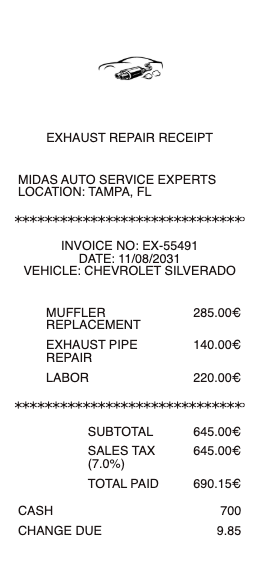
What’s on an Exhaust Repair Receipt
Shop and vehicle — make, model, mileage, and often the VIN
The parts replaced — muffler, catalytic converter, resonator, pipes, gaskets, O2 sensor, clamps
Labor, itemized separately, including any welding
Diagnostic fee if a check-engine light or emissions code was traced
Part type — OEM, aftermarket, or (for converters) CARB-compliant
Warranty terms on parts and labor
Total, tax, and payment method
The Catalytic Converter — Cost, Emissions, and Theft
One part dominates exhaust repair: the catalytic converter. It contains precious metals, which makes it both expensive to replace and a well-known theft target — a stolen-converter claim or replacement is a common reason this receipt exists. A failed converter is also the usual culprit behind a failed emissions test, so many converter jobs are done specifically to pass. That’s where CARB compliance matters: California and states following its rules require a converter certified to CARB standards, and the receipt should state that a compliant unit was installed — proof you’ll need to pass re-inspection. A cheaper non-compliant converter can fail the test and the visual check. For an insurance claim on a stolen converter, or a re-test at the emissions station, the itemized receipt naming the exact part is the document that settles it.
Repairs, Systems, and What Drives the Price
Exhaust work ranges from a small fix to a full section. A rusted-through pipe or a blown gasket may just need a weld or clamp; a rotted muffler needs the muffler; a droning noise might be the resonator. Bigger jobs replace a section — a cat-back (everything behind the converter) or axle-back system. Price is driven mostly by which part (a converter dwarfs a muffler) and whether the shop can bolt on a replacement or has to cut and weld. A rattling or roaring sound, a sulfur smell, or a check-engine light for an O2 sensor or catalyst-efficiency code is what usually brings a car in, so the receipt often starts with a diagnostic line. Reading the parts-versus-labor split tells you where the money went and what was actually replaced versus repaired.
Warranties, Emissions Records, and Getting a Copy
Two records make this receipt worth filing. First, warranty: national muffler chains such as Midas and Meineke are known for lifetime warranties on mufflers and some exhaust parts — but the warranty is only as good as your proof of purchase, so the receipt is what you present for a free replacement later. Second, emissions: if the repair was to pass a smog or safety inspection, keep the receipt alongside the pass certificate and your registration renewal — together they show the vehicle was brought into compliance. For a business or fleet vehicle, exhaust repair is a deductible maintenance expense the receipt substantiates. Copies are easy to get — chains keep your service history under your account or phone number and can reprint — but for a lifetime-warranty part, hold onto the original that names the exact component installed.
Related auto service receipts: see also our brake service receipt guide and our wheel alignment receipt guide.
Create an Exhaust Repair Receipt
Our generator reproduces an exhaust-repair receipt — shop and vehicle details, parts (muffler, converter, pipes) and labor, warranty terms, and total — as a clean PDF when you need a legible copy for a warranty claim, an emissions record, or a business expense file.
Use it responsibly: recreate only real repairs that were actually done, with their true parts and amounts. Fabricating an exhaust receipt to fake an emissions repair, support a false stolen-converter insurance claim, or claim a warranty you’re not owed is fraud — the shop’s records, the part numbers, and the emissions station can all be verified. The repairing shop’s own receipt is the authoritative document; this tool is for legitimate record-keeping only.
Frequently asked questions
Everything you need to know about the product and billing.
What does an exhaust repair receipt show?
The shop and vehicle (make, model, mileage, often VIN), the parts replaced (muffler, catalytic converter, resonator, pipes, gaskets, O2 sensor), itemized labor including welding, any diagnostic fee, the part type (OEM, aftermarket, or CARB-compliant), warranty terms, and the total.
Why is a catalytic converter so expensive to replace?
It contains precious metals, which makes it costly and a common theft target. A failed converter is also the usual cause of a failed emissions test, so many replacements are done to pass — which is why the receipt and the exact part named on it matter.
What is CARB compliance on an exhaust receipt?
California and states following its rules require a catalytic converter certified to CARB standards. The receipt should state a compliant unit was installed — that’s your proof for passing re-inspection. A cheaper non-compliant converter can fail both the emissions test and the visual check.
Do muffler shops really offer lifetime warranties?
National chains like Midas and Meineke are known for lifetime warranties on mufflers and some exhaust parts. But the warranty is only as good as your proof of purchase, so keep the receipt that names the exact part to claim a free replacement later.
Why keep an exhaust receipt for an emissions test?
If the repair was done to pass a smog or safety inspection, keeping the receipt alongside the pass certificate and registration renewal shows the vehicle was brought into compliance — useful proof if the compliance is ever questioned at re-registration.
Can I get a copy of an exhaust repair receipt?
Yes — muffler chains and shops keep your service history under your account or phone number and can reprint it. For a lifetime-warranty part, hold onto the original receipt that names the exact component installed, since that’s what a warranty claim requires.