A car insurance receipt proves you paid your premium — and the first thing to know is that it is not the same as proof of insurance. One shows the money changed hands; the other shows you’re covered. People need the payment receipt for specific reasons: proving a payment during a lapse dispute, a business expense claim, or a reinstatement. This page explains what it shows and how it differs from the documents that prove coverage.
Car Insurance Receipt
Add custom logo
Edit line items
Choose payment method
Add/remove elements
Customize business information
Choose font
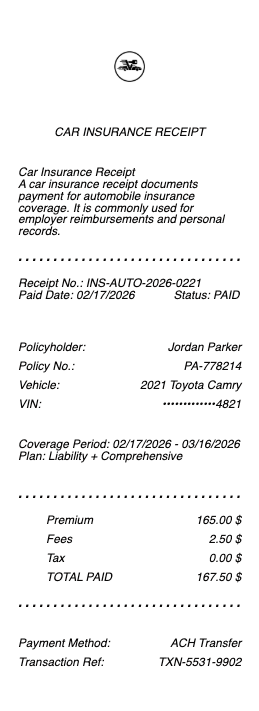
What’s on a Car Insurance Receipt
Insurer name and the policy number
Policyholder name and the payment date
The amount paid and what it covered — a full term, a monthly installment, or a down payment
The billing period / term the payment applies to
Any installment or processing fee
Remaining balance and next due date, if paying in installments
Payment method and a confirmation or transaction number
Payment Receipt vs Proof of Insurance
This is the distinction that trips people up. A payment receipt proves you paid a premium. Proof of insurance — the insurance ID card you carry, or the declarations page summarizing your coverage — proves you’re covered, and it’s what police, the DMV, and a lender ask for. They are different documents doing different jobs: a receipt won’t satisfy a traffic stop, and an ID card won’t prove you made a specific payment. The declarations page is the coverage summary (limits, deductibles, vehicles, term and total premium); the ID card is the pocket proof; the receipt is the money trail. Knowing which one a situation calls for saves a lot of confusion — when someone says they need their “insurance paper,” it’s worth asking whether they mean coverage or payment.
Installments, Down Payments, and Lapses
How you pay shapes the receipt. Auto policies typically run a 6-month or annual term, payable in full (often cheaper, sometimes with a pay-in-full discount) or in monthly installments — usually starting with a down payment and often carrying a small installment fee each month. The receipt shows which you paid and the period it covers. This matters most around a lapse: miss a payment and the insurer can cancel for non-payment, creating a coverage gap that raises your future rates — so a receipt proving you paid on time is your evidence if the insurer’s records disagree. Reinstating a lapsed policy may require a reinstatement fee and sometimes a signed no-loss statement, and the payment receipt documents that too. Keeping installment receipts builds a record of continuous coverage.
Refunds, Business Deductions, and Getting a Copy
A few more situations put this receipt to work. Cancel mid-term and you’re generally owed a refund of unearned premium — the receipts establish what you’d paid in. For taxes, personal auto insurance isn’t deductible, but insurance on a vehicle used for business is deductible under the actual-expense method (by the business-use percentage), and the receipts substantiate it — a key record for the self-employed and rideshare drivers. High-risk drivers filing an SR-22 (proof of financial responsibility) keep payment records to prove the policy stayed active, since a lapse there has legal consequences. Copies are easy: insurers keep payment history in your online account or app, and you can download or reprint a receipt anytime, or request one from an agent. For a business claim, get the receipt that shows the policy number and period clearly.
Related vehicle receipts: see also our Gas receipt guide and our Car Maintenance receipt guide.
Create a Car Insurance Receipt
Our generator reproduces a car insurance payment receipt — insurer and policy number, policyholder, amount paid, the term or installment it covers, any fee, and total — as a clean PDF when you need a legible copy for a business expense record, a payment dispute, or your own files.
Use it responsibly: recreate only real payments you actually made, with their true amounts and dates. Fabricating an insurance receipt to fake proof of payment, misrepresent coverage, or claim a deduction you’re not owed is fraud — and a receipt is not proof of insurance; only your insurer’s records and ID card establish coverage, and they’re verifiable. This tool is for legitimate record-keeping only.
Frequently asked questions
Everything you need to know about the product and billing.
What does a car insurance receipt show?
The insurer and policy number, the policyholder and payment date, the amount paid and what it covered (a full term, a monthly installment, or a down payment), the billing period, any installment fee, the remaining balance and next due date, and the payment method with a confirmation number.
Is a car insurance receipt the same as proof of insurance?
No. A payment receipt proves you paid a premium. Proof of insurance — your ID card or declarations page — proves you’re covered, and it’s what police, the DMV, and lenders require. A receipt won’t satisfy a traffic stop, and an ID card won’t prove a specific payment.
What is the declarations page versus the insurance ID card?
The declarations page is your coverage summary — limits, deductibles, vehicles, term, and total premium. The ID card is the pocket proof you carry in the car. The payment receipt is separate again: it’s the money trail showing a premium was paid.
Why does keeping insurance payment receipts matter for a lapse?
Missing a payment lets an insurer cancel for non-payment, creating a coverage gap that raises future rates. A receipt proving you paid on time is your evidence if the insurer’s records disagree, and reinstating a lapsed policy often requires a fee the receipt also documents.
Is car insurance tax-deductible?
Personal auto insurance isn’t. Insurance on a vehicle used for business is deductible under the actual-expense method, by the business-use percentage — relevant for the self-employed and rideshare drivers. The payment receipts, showing policy and period, are the substantiation.
How do I get a copy of a car insurance payment receipt?
Insurers keep your payment history in your online account or app, so you can download or reprint a receipt anytime, or ask your agent. For a business expense claim, get the version that clearly shows the policy number and the period the payment covers.