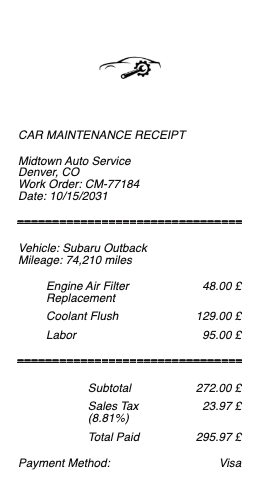
A car maintenance receipt shows proof of payment for routine upkeep services beyond oil changes. It is commonly used for fleet vehicles, business expense tracking, and long-term maintenance records. Car maintenance receipts typically include service descriptions, parts used, labor, and total paid.
Car Maintenance Receipt
Add custom logo
Edit line items
Choose payment method
Add/remove elements
Customize business information
Choose font
What's on an Oil Change & Car Maintenance Receipt
Whether it comes from a quick-lube chain or your local garage, a car maintenance receipt is the paper trail that proves a service was done — and for an oil change it needs specific details to count for a warranty or a resale record. A complete oil change receipt typically shows:
Shop name, address and phone — the business that performed the work (Walmart Auto Care, Jiffy Lube, Take 5, Valvoline or an independent shop).
Date and mileage — the service date and the vehicle's odometer reading, the two figures that anchor a maintenance history.
Vehicle details — year, make, model, and often the VIN and licence plate.
Service performed — the oil type (conventional, synthetic blend or full synthetic), the number of quarts, and the oil filter, plus any add-ons like a tyre rotation or air filter.
Parts, labour and totals — line-item parts and labour, sales tax, and the grand total, with the payment method.
Next-service reminder — the mileage or date recommended for the next oil change, the figure printed on your windscreen sticker.
Why your oil change receipt matters
An oil change receipt is more than a formality. Manufacturers can require proof of scheduled maintenance to honour a powertrain warranty, so a dated receipt showing the mileage and oil type is what backs up a claim if an engine problem ever arises. When you sell the car, a folder of car maintenance receipts is one of the simplest ways to raise its value and reassure a buyer that it was looked after. And the mileage on each receipt lets you track your interval — whether you follow a roughly 3,000–5,000-mile schedule on conventional oil or a longer one on full synthetic, always to your manufacturer's recommendation. Keep every receipt, because the gap between two of them is the record that tells the whole story.
Walmart, Jiffy Lube, Take 5 and Valvoline receipts
Every service provider prints its own oil change receipt format, which is why shoppers search for a specific one. A Walmart oil change receipt comes from the Auto Care Center and lists the service package and parts; a Jiffy Lube oil change receipt itemises the signature service and any extras; Take 5 and Valvoline Instant Oil Change hand you a slip before you drive off. All of them share the same core fields — shop, date, mileage, oil type and total — so if yours has faded on the thermal paper or was never handed over, you can rebuild a clean, itemised copy from the details you have. Ask the shop first, too: many keep your service history on file and can reprint it.
Replacing a lost service receipt
Thermal receipts fade, and a lost oil change receipt can leave a gap in an otherwise complete history. Start with the shop, which can often reprint from your vehicle record or loyalty account; a card or bank statement corroborates the date and amount. When you need a legible, itemised copy for your own records and only a faded slip or a statement line remains, reconstructing the receipt from the real service details keeps your maintenance log intact. The purpose is honest documentation of work that was actually performed — a clean stand-in for a receipt you lost — never the invention of a service that didn't happen. Fabricating a maintenance record to support a warranty claim for work never done is fraud, and this tool isn't for that.
Related vehicle receipts: see also our Car Insurance receipt guide and our EV Charging receipt guide.
Free oil change & car maintenance receipt generator
Our oil change receipt generator builds a clean service receipt with every field in place — shop details, date, vehicle and mileage, oil type and quarts, filter, parts and labour, tax and total — and downloads as a print-ready PDF, PNG or JPG in under a minute, no account required. Use this car maintenance receipt template to replace a faded slip, to keep a tidy service log for warranty and resale, or to itemise a job for your own records. Please use it responsibly and lawfully: create receipts only for services that genuinely took place, for legitimate documentation — not to fake a maintenance history, mislead a buyer, or support a warranty claim for work that wasn't performed.
Tires have their own warranty paperwork — see the tire shop receipt example.
Frequently asked questions
Everything you need to know about the product and billing.
What should be on an oil change receipt?
The shop name and address, the service date and the vehicle's mileage, the vehicle details (and often VIN), the oil type and number of quarts, the oil filter, parts and labour with tax and total, and the recommended next-service mileage. Those fields are what make it valid for a warranty or resale record.
Why do I need to keep oil change receipts?
They prove you maintained the car on schedule, which manufacturers can require to honour a powertrain warranty, and a complete set raises resale value. The mileage on each one also lets you track your service interval.
How do I get a copy of a lost Walmart or Jiffy Lube oil change receipt?
Ask the provider first — Walmart Auto Care, Jiffy Lube, Take 5 and Valvoline often keep your service history on file and can reprint it. A card or bank statement corroborates the date and amount if you need to reconstruct a clean copy.
How often should I change my oil?
Follow your manufacturer's recommendation. As a rough guide, conventional oil is often changed every 3,000–5,000 miles and full synthetic can go longer, but the owner's manual and your driving conditions are the authority.
What's the difference between conventional and synthetic on the receipt?
The receipt notes the oil type used — conventional, synthetic blend, or full synthetic — because it affects both the price and the recommended interval to your next change. Full synthetic usually costs more but lasts longer.
Can I use this generator legitimately?
Yes — to replace a faded or lost receipt for a service that actually happened, or to keep an itemised maintenance log. It is not for fabricating a service history or supporting a warranty claim for work that wasn't done.