A carpenter receipt documents woodworking that ranges from framing a wall to building custom cabinetry — and how it reads depends on whether the job was rough structural work or fine finish work, and whether it was billed by the hour or as a fixed-price project. This page covers what the receipt shows and how materials, labor, and custom builds sit on it.
Carpenter Receipt
Add custom logo
Edit line items
Choose payment method
Add/remove elements
Customize business information
Choose font
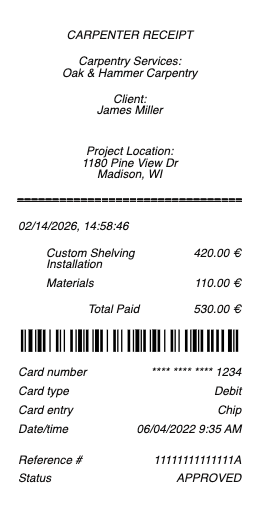
What’s on a Carpenter Receipt
Carpenter or company name — and license/insurance where the work requires it
Customer and job address, with the date or project period
The work — framing, trim and molding, cabinetry, built-ins, decks, doors, repairs
Labor — hourly, or a fixed project price from a bid
Materials — lumber, sheet goods, hardware, finishes — itemized or included
Deposit and balance, on larger custom jobs
Total, payment method, and any workmanship warranty
Rough vs. Finish Carpentry
Carpentry splits into two kinds of work, and the receipt reflects which. Rough carpentry is structural and hidden — framing walls, floors, roofs, subfloors — where speed and strength matter more than looks, and it often ties into a permit and inspection like other structural trades. Finish carpentry is the visible, precise work — trim, crown molding, doors, stairs, built-ins, cabinetry — where the labor is skilled and the materials are finer, so finish work usually carries a higher labor rate per hour or per linear foot. A receipt for a built-in bookshelf reads very differently from one for framing a garage, and knowing which you commissioned explains both the price and the level of finish you should expect.
Hourly vs. Fixed-Price, and Custom Builds
Carpenters bill two ways, and the receipt shows which was agreed. Hourly suits open-ended repairs and small jobs where the scope is uncertain. A fixed-price project bid suits defined work — a deck, a set of cabinets, a room of trim — and is what most custom builds run on, giving you a total agreed upfront that the receipt should match unless the scope changed. Custom builds take a deposit, since the carpenter buys materials and commits time, and the receipt records the deposit against the balance due on completion. For custom cabinetry or furniture, the receipt is also effectively a spec record — dimensions, wood species, finish — worth keeping in case a piece needs matching or repair later.
Homeowners, Landlords, Business, and Records
Carpenter receipts land in several files. Homeowners keep them as proof of improvements that add value at resale — a finished basement, built-ins, a deck — and permitted structural work that satisfies inspectors. Landlords file them as deductible repairs or capital improvements, depending on the work, which the itemized receipt helps distinguish. Businesses commissioning fit-outs or custom fixtures expense them, sometimes capitalizing built-in improvements separately. And many carpenters warranty their workmanship for a period; the receipt activates it if a joint fails or trim separates. Keep the receipt — especially for custom and structural work — with home or business property records rather than loosely, since it may be needed years later for a sale, a claim, or a matching repair.
Related home service receipts: see also our Plumber receipt guide and our Handyman receipt guide.
Create a Carpenter-Style Receipt
Our generator rebuilds a carpentry receipt — carpenter and job details, the work, labor (hourly or project), itemized materials, any deposit and balance, and total — as a clean PDF for home, rental, or business records when the original is lost.
Use it responsibly: document real work at true amounts. Fabricating carpenter receipts — for an insurance claim, a resale improvement that did not happen, or a landlord deduction — is fraud. For genuine work, the carpenter can reissue the receipt and any bid or spec records.
Frequently asked questions
Everything you need to know about the product and billing.
What should a carpenter receipt include?
The carpenter and (where required) license/insurance, the customer and job address, the work performed, labor as hourly or a fixed project price, itemized materials, any deposit and balance, the total, and any workmanship warranty.
What is the difference between rough and finish carpentry?
Rough carpentry is structural and hidden — framing walls, floors, roofs — often tied to a permit. Finish carpentry is the visible, precise work — trim, molding, cabinetry, built-ins — which is more skilled and usually carries a higher labor rate.
Do carpenters charge hourly or by the project?
Both — hourly suits open-ended repairs and small jobs; a fixed-price bid suits defined work like a deck or cabinets, giving a total agreed upfront. The receipt shows which was agreed, and a fixed price should match unless the scope changed.
Why does a custom carpentry job take a deposit?
The carpenter buys materials and commits time ahead, so custom builds are booked with a deposit recorded on the receipt against the balance due on completion. The receipt also serves as a spec record of dimensions, wood, and finish.
Can landlords deduct carpenter receipts?
Yes, but the treatment differs — routine repairs are deductible expenses, while built-in improvements may be capital improvements. The itemized receipt helps distinguish them for tax purposes.
Does a carpenter receipt cover a warranty?
Often — many carpenters warranty their workmanship for a period, and the receipt activates it if a joint fails or trim separates. Keep it, especially for custom and structural work, with property records.