A plumbing receipt (or plumber's invoice) documents the work done, the parts used, and what you paid — the record homeowners need for insurance claims, home warranties, and resale files, and plumbers need for their books. This guide covers what a plumbing receipt should include, handwritten vs. printed receipts, and how homeowners and plumbers both use them.
Plumber Receipt
Add custom logo
Edit line items
Choose payment method
Add/remove elements
Customize business information
Choose font
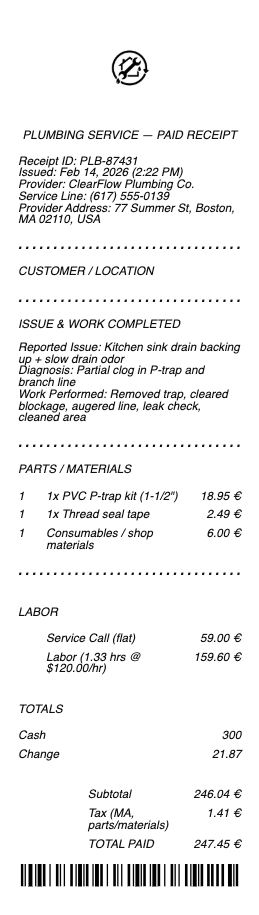
What's on a plumbing receipt
A proper plumbing receipt or invoice itemizes the job clearly:
Company name & license number — the plumber or company, contact details, and the state license number most jurisdictions require on invoices.
Service address & date — where and when the work was done.
Description of work — the problem and the fix (cleared main line, replaced water heater, repaired burst pipe).
Parts & labor, itemized — materials with prices, labor hours or flat rate, and any service-call fee.
Permits — noted when the job required one.
Warranty on the work — the guarantee period on parts and labor.
Total, payment method & balance — what was paid and anything still due.
Handwritten vs. printed plumbing receipts
Plenty of plumbing receipts are still handwritten — a carbon-copy invoice book on the truck is standard for small shops, and a handwritten receipt is perfectly valid as long as it carries the key fields: company and license, date and address, work description, parts and labor, and the total with a signature. Larger outfits print from job-management software and email a PDF. For the customer the format doesn't matter — the itemization does. A one-line "plumbing work — $850" receipt is what causes problems later; ask for the breakdown before the truck leaves.
Why homeowners need the itemized plumbing receipt
The moments you'll reach for a plumbing receipt are exactly when a vague one fails. Water-damage insurance claims: your insurer wants the itemized invoice showing what failed and what was repaired, and the plumber's report can anchor the whole claim. Home warranty companies reimburse against itemized invoices. Landlords file plumbing receipts as deductible maintenance for Schedule E. And when selling the house, receipts for a repiped bathroom or new water heater document the upgrades buyers ask about. Keep every plumbing receipt with your home records — they compound in value.
For work that legally requires one, the permit number belongs on the paperwork: water heater replacements, sewer line work, and remodel plumbing commonly need permits, and an inspection sign-off closes them. At resale, a title or inspection search that surfaces unpermitted plumbing work reads directly against the receipts you kept — the receipt naming the permit is the one that closes the question.
For plumbers: issuing receipts that get you paid
If you run a plumbing business, clean receipts and invoices do three jobs: they justify the bill (an itemized parts-and-labor breakdown pre-empts the "why so much?" call), they document income and materials costs for taxes, and the license number plus warranty terms on every receipt signals professionalism that wins referrals. A reusable template — printed, PDF, or a numbered receipt book — keeps every job documented the same way, including the service-call fee and any balance due on multi-visit jobs.
Related home service receipts: see also our Electrician receipt guide and our Carpenter receipt guide.
Emergency calls deserve their own line-item discipline: after-hours rates, the emergency call-out premium, and any temporary-fix-then-return sequence should each print separately. A single lump sum for a burst-pipe night visit is exactly the invoice an insurer or landlord queries — the same total, itemised, sails through.
Create a plumbing receipt
Our plumbing receipt template and generator lays out the full trade format — company and license number, service address, work description, itemized parts and labor, warranty, and total — in a clean printable or PDF form for plumbers and for homeowners organizing their repair records.
For genuine work only — and this matters. Submitting a fake or inflated plumbing receipt to an insurer, home warranty, or landlord is fraud. Use this only to document real plumbing work that was actually performed and paid for.
Related receipts: for other trades, see the roofing receipt, locksmith receipt, and pest control receipt.
Frequently asked questions
Everything you need to know about the product and billing.
What should a plumbing receipt include?
The company name and license number, the service address and date, a description of the work, itemized parts and labor (including any service-call fee), permits if required, the warranty on the work, and the total with payment method and any balance due. For permit-required work — water heaters, sewer lines — the permit number belongs on it, since unpermitted work surfaces at resale against the very receipts you kept.
Is a handwritten plumbing receipt valid?
Yes — carbon-copy invoice books are still standard for small shops. It's valid as long as it includes the key fields: company and license, date, address, work description, itemized parts and labor, and the signed total.
Do I need an itemized plumbing receipt for an insurance claim?
Yes. For water-damage claims, insurers want the itemized invoice showing what failed and what was repaired — a one-line total isn't enough. The plumber's description of the failure often anchors the claim.
Why is there a service-call fee on my plumbing receipt?
Most plumbers charge a base fee for coming out, which covers travel and diagnosis. It appears as its own line, with parts and labor itemized on top — some shops credit it toward the repair if you proceed. After-hours and emergency premiums should print as their own lines too — lump-sum night-visit invoices get queried; itemised ones get paid.
Should landlords keep plumbing receipts?
Yes — plumbing repairs on a rental are deductible maintenance expenses, documented by the itemized receipts, and they also build the property's repair history for disputes or sale.
What warranty should be on a plumbing receipt?
Reputable plumbers state a guarantee period on parts and labor (often 30 days to a year or more depending on the work). It belongs on the receipt so both sides have the terms in writing.