A handyman receipt documents small repair and maintenance work — the kind billed by the hour or as a simple flat job, often without a formal contract. It splits labor from materials, names the tasks completed, and gives homeowners, landlords, and tenants the paper trail they need for deposits, reimbursements, and home records.
Handyman Receipt
Add custom logo
Edit line items
Choose payment method
Add/remove elements
Customize business information
Choose font
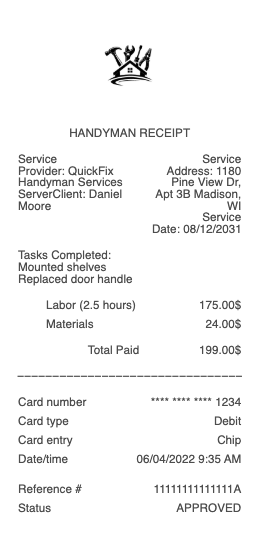
What’s on a Handyman Receipt
The handyman’s or business name and contact details
Customer name and job address
Date of service
Tasks completed — listed individually, not just “repairs”
Labor — hours worked and hourly rate, or the agreed flat price per job
Materials and parts with their prices, or a note that the customer supplied them
Total, payment method, and amount received
Warranty note on the work, if offered
Handyman Receipt Template: Labor, Materials, and Flat-Rate Jobs
A good handyman receipt template handles the two ways this work gets billed. Hourly jobs need the hours and the rate on separate lines so the math is visible; flat-rate jobs — hanging a door, mounting a TV, a gutter clean — just need the task and its price. Materials deserve their own section either way: mark up parts you bought, or write “materials supplied by customer” when they bought them, so nobody disputes the total later. If you work several small tasks in one visit, itemize each one — a receipt that reads “misc repairs, $300” protects neither side.
Include a simple receipt number too — even a date-based one like 2026-081. Repeat customers, landlords with multiple units, and your own tax file all benefit from receipts that can be told apart at a glance.
Receipt Books vs. Digital Receipts for Handyman Work
Carbon-copy handyman receipt books still dominate this trade because jobs end at the kitchen counter, not at a desk. They work — but the copies fade, get lost with the truck, and can’t be searched at tax time. A generated PDF receipt does the same job and leaves both parties a permanent copy: fill in the tasks, labor, and materials on your phone, download, and text or email it to the customer before you leave. Keep whichever format you use consistent, because your receipts are the income record the IRS expects a sole proprietor to keep.
Handyman vs. Contractor Receipts — and Why the Paper Matters
Handyman work is typically the unlicensed-trades zone: small repairs below your state’s contractor-license threshold, no permits, no progress billing. That is exactly why the receipt matters more, not less — without a contract, the receipt is often the only written record of what was done and what was paid. Landlords use it to charge repairs against a deposit, tenants use it to prove they fixed what they were asked to, and homeowners file it with home-sale records. Larger licensed jobs with permits and draws belong on a contractor invoice instead.
State license thresholds vary widely — some cap handyman work at a few hundred dollars per job, others in the thousands — so when a job creeps toward permit territory, the paperwork should graduate with it: from this receipt to a written estimate and contractor invoice.
Related home service receipts: see also our Carpenter receipt guide and our Locksmith receipt guide.
Create a Handyman Receipt
Our generator builds a clean handyman receipt in a minute — your name, the customer, each task, labor hours or flat rate, materials, and the total — downloadable as a printable PDF. It beats a faded receipt-book carbon and looks professional to every landlord and property manager you work with.
Use it responsibly: document real work at real prices. Writing receipts for work never performed — for a deposit dispute, an insurance claim, or a reimbursement — is fraud.
Bigger or more specialized jobs? See the contractor receipt, plumbing receipt, and landscaping receipt examples.
Frequently asked questions
Everything you need to know about the product and billing.
What should a handyman receipt include?
The handyman’s name and contact details, the customer and job address, the service date, each task completed, labor shown as hours × rate or a flat price, materials with prices, and the total with payment method.
Should labor and materials be separate on a handyman receipt?
Yes. Separate lines prevent disputes and make tax time easier — labor is service income, while materials may be reimbursed at cost or marked up. Note when the customer supplied their own materials.
Is a handyman receipt the same as a contractor invoice?
No. A receipt confirms payment for completed small jobs. Contractor invoices cover larger licensed work — permits, progress payments, retainage — billed before payment is made.
Do handymen have to give receipts?
A customer who pays — especially in cash — should always get one, and landlords and property managers usually require them. The receipt is also your own income record as a sole proprietor.
Are handyman receipt books better than digital receipts?
Books are convenient on site, but carbons fade and get lost. A generated PDF gives both sides a permanent, searchable copy and can be sent from your phone before you leave the job.
Can a tenant use a handyman receipt in a deposit dispute?
Yes — an itemized receipt showing what was repaired, when, and for how much is standard evidence in deposit disputes for both tenants and landlords.