A Cartier receipt documents the purchase of luxury jewelry or watches. It is commonly used for insurance purposes, gifting records, and resale authentication. Cartier receipts usually include item description, boutique location, and total paid.
Cartier Receipt
Add custom logo
Edit line items
Choose payment method
Add/remove elements
Customize business information
Choose font
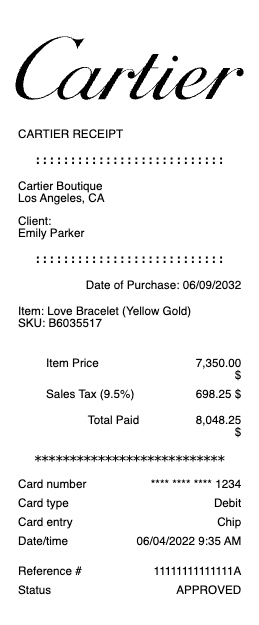
What's on a Cartier Receipt
A Cartier receipt documents the purchase of fine jewelry or a watch from a Cartier boutique or cartier.com. Because these are high-value, serial-numbered pieces, the receipt is built around precise product identification rather than a long list of items. A Cartier receipt or invoice typically includes:
Boutique name and location (or the online order reference)
Date of purchase and a receipt / invoice number
Sales associate reference and, often, the client name
Item name — e.g. Love bracelet, Juste un Clou, Trinity ring, Tank or Ballon Bleu watch
Reference number and, for many pieces, the serial number
Metal, size, and specifications (e.g. 18k yellow gold, size 17)
Price, VAT or sales tax, and total
Payment method and any warranty reference
Reference and Serial Numbers on Cartier Jewelry and Watches
What sets a Cartier receipt apart from an ordinary jewelry receipt is the identifiers. Each design has a reference number tied to Cartier's catalog, and most pieces carry an engraved serial number — a Love bracelet, for instance, is engraved on the inside with its serial and size, and every Cartier watch has its own serial. These numbers link the receipt directly to the specific piece you own. On the secondary market and for insurance, that connection is everything: a receipt that names the exact reference, serial, metal, and size is far stronger documentation than one that just says "gold bracelet."
A Cartier watch receipt deserves one extra pairing: the watch's serial engraved on the case should match what the boutique recorded at sale, and every later service adds its own paperwork to the same file. On the vintage market a Tank or Santos with its original receipt, warranty card, and service trail is a different asset from the same watch bare — with watches even more than jewelry, the paper trail compounds value over decades.
The Cartier Receipt, Warranty Card, and Resale Value
A Cartier purchase comes with more than the piece — it includes the Cartier International Warranty card and, for watches, service documentation. Together with the receipt, these form the "full set" that buyers look for. When a Cartier item is resold through platforms like The RealReal, Vestiaire Collective, or a watch dealer, the original receipt and warranty card raise both buyer confidence and resale value, because they establish where and when the piece was bought. The same paperwork is what an insurer wants when scheduling a high-value item on a policy, and what a service center references for repairs. Keeping a clean, legible copy protects the piece's provenance.
Boutique vs cartier.com — Where the Receipt Comes From
A boutique receipt carries the specific store's name and address — a Cartier Fifth Avenue or New Bond Street purchase shows that location, which matters to collectors who value provenance. A cartier.com order instead produces an online order confirmation and invoice with an order number, billing and shipping details, and the same reference and serial information. Both are valid records; the fields differ slightly. When you reconstruct a Cartier receipt, match it to how the purchase was actually made — in-boutique or online — so the document is internally consistent.
Related fine jewelry receipts: see also our Tiffany & Co receipt guide and our Van Cleef & Arpels receipt guide.
Generate a Cartier Receipt — Free, No Login
Our Cartier receipt generator lays out every field of a boutique-style invoice: boutique or order reference, date, sales associate, client name, item name, reference and serial number, metal and size, price, VAT or sales tax, total, and payment method. Edit each field and download a formatted file in PDF, PNG, or JPG in under a minute — no account required. It's ideal for reconstructing a lost receipt for a piece you own, documenting an item for insurance, or keeping an organized record of a collection.
Legal note: Cartier is a trademark of Cartier International AG. Any Receipt Generator is not affiliated with, endorsed by, sponsored by, or associated with Cartier, and does not validate or certify the authenticity of any generated document. This template is for legitimate uses only — reconstructing a lost receipt, insurance records, and personal bookkeeping. Using it to misrepresent ownership, pass off counterfeit goods as authentic, fabricate proof of purchase for authentication, or commit fraud is prohibited; users assume full responsibility for the accuracy and intended use of the files they generate.
Frequently asked questions
Everything you need to know about the product and billing.
What is a Cartier receipt?
A Cartier receipt documents the purchase of fine jewelry or a watch from a Cartier boutique or cartier.com, showing the item, its reference and serial number, metal and size, price, tax, and total.
What's on a Cartier receipt or invoice?
The boutique or order reference, date, sales associate, client name, item name (e.g. Love bracelet or Tank watch), reference and serial number, metal and size, price, VAT or sales tax, total, and payment method.
Do Cartier pieces have serial numbers?
Yes. Most Cartier jewelry and every Cartier watch carries an engraved serial number — a Love bracelet, for example, is engraved inside with its serial and size — and the reference number ties the piece to Cartier's catalog. On watches the serial is engraved on the caseback or lugs — the receipt and warranty card recording that same number is what makes the set coherent for insurers and buyers.
Why does a Cartier receipt matter for resale or insurance?
The original receipt, along with the Cartier International Warranty card, establishes where and when a piece was bought. It raises buyer confidence and resale value on the secondary market and is the documentation insurers want for high-value items.
Does a Cartier purchase come with a warranty card?
Yes. Cartier purchases include the Cartier International Warranty card, and watches come with service documentation. Together with the receipt, these make up the "full set" collectors and resale platforms look for.
What formats can I download, and is it free?
You can export Cartier receipts as PDF, PNG, or JPG for free, with no login. Watermark-free downloads are available with a paid upgrade.