A Van Cleef & Arpels receipt documents a purchase from one of the great Place Vendôme jewelry maisons — most often a piece from the iconic Alhambra line, or high jewelry. Fine jewelry paperwork does specific work: it supports insurance, provenance, and authentication for items whose value can be substantial. This page explains what a Van Cleef receipt shows, how the maison’s documentation works, and why the record matters for a piece meant to last.
Van Cleef & Arpels Receipt
Add custom logo
Edit line items
Choose payment method
Add/remove elements
Customize business information
Choose font
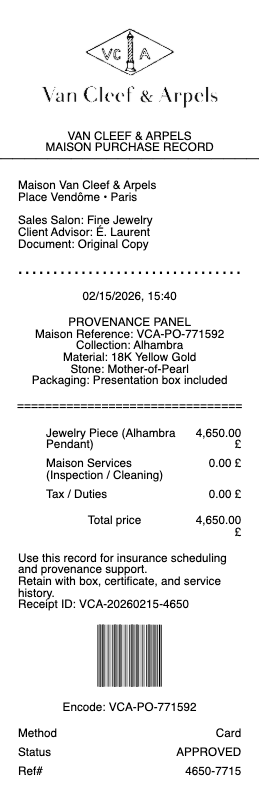
What’s on a Van Cleef & Arpels Receipt
The boutique and purchase date
The collection and piece — e.g. Vintage Alhambra, Perlée, Frivole, or a high-jewelry creation
Materials and stones — gold type, mother-of-pearl, diamonds, carat details
A reference or serial identifying the piece
The price paid and applicable tax/VAT
Reference to the maison certificate issued with fine pieces
Engraving, sizing, or after-sales notes, where applicable
Alhambra, the Mystery Set, and What You Bought
Van Cleef’s signatures give a receipt its meaning. The Alhambra motif — the four-leaf clover introduced in 1968 — is the maison’s most recognizable line, and pieces are defined by their material (mother-of-pearl, onyx, malachite, or diamonds) and configuration (a bracelet of five motifs, a long necklace of twenty, and so on), all of which the receipt should specify. At the haute-joaillerie end, Van Cleef is famous for the Mystery Set (Serti Mystérieux) — a patented technique that sets stones with no visible prongs, one of the most technically demanding methods in jewelry. Knowing exactly which piece, in which materials and stones, is what the receipt records — and it matters, because an Alhambra bracelet in diamonds and one in onyx are very different values. That specification is the starting point for insuring, valuing, or one day reselling the piece.
The Maison Certificate and Provenance
Fine Van Cleef pieces are accompanied by a certificate of authenticity from the maison, and higher jewelry with detailed documentation of its stones. That certificate — not the sales receipt alone — is the primary authenticity reference, while the receipt establishes where and when the piece was bought and for how much. Together they build the provenance that matters for a house whose pieces are widely counterfeited: Alhambra is one of the most copied designs in jewelry, so genuine documentation and the boutique purchase trail carry real weight. Van Cleef also offers after-sales service and can often confirm a piece through its own records, and keeping the original box, certificate, and receipt together preserves the full set. For resale, a documented Van Cleef piece with its certificate commands more confidence and price than one without — the paperwork is part of what the next owner is buying.
Insurance, Appraisals, and Authentication
For jewelry of this value, the receipt anchors the practical paperwork. Insurance: scheduling fine jewelry on a homeowner’s policy or a standalone jewelry rider requires proof of value, and the receipt establishes purchase price, usually paired with an independent appraisal that also supports replacement value — important because fine jewelry can appreciate and because appraisals are needed for coverage limits. Authentication: a receipt is supporting evidence, not proof on its own; genuine authentication comes from the maison examining the piece, its hallmarks, and its certificate, which is precisely why counterfeit sellers try to supply fake receipts and cards. Records: keeping the receipt, certificate, and box together — and noting any servicing or resizing — maintains the documentation a valuable piece deserves. Because these are heirloom-grade purchases, the paperwork is worth storing as carefully as the jewelry itself.
Related fine jewelry receipts: see also our Cartier receipt guide and our Tiffany & Co receipt guide.
Create a Van Cleef & Arpels Receipt
Our generator reproduces a Van Cleef-style purchase receipt — boutique, collection and piece, materials and stones, price, and certificate reference — as a clean PDF when you need a legible copy for insurance scheduling, a provenance file, or your own records.
Use it responsibly: recreate only a genuine piece you actually purchased, with its true details. Fabricating a Van Cleef receipt to authenticate a counterfeit, inflate an insurance claim, or fake provenance for resale is fraud — authenticity rests on the maison examining the physical piece and its certificate, not on any document, and Alhambra is among the most counterfeited designs. Van Cleef & Arpels is a trademark of its owner; this tool is not affiliated with it and is for legitimate record-keeping only.
Frequently asked questions
Everything you need to know about the product and billing.
What does a Van Cleef & Arpels receipt show?
The boutique and date, the collection and piece (Vintage Alhambra, Perlée, Frivole, or high jewelry), the materials and stones (gold type, mother-of-pearl, diamonds), a reference or serial, the price and VAT, a reference to the maison certificate, and any engraving or after-sales notes.
What is the Alhambra collection?
Van Cleef’s most recognizable line, built on a four-leaf clover motif introduced in 1968. Pieces are defined by their material (mother-of-pearl, onyx, malachite, diamonds) and how many motifs they carry, all of which the receipt should specify since it strongly affects value.
What is the Van Cleef Mystery Set?
A patented haute-joaillerie technique (Serti Mystérieux) that sets stones with no visible prongs — one of the most technically demanding methods in jewelry. It appears on high-jewelry pieces, and such creations come with detailed maison documentation of their stones.
Does a Van Cleef receipt prove authenticity?
No. The maison certificate is the primary authenticity reference, and true authentication comes from Van Cleef examining the piece and its hallmarks. The receipt is supporting evidence — which is why counterfeit sellers, especially of Alhambra, try to supply fake receipts and cards.
Do I need my Van Cleef receipt for insurance?
Usually yes. Scheduling fine jewelry on a policy or a jewelry rider requires proof of value, and the receipt establishes purchase price — typically paired with an independent appraisal that supports replacement value and coverage limits, since fine jewelry can appreciate.
Why keep the Van Cleef certificate and box with the receipt?
Because together they form the full set that establishes provenance, which matters for a widely counterfeited house. A documented piece with its certificate commands more confidence and price at resale, and the maison can often confirm a piece through its own records.