A Tiffany & Co. receipt documents a purchase from the house behind the robin’s-egg-blue box — most often an engagement ring or a piece from a signature collection. Fine-jewelry paperwork does real work: it supports insurance, authentication, and provenance for items whose value can be significant and which are among the most counterfeited in the world. This page explains what a Tiffany receipt shows, how the diamond certificate and serial fit, and why the record matters.
Tiffany & Co. Receipt
Add custom logo
Edit line items
Choose payment method
Add/remove elements
Customize business information
Choose font
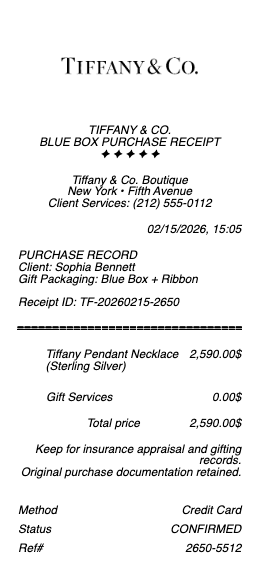
What’s on a Tiffany & Co. Receipt
The store and purchase date
The piece — collection and description (e.g. Tiffany Setting ring, Return to Tiffany, Tiffany T)
Metal and stones — platinum or gold, diamond carat and the 4 Cs where applicable
A style or item number, and any ring size
The price paid and applicable tax
Reference to the Tiffany Diamond Certificate for a diamond
Engraving details, and any servicing notes
The Tiffany Setting, the Blue Box, and the Diamond Certificate
Tiffany’s signatures give a receipt its meaning. The Tiffany® Setting — the six-prong solitaire the house introduced in 1886, which lifts the diamond above the band to maximize light — is the archetypal engagement ring, and a receipt for one specifies exactly that. Every Tiffany engagement diamond comes with a Tiffany Diamond Certificate documenting its 4 Cs to the house’s exacting standard, and many carry a laser-inscribed serial (registration) number on the girdle that ties the stone to Tiffany’s records. The famous Blue Box and white ribbon complete the presentation. For the buyer, the receipt records where and when the piece was bought and for how much, while the diamond certificate documents the stone itself — together they’re the documentation set for a significant purchase. Knowing which piece, metal, and stone the receipt specifies is the starting point for insuring or valuing it.
Authentication and the Counterfeit Problem
Tiffany is one of the most counterfeited jewelers in the world — fake “Tiffany” silver, Return to Tiffany tags, and boxes are everywhere — which makes genuine documentation meaningful and makes forged receipts a real problem. Here’s the key point: a receipt does not authenticate a piece. Genuine authentication comes from the item itself — Tiffany’s hallmarks and stamps, the quality of the piece, and, for diamonds, the serial number and certificate checked against Tiffany’s records. Tiffany can often verify a piece or diamond through its own records, and its boutiques handle servicing. Because counterfeit sellers frequently supply fake receipts and boxes to lend credibility, the receipt is supporting evidence at best, never proof on its own. For a buyer, that means trusting the piece and the certificate — bought from Tiffany or a reputable source — rather than a document, and keeping the genuine paperwork together as part of the provenance.
Insurance, Appraisals, and Records
For jewelry of this value, the receipt anchors the practical paperwork. Insurance: scheduling a ring or fine piece on a homeowner’s policy or a standalone jewelry rider requires proof of value, and the receipt establishes purchase price — usually paired with an independent appraisal that supports replacement value and coverage limits, important because fine jewelry can appreciate and because insurers want a current valuation. Engraving and sizing details on the receipt matter for a bespoke piece. Records: keeping the receipt, the Tiffany Diamond Certificate, and the box together maintains the documentation a valuable piece deserves, and supports a warranty or service claim. Because these are often heirloom or milestone purchases, the paperwork is worth storing as carefully as the jewelry — the certificate and receipt together are what a future appraiser, insurer, or family member will rely on.
Related fine jewelry receipts: see also our Cartier receipt guide and our Van Cleef & Arpels receipt guide.
Create a Tiffany & Co. Receipt
Our generator reproduces a Tiffany-style purchase receipt — store, piece and collection, metal and stone details, price, and certificate reference — as a clean PDF when you need a legible copy for insurance scheduling, a provenance file, or your own records.
Use it responsibly: recreate only a genuine piece you actually purchased, with its true details. Fabricating a Tiffany receipt to authenticate a counterfeit, inflate an insurance claim, or fake provenance for resale is fraud — a receipt is not proof of authenticity, and Tiffany is among the most counterfeited jewelers, so genuine verification rests on the piece, its hallmarks, and its diamond certificate checked against Tiffany’s records. Tiffany & Co. is a trademark of its owner; this tool is not affiliated with it and is for legitimate record-keeping only.
Frequently asked questions
Everything you need to know about the product and billing.
What does a Tiffany & Co. receipt show?
The store and date, the piece and collection (a Tiffany Setting ring, Return to Tiffany, Tiffany T), the metal and stones with diamond carat and 4 Cs where applicable, a style or item number and ring size, the price and tax, a reference to the Tiffany Diamond Certificate, and any engraving.
What is the Tiffany Setting?
The six-prong solitaire engagement ring setting Tiffany introduced in 1886, which lifts the diamond above the band to maximize its light. It’s the archetypal engagement ring, and a receipt for one specifies exactly that setting and the diamond’s details.
What is the Tiffany Diamond Certificate?
A document Tiffany issues with every engagement diamond, recording its 4 Cs to the house’s standard. Many stones also carry a laser-inscribed serial (registration) number on the girdle tying them to Tiffany’s records. It documents the stone; the receipt documents the purchase.
Does a Tiffany receipt prove a piece is authentic?
No. Tiffany is among the most counterfeited jewelers, and forged receipts and boxes are common. Authentication rests on the piece itself — its hallmarks, quality, and, for diamonds, the serial and certificate checked against Tiffany’s records. A receipt is supporting evidence at best.
Do I need my Tiffany receipt for insurance?
Usually yes. Scheduling a ring or fine piece on a policy or jewelry rider requires proof of value, and the receipt establishes purchase price — typically paired with an independent appraisal that supports replacement value and coverage limits, since fine jewelry can appreciate.
Why keep the Tiffany certificate and box with the receipt?
Together they form the documentation set that establishes provenance and supports insurance, servicing, and any future appraisal. For a widely counterfeited house, genuine paperwork kept together — receipt, diamond certificate, and box — is part of what proves and protects the piece over time.