A cash register receipt is the classic printed till slip — the narrow tape that curls out of the register with your items, total, and change. It looks simple, but the register behind it is running a double record: your copy, and a journal the business keeps to balance the drawer at closing. This page explains what a register receipt shows, how the till’s two records and Z-reports work, and why these receipts fade — and how to preserve one.
Cash Register Receipt
Add custom logo
Edit line items
Choose payment method
Add/remove elements
Customize business information
Choose font
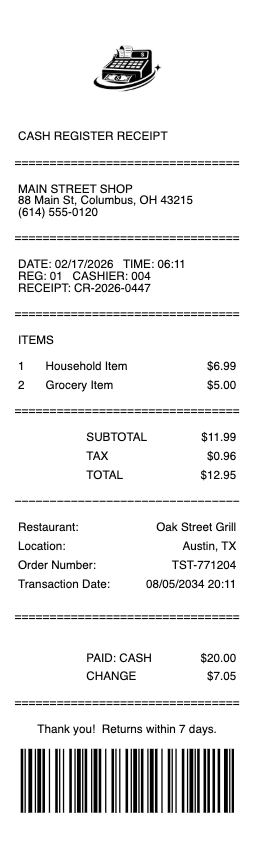
What’s on a Cash Register Receipt
The store — name, address, and often phone — in the header
Register/till number and cashier ID
Itemized purchases with prices, then subtotal, tax, and total
Amount tendered and change given — the cash-sale signature lines
Date, time, and a transaction number
A return-policy or thank-you footer
Printed on thermal paper, in the familiar narrow tape format
The Till’s Two Records — Your Copy and the Journal
A cash register never prints just one record. Alongside the customer receipt you take, the register keeps a journal — historically a second paper roll winding inside the machine, today usually an electronic journal — logging every transaction the till rings. That double record is the backbone of cash control: at closing, the drawer is counted against what the journal says was rung. The register produces the reports for that: an X-report (a mid-shift reading that doesn’t reset) and the end-of-day Z-report, which totals the day’s sales, tax, and payment types and resets the counter. If the counted cash doesn’t match the Z-report, the drawer is over or short — the daily discipline every cash business runs on. So the little slip in your hand is one half of a paired record; the other half is what the business reconciles, audits, and keeps.
Cash Sales — Tendered, Change, and Why It Matters
What marks a register receipt as a cash sale is the pair of lines card receipts don’t need: amount tendered (the cash you handed over) and change due. Those lines matter more than they look. For the customer, they’re the on-the-spot check that the change was right — disputes at the till are settled by the tape. For the business, cash sales leave no bank trail of their own, so the register receipt and journal are effectively the only transaction record — which is why tax authorities expect cash businesses to ring every sale and keep register tapes and Z-reports as substantiation of reported income. A cash purchase with no receipt is invisible to everyone’s records — including yours: for a return, a warranty, or an expense claim, the register receipt is the only proof a cash buyer has, since there’s no card statement backing it up. That makes keeping it genuinely important.
Thermal Paper, Fading, and Preserving a Receipt
Register receipts print on thermal paper — the printer heats a chemically coated tape rather than using ink, which is why receipts are fast, silent, and cheap, and also why they fade. Heat, sunlight, humidity, and time turn a thermal receipt grey or blank — a receipt left in a car or wallet can become unreadable in months, sometimes weeks. If a register receipt matters — a warranty, a big purchase, taxes — scan or photograph it promptly and store the copy; a photocopy also outlives the original. Avoid heat and plastic sleeves that trap moisture against the coating (and don’t laminate one — the heat can blank it instantly). Businesses face the same issue with their own paper journals, which is one reason electronic journals replaced them. The rule of thumb: treat a thermal receipt as a temporary original — the durable record is the copy you make of it.
Related point of sale receipts: see also our POS receipt guide and our Clothing Store receipt guide.
Create a Cash Register Receipt
Our generator reproduces a classic register receipt — store header, register and cashier, itemized purchases, tax, total, tendered and change — as a clean PDF in the familiar tape format, for when a faded or lost cash receipt needs a legible replacement in your records.
Use it responsibly: recreate only real purchases that actually happened, with true items and amounts. Fabricating a register receipt to invent a cash purchase, support a false return, expense, or warranty claim, or misstate cash income is fraud — the store’s journal and Z-reports record every genuine sale, and cash-business records are exactly what audits examine. This tool is for legitimate record-keeping only.
Frequently asked questions
Everything you need to know about the product and billing.
What does a cash register receipt show?
The store header (name, address), the register number and cashier ID, itemized purchases with subtotal, tax, and total, the amount tendered and change given for cash sales, the date, time, and a transaction number, and usually a return-policy footer — printed on narrow thermal tape.
What is the register journal?
The register’s own copy of every transaction — historically a second paper roll inside the machine, now usually an electronic journal. It pairs with your customer receipt, and at closing the drawer is counted against it to check the till balances.
What is a Z-report?
The end-of-day register report totaling the day’s sales, tax, and payment types, which resets the counter (an X-report is the same reading mid-shift, without resetting). Counted cash is reconciled against the Z-report — if they differ, the drawer is over or short.
Why do register receipts fade?
They print on thermal paper — heat marks a chemical coating instead of ink — and heat, sunlight, humidity, and time blank that coating. A receipt kept in a car or wallet can fade in months, so scan or photocopy any register receipt you need to keep, and never laminate one.
Why does a cash receipt matter more than a card receipt?
A cash sale leaves no bank or card-statement trail, so the register receipt is the only proof of purchase the buyer has — and the tape and journal are the business’s only transaction record, which tax authorities expect cash businesses to keep as proof of reported income.
What are the tendered and change lines?
The cash-sale signature: “tendered” is the cash you handed over, “change” is what came back. They let you verify your change on the spot, and they mark the receipt as a cash transaction rather than a card payment.