A Chanel receipt shows proof of purchase for luxury handbags, jewelry, or ready-to-wear items. It is frequently requested for resale authentication and insurance valuation. Chanel receipts usually include item name, boutique location, and total paid.
Chanel Receipt
Add custom logo
Edit line items
Choose payment method
Add/remove elements
Customize business information
Choose font
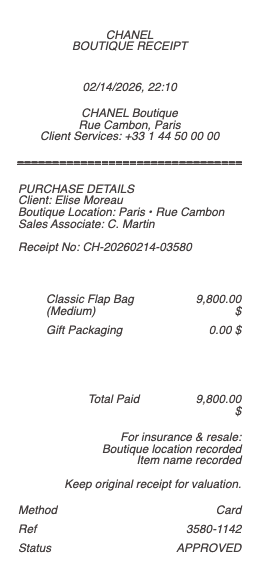
What a Chanel Boutique Receipt Contains
Chanel’s paperwork reflects how tightly the house controls its bags: classic handbags are sold in boutiques only — Chanel does not sell them online — so a genuine bag receipt is a boutique receipt, naming the location and advisor, the date, and the piece by its style reference. Since around 2021 the receipt has carried extra weight: Chanel discontinued the little authenticity cards that once accompanied bags, moving to a metal plate and embedded microchip inside the bag itself — which leaves the dated boutique receipt as the main human-readable proof of where and when a piece was bought. And because Chanel’s well-documented price increases arrive almost yearly, a receipt is also a time-stamp of value: what a flap bag cost on its purchase date versus today is often a startling spread that insurers and resellers both care about.
Serial Numbers, Authenticity Cards, and Microchips on Chanel Bags
Chanel bags carry their own identifiers, and they matter to any receipt. Older bags include a serial number sticker (a hologram-backed decal inside the bag) paired with a matching authenticity card; the serial's number range corresponds to the year the bag was made. From around 2021, Chanel began replacing the sticker-and-card system with an embedded microchip. Whichever a bag has, the receipt connects that specific piece to a documented purchase. On the resale market, a receipt whose date and details line up with the bag's serial or chip is far stronger proof than the bag alone.
The Chanel Receipt and Resale Value
For a brand as resold as Chanel, paperwork is part of the value. The original receipt and authenticity card together make up the "full set" that resale platforms — The RealReal, Vestiaire Collective, Fashionphile, Rebag — and private buyers look for. That documentation raises both buyer confidence and resale price, because it establishes where and when the bag was bought. The same record is what an insurer wants when scheduling a high-value handbag on a policy, and what you'd reference for a repair or spa service. Keeping a clean, legible copy preserves the piece's provenance.
Handbags, Beauty, and Boutique vs Online
Not every Chanel receipt looks the same. A boutique handbag purchase shows the store's name and address, the style, and often the client's name — details collectors value. A chanel.com or beauty order looks more like a standard retail receipt: order number, itemized products (a No.5 fragrance, a lipstick), and shipping. Fine jewelry and watches add reference and serial details similar to other luxury houses. When you reconstruct a Chanel receipt, match it to what was actually bought and where, so the format and fields are consistent.
Related luxury fashion receipts: see also our Dior receipt guide and our Hermes receipt guide.
Reproduce a Chanel Receipt — Carefully
Our generator lays out a Chanel-style boutique receipt — location, date, style reference, price, and payment — as a clean PDF when a real purchase needs a legible record: an insurance schedule, an estate inventory, or a provenance file where the thermal original has faded.
The hard line: never fabricate one. With authenticity cards gone, forged receipts have become a favorite prop for counterfeit Chanel — and a receipt authenticates nothing; the bag’s microchip, plate, craftsmanship, and the boutique’s own sales records do. Creating paperwork for a bag that was never bought, or inflating a declared value, is fraud with real consequences. Chanel is a trademark of its owner; this independent tool is for honest record-keeping only.
Frequently asked questions
Everything you need to know about the product and billing.
What is a Chanel receipt?
A Chanel receipt documents a purchase from a Chanel boutique or chanel.com — a handbag, ready-to-wear, jewelry, or beauty — showing the item, its style and reference, color and size, price, tax, and total.
What's on a Chanel receipt or invoice?
The boutique or order reference, date, sales associate, client name, item name and style (e.g. Classic Flap), color, size and material, price, VAT or sales tax, total, and payment method.
Do Chanel bags have a serial number?
Older Chanel bags have a serial number sticker inside paired with an authenticity card, with the number range indicating the production year. From around 2021, Chanel began using an embedded microchip instead.
Why does a Chanel receipt matter for resale or insurance?
The original receipt and authenticity card make up the "full set" resale platforms and buyers look for. It establishes where and when the bag was bought, raising resale value and serving as the documentation insurers want for high-value pieces.
What's the difference between a boutique and a chanel.com receipt?
A boutique receipt shows the specific store's name and address and the style details; a chanel.com or beauty order looks more like a standard retail receipt with an order number, itemized products, and shipping.
What formats can I download, and is it free?
You can export Chanel receipts as PDF, PNG, or JPG for free, with no login. Watermark-free downloads are available with a paid upgrade.