An Hermès receipt carries more weight than almost any other retail slip, for one structural reason: Hermès includes no authenticity cards with its bags. On the resale market for Birkins and Kellys, the boutique receipt is therefore the closest thing to factory paperwork a bag can have — which is exactly why buyers scrutinize it and why fakes of the receipt itself exist.
Hermès Receipt
Add custom logo
Edit line items
Choose payment method
Add/remove elements
Customize business information
Choose font
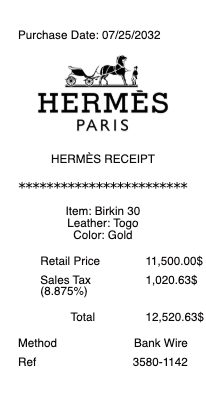
What’s on an Hermès Receipt
The boutique — city and store details, printed at the top
Date of purchase
The item as Hermès describes it — model, leather or material, color name, and hardware for bags
Price and tax — with detaxe/duty-free handling on eligible travel purchases
Payment method
The client relationship — boutique purchases attach to a client profile, which is how the house tracks purchase history
No Authenticity Cards: Why the Receipt Matters at Hermès
Unlike most luxury houses, Hermès ships no authenticity card — a real Birkin comes with a dust bag, a box, perhaps rain protection, and nothing that “certifies” it. Any orange card claiming to be an Hermès authenticity card is itself a counterfeit tell. That vacuum is what elevates the receipt: it is the only document connecting a specific bag, described in the house’s own vocabulary of leather, color, and hardware, to a boutique sale. Collectors keep receipts with the box for exactly this reason, and estates and resellers treat a matching receipt as meaningful provenance.
Real vs. Fake Hermès Receipts
Because receipts add resale value, counterfeit receipts exist — and “real vs. fake Hermès receipt” checks are weaker than people hope. Layouts, fonts, and details vary legitimately by boutique, country, and era, so a stranger comparing two slips online proves little. What a careful buyer actually checks: the item description matches the bag precisely (model, size, leather, color code, hardware), the boutique and date are plausible for the seller’s story, and — decisive — the bag itself passes inspection of stitching, stamping, hardware, and craftsmanship. A perfect receipt on a wrong bag is just evidence of effort. Authenticate the bag; treat the receipt as supporting cast.
Birkin and Kelly Resale: Receipts, Privacy, and Missing Paper
Resale listings often photograph the receipt with the bag — sensible, with two cautions. Sellers should cover their name and any client details before sharing; the document proves the purchase without exposing the buyer’s identity. And a missing receipt is not disqualifying: quota bags change hands, gifts lose paperwork, and older pieces predate the habit. Serious buyers rely on professional authentication and the bag’s own craft signals, with the receipt as a bonus. For your own collection records — insurance schedules included — keep receipts, boxes, and photographs together; jewelry-grade documentation is appropriate at these prices.
Insurers apply the same logic: schedules for high-value bags ask for purchase documentation, and a receipt paired with dated photographs is what turns a five-figure bag into an insurable, provable asset.
Related luxury fashion receipts: see also our Chanel receipt guide and our Louis Vuitton receipt guide.
Rebuild an Hermès-Style Receipt
Our generator rebuilds a boutique-style receipt — store block, the item line in model/leather/color/hardware format, price, tax, and payment — as a clean PDF for personal records when an original has faded or gone missing from your files.
Use it responsibly — especially here: recreate only purchases you genuinely made. Fabricating an Hermès receipt to boost a resale price or pass a counterfeit is fraud in the most literal sense — the exact deception this market polices hardest. No paper authenticates a bag; the bag does. Hermès is a trademark of its owner; this tool is not affiliated with Hermès.
Keeping records on other houses too? The Prada receipt, Chanel receipt, and Cartier receipt pages cover their paperwork.
Frequently asked questions
Everything you need to know about the product and billing.
What does a real Hermès receipt look like?
A boutique-headed slip showing the store, date, the item in Hermès vocabulary — model, leather, color, hardware — price with tax, and payment method. Details vary legitimately by boutique, country, and era.
Do Hermès bags come with authenticity cards?
No — Hermès includes no authenticity cards. A bag comes with its dust bag and box; an orange “authenticity card” is itself a sign of a counterfeit. That is why the receipt carries provenance weight.
Does a receipt prove a Birkin is authentic?
No. It connects a described bag to a boutique sale, but the bag in hand must still pass inspection — stitching, stamping, hardware, craftsmanship. Counterfeit receipts exist precisely because buyers over-trust them.
Should I share my receipt when selling an Hermès bag?
It helps — with your name and client details covered. The receipt proves the purchase and its description without exposing your identity.
Is a Birkin without a receipt still sellable?
Yes — missing paperwork is common with gifts, quota bags, and older pieces. Professional authentication of the bag itself is what serious buyers rely on; the receipt is supporting evidence, not a requirement.
Can Hermès reprint a lost receipt?
Boutique purchases attach to your client profile, so the boutique that sold the item can typically confirm the purchase and often provide documentation — ask the store directly with the approximate date.