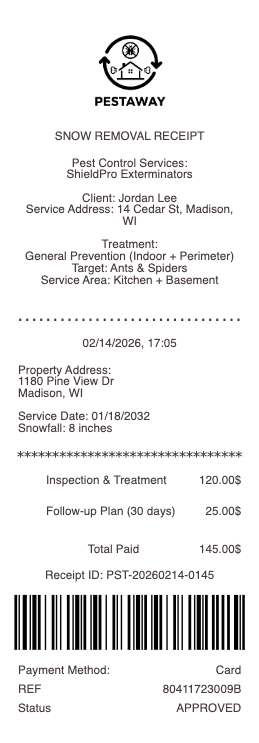
A pest control receipt documents payment for extermination or prevention services. It is commonly used for rental compliance, property management, and health-related records. Pest control receipts usually include treatment type, service area, and total paid.
Pest Control Receipt
Add custom logo
Edit line items
Choose payment method
Add/remove elements
Customize business information
Choose font
What's on a Pest Control Invoice & Receipt
A pest control receipt — often issued as a service invoice or ticket — does more than record a payment; in many states it's a regulated document. A complete pest control invoice shows:
Company and licence number — the business name and the applicator's state pest-control licence or certification number.
Customer and service address — who was served and the property treated.
Service type — general pest, termite, bed bug, rodent, mosquito or wildlife, and whether it was a one-time visit or part of a plan.
Product applied — many states require the ticket to list the pesticide used and the target pest, not just "treatment."
Plan and next service — one-time, monthly or quarterly, with the date of the next scheduled visit.
Charges and total — the service fee, any materials, tax, total and payment method.
One-time, quarterly and recurring plans
Pest control is often sold as a plan, so your pest control receipt may show a recurring charge rather than a single visit. A one-time treatment tackles an active problem; monthly or quarterly plans — the model used by national brands like Terminix and Orkin as well as local operators — keep pests away with scheduled visits and usually include free re-treatments between them. Your receipt should make the plan clear: what's covered, the price per visit or per month, and the next service date. Reading it carefully tells you whether a callback is included or billed separately, which is the detail customers most often overlook.
Why the product and licence number matter
Unlike a shop receipt, a pest control service ticket is often a compliance record. Many states require the invoice to list the pesticide product applied, the target pest and the applicator's licence number, so that treatments are traceable and safe. That's useful to you as well: if anyone in the household reacts to a treatment, the receipt tells a doctor exactly what was used, and if a landlord or buyer questions a treatment, the licensed record settles it. When you keep these tickets, you're keeping a small chemical-application history for your property — one reason a clear, complete receipt is worth more than a scribbled total.
Records for landlords, restaurants and home sales
A pest control receipt is proof of service that others often demand. Landlords use it to show tenants that a unit was treated; restaurants and food businesses must keep pest-control records for health inspections; and home sales frequently require a wood-destroying-organism (termite) report or a recent treatment receipt before closing. Businesses also expense pest control as an operating cost, so a clean itemised copy matters at tax time. If your original ticket faded or went missing and you need a legible copy for a landlord, an inspector or your books, reconstructing it from the real service details keeps your record complete and verifiable.
Related home service receipts: see also our Cleaning Service receipt guide and our Landscaping receipt guide.
Free pest control invoice & receipt generator
Our pest control invoice generator builds a clean, itemised ticket with every field in place — company and licence number, service address, service type and product applied, plan and next-service date, charges and total — and downloads as a print-ready PDF, PNG or JPG in under a minute, no account required. Use this pest control receipt template to bill a job, to give a customer a record for their landlord or inspector, or to replace a ticket you lost for your own files. Please use it responsibly and lawfully: create receipts only for services that genuinely took place — never to fabricate a treatment, mislead an inspector or tenant, or misrepresent what was applied.
Related receipts: our locksmith receipt, plumber receipt, and roofing receipt templates cover other trade jobs.
Smaller odd-job paperwork lives on the handyman receipt page.
Frequently asked questions
Everything you need to know about the product and billing.
What should a pest control invoice include?
The company name and applicator licence number, the service address, the service type, the product applied and target pest, whether it's a one-time or recurring plan with the next-service date, and the charges, tax and total. Many states require the product and licence details on the ticket.
Why does my pest control receipt list the chemical used?
Because many states require the service ticket to record the pesticide applied and the target pest, so treatments are traceable. It's also useful if anyone reacts to a treatment — the receipt tells a doctor exactly what was used.
What's the difference between a one-time and a recurring plan on the receipt?
A one-time charge covers a single treatment; a recurring plan (monthly or quarterly, the model used by Terminix, Orkin and local firms) bills per visit or per month and usually includes free re-treatments between visits. Your receipt should show which you're paying for.
Do I need pest control receipts for a rental or restaurant?
Often yes. Landlords use them to prove a unit was treated, and restaurants must keep pest-control records for health inspections. Home sales may also require a recent treatment receipt or a termite (WDO) report before closing.
How do I get a copy of a lost pest control receipt?
Ask the company for a duplicate — they keep service records tied to your account — and your card statement corroborates the date and amount. If you need a clean itemised copy for a landlord or your books, reconstruct it from the real service details.
Can I use this generator legitimately?
Yes — for pest control operators billing real jobs and customers replacing a lost receipt for a service that actually happened. It is not for fabricating a treatment, misleading an inspector or tenant, or misrepresenting what was applied.