A clinic receipt records a single outpatient visit — a doctor’s office, a walk-in, or an urgent-care stop — and for most people it comes down to one small line: the copay. It’s a far simpler document than a hospital bill, but it still does real work: proving you attended, claiming a reimbursement, or paying from an HSA. This page explains what a clinic receipt shows and the jobs it actually does.
Clinic Receipt
Add custom logo
Edit line items
Choose payment method
Add/remove elements
Customize business information
Choose font
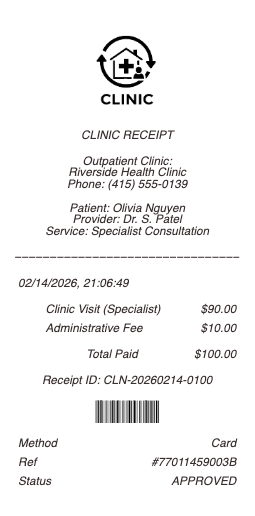
What’s on a Clinic Receipt
Clinic name and provider, with the visit date
Patient name and account or chart number
The office-visit code (an E/M CPT like 99213 or 99214) and any procedure done
The copay collected, or the self-pay fee if uninsured
A diagnosis code if it’s an itemized receipt or superbill
Payment method and amount paid
Balance, if anything is billed to insurance afterward
Copays, Office-Visit Codes, and Self-Pay
Most clinic visits run on a simple model: you pay a fixed copay at check-in and the clinic bills your insurer for the rest, so the receipt you leave with often shows just that copay. Behind it sits an office-visit E/M code — commonly 99213 or 99214 for an established patient, or the 99203–99204 range for a new one — which reflects the visit’s complexity and is what the insurer prices. If you’re uninsured or self-pay, the receipt shows the clinic’s cash fee instead of a copay, and many clinics offer a discounted self-pay rate worth asking about. Urgent-care and walk-in clinics work the same way — a copay or flat visit fee — at a fraction of an emergency-room cost. The receipt captures whichever applied, which is what you need when reconciling later insurance activity.
Proof of Visit vs a Doctor’s Note
A common reason people want a clinic receipt is to prove they were seen — for an employer, a school, or a court — and here a distinction matters. The receipt proves you attended and paid; it is not a doctor’s note, which is a separate signed statement excusing an absence or clearing you for work. Some workplaces accept the receipt as evidence of the appointment; others specifically require the note. If you need to justify time off, ask the clinic for the note explicitly rather than assuming the receipt covers it. That said, the dated receipt is solid proof the visit happened, which is often all that’s needed for a reimbursement or a flexible-benefit claim — just not a medical excuse in itself.
Superbills, HSA/FSA, and Getting a Copy
For an out-of-network clinic visit, ask for an itemized receipt or superbill — with the E/M code, diagnosis, and the provider’s NPI — and submit it to your insurer for reimbursement at your out-of-network rate. The same itemized receipt is what substantiates an HSA or FSA claim, since an outpatient visit is a qualified medical expense; the copay alone is reimbursable with proof. Clinics keep visits in your chart or patient portal, so a copy is usually a portal download, a front-desk reprint, or an emailed receipt. When the receipt is for reimbursement rather than just your budget, ask for the itemized version showing the code and amount — a bare “paid $30 copay” slip is thinner than what most claims want. Keep it with the visit date clearly shown.
Related medical receipts: see also our Health Insurance receipt guide and our Hospital receipt guide.
Create a Clinic Receipt
Our generator produces a clean clinic-visit receipt — clinic and provider details, the visit code, copay or self-pay fee, and amount paid — as a PDF when you need a legible copy for an HSA/FSA claim, a reimbursement, or proof of an appointment.
Use it responsibly: recreate only real visits that took place, with their true fees. Fabricating a clinic receipt to fake an appointment, support a false absence excuse, or claim a reimbursement you’re not owed is fraud — the clinic’s records and your insurer can verify whether a visit happened. Your provider’s own receipt is the authoritative document; this tool is for legitimate record-keeping only.
Frequently asked questions
Everything you need to know about the product and billing.
What does a clinic receipt show?
The clinic and provider, the visit date, the patient details, the office-visit E/M code (like 99213 or 99214) and any procedure, the copay collected or self-pay fee, a diagnosis code if it’s an itemized receipt or superbill, and the amount paid.
What is the E/M code on a clinic receipt?
An evaluation-and-management CPT code describing the visit’s complexity — commonly 99213 or 99214 for an established patient, or 99203–99204 for a new one. It’s what the insurer prices the visit against, and it sits behind the copay you pay at check-in.
Is a clinic receipt the same as a doctor’s note?
No. The receipt proves you attended and paid; a doctor’s note is a separate signed statement excusing an absence or clearing you for work. Some employers accept the receipt, but if you need to justify time off, ask the clinic for the note specifically.
Can I use a clinic receipt for my HSA or FSA?
Yes — an outpatient clinic visit is a qualified medical expense, so the copay or self-pay fee is reimbursable from an HSA or FSA. Keep the itemized receipt showing the code and amount, since the account administrator may ask for substantiation.
How do I get a receipt for an out-of-network clinic visit?
Ask for an itemized receipt or superbill with the E/M code, diagnosis, and provider NPI, then submit it to your insurer for reimbursement at your out-of-network rate. A bare copay slip usually isn’t enough for an out-of-network claim.
Do walk-in and urgent-care clinics give receipts?
Yes — they work like any clinic visit, collecting a copay or a flat self-pay fee and issuing a receipt for it, at a fraction of an emergency-room cost. Ask for an itemized version if you need it for reimbursement or an HSA/FSA claim.