A hospital receipt — really the itemized hospital bill and the proof of what you paid — is one of the hardest medical documents to read, because the number the hospital lists is almost never the number anyone actually pays. Between the chargemaster price, the insurer’s adjustment, and your share, there are several figures. This page explains what the itemized bill shows, how to get one, and how to reconcile it with your insurance.
Hospital Receipt
Add custom logo
Edit line items
Choose payment method
Add/remove elements
Customize business information
Choose font
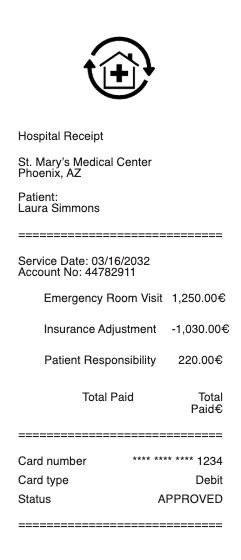
What’s on an Itemized Hospital Bill
Facility and patient details, admission and discharge dates
Every charge as a line item — room, pharmacy, lab, imaging, supplies, procedures
Revenue codes (the 4-digit UB-04 codes) and CPT/HCPCS codes
The chargemaster price for each item — the hospital’s list rate
Insurance adjustments / contractual write-offs
Amount paid by insurance and your patient responsibility
Balance due, payments received, and any plan applied
Chargemaster, Adjustments, and What You Actually Owe
The single most confusing thing about a hospital bill is that the big number isn’t real for most people. Each line starts at the chargemaster price — the hospital’s internal list rate — but insurers pay a negotiated amount far below it, and the difference is written off as a contractual adjustment. So an itemized bill can read $40,000 while the insurer’s allowed amount is a fraction of that and your responsibility smaller still. Self-pay and uninsured patients are often eligible for a discount off chargemaster too — many hospitals apply one automatically or on request. The figure that matters is patient responsibility after adjustments and insurance, not the gross charges. Reading the bill means finding that line, not reacting to the total at the top.
Reconciling the Bill With Your Insurance EOB
Your itemized bill should be checked against the Explanation of Benefits (EOB) your insurer sends — and they are not the same document. The EOB is not a bill; it shows the billed amount, the allowed amount, what the plan paid, and what you owe. Line the two up: the patient responsibility on the EOB should match the balance the hospital bills you. Mismatches are common and worth disputing — duplicate charges, services you didn’t receive, or an item billed before insurance processed. Errors on itemized hospital bills are frequent enough that requesting the itemized version specifically (not the summary) is the first step any patient advocate recommends. The receipt for what you actually paid then closes the loop, proving the balance was settled.
Getting an Itemized Bill, Financial Assistance, and Taxes
You have the right to request an itemized bill — hospitals must provide the line-by-line breakdown, and the summary statement they mail first usually isn’t it. Nonprofit hospitals are also required to offer a financial assistance policy (charity care) that can reduce or eliminate a bill based on income; ask before assuming a balance is fixed. Uninsured and self-pay patients are entitled to a Good Faith Estimate under the No Surprises Act. For taxes, out-of-pocket hospital costs count toward the medical expense deduction above the AGI threshold and are reimbursable from an HSA or FSA — for both, the itemized bill plus the paid receipt is the substantiation. Keep both documents: one shows what was charged, the other proves what you paid.
Related medical receipts: see also our Clinic receipt guide and our Massage receipt guide.
Create a Hospital Receipt
Our generator builds an itemized hospital-bill or payment-receipt layout — facility and patient details, line-item charges with codes, adjustments, patient responsibility, and amount paid — as a clean PDF when you need a legible copy for an HSA/FSA claim, a tax file, or your own records.
Use it responsibly: recreate only real charges and payments, with their true amounts. Fabricating a hospital bill or receipt to claim a deduction, an HSA/FSA reimbursement, or an insurance payment you’re not entitled to is fraud — the hospital’s billing system and your insurer’s EOB are the authoritative records, and they’re cross-checked. This tool is for legitimate record-keeping only.
Frequently asked questions
Everything you need to know about the product and billing.
What does an itemized hospital bill show?
Facility and patient details, admission and discharge dates, and every charge as a separate line — room, pharmacy, labs, imaging, supplies, procedures — with revenue codes and CPT/HCPCS codes, the chargemaster price, insurance adjustments, what insurance paid, and your patient responsibility.
Why is the total on my hospital bill so high?
The line items start at the chargemaster (the hospital’s list price), which almost no one pays. Insurers pay a negotiated amount far lower, and the rest is written off as a contractual adjustment. The figure that matters is your patient responsibility after adjustments, not the gross total.
Is a hospital bill the same as an EOB?
No. The Explanation of Benefits from your insurer is not a bill — it shows the billed amount, the allowed amount, what the plan paid, and what you owe. Reconcile it against the hospital’s itemized bill; the patient responsibility should match, and mismatches are worth disputing.
How do I get an itemized hospital bill?
Request it from the hospital’s billing department — you have the right to the line-by-line breakdown, and the summary statement mailed first usually isn’t it. Ask specifically for the itemized version, which is what reveals errors and supports insurance or tax claims.
Can I reduce a hospital bill I can’t afford?
Often yes. Nonprofit hospitals must offer a financial assistance (charity care) policy that can reduce or eliminate a bill based on income, self-pay discounts off chargemaster are common, and payment plans are widely available. Ask before assuming the balance is fixed.
Can I use a hospital receipt for taxes or my HSA?
Yes. Out-of-pocket hospital costs count toward the medical expense deduction above the AGI threshold and are reimbursable from an HSA or FSA. Keep both the itemized bill (what was charged) and the paid receipt (proof you paid) as substantiation.