A health insurance receipt is proof you paid a premium — and it sits among a set of health-coverage documents people constantly mix up: the premium receipt, the EOB, and the year-end 1095 forms each do a completely different job. Getting them straight matters for taxes, reimbursement, and proving coverage. This page explains what a health insurance premium receipt shows, how it differs from those other documents, and where it’s needed.
Health Insurance Receipt
Add custom logo
Edit line items
Choose payment method
Add/remove elements
Customize business information
Choose font
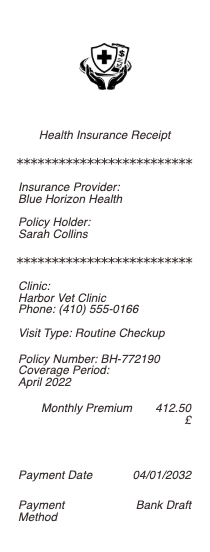
What’s on a Health Insurance Receipt
The insurer and the policy/member ID
The policyholder name and the coverage period the payment covers
The premium amount paid and the payment date
The plan — and whether it’s individual, family, or marketplace coverage
Any subsidy applied, for marketplace plans (the net premium you paid)
The payment method and a confirmation number
Whether paid directly, via marketplace, or through COBRA
Premium Receipt vs EOB vs 1095 — Three Different Documents
This is the distinction that causes the most confusion. A premium receipt proves you paid for coverage — the monthly (or other) cost of having insurance. An Explanation of Benefits (EOB) is something else entirely: it arrives after you receive care, is not a bill, and shows what the provider charged, what the insurer paid, and your patient responsibility — it’s about a specific medical service, not your premium. And the year-end Form 1095 (1095-A for marketplace plans, 1095-B/C for others) is proof of coverage for your taxes, reporting the months you were insured. So three documents, three jobs: the receipt proves you paid the premium, the EOB explains a claim, and the 1095 proves you had coverage. Reaching for the wrong one is a common mistake — for a premium deduction or reimbursement you want the receipt, not the EOB; for tax filing of coverage you want the 1095.
The Self-Employed Deduction and Premium Reimbursement
The premium receipt earns its keep in a few specific situations. For the self-employed, health insurance premiums are often deductible — the self-employed health insurance deduction lets eligible individuals deduct premiums for themselves and family, and the receipts substantiate the amount paid. For employees, premiums paid through payroll are usually pre-tax (so not separately deductible), which the receipt or pay records reflect. Reimbursement arrangements are another: some employers use an HRA (Health Reimbursement Arrangement) or ICHRA to reimburse employees for premiums they pay directly, and that reimbursement requires proof of premium payment — the receipt. COBRA continuation coverage (after leaving a job) is paid directly, and those receipts matter for both budgeting and any reimbursement. In each case, the premium receipt is the document that proves what you paid for coverage, separate from any medical bills.
HSA/FSA, Marketplace Subsidies, and Records
A few more points tie the receipt to money. HSA/FSA: while insurance premiums generally can’t be paid from an HSA/FSA (with limited exceptions like COBRA or coverage while receiving unemployment), the medical costs your EOB shows as your responsibility usually can — so keep both documents, each for its own account. Marketplace subsidies: if you buy ACA marketplace coverage with an advance premium tax credit (APTC), your receipt reflects the net premium after the subsidy, and the 1095-A reconciles the subsidy at tax time — keeping the receipts helps you track what you actually paid. For records, insurers and the marketplace keep payment history in your online account, downloadable, and a lapse in premium payment can end coverage, so proof of on-time payment matters. Keeping premium receipts — distinct from EOBs and 1095s — is what supports a deduction, a reimbursement, or a coverage dispute.
Related medical receipts: see also our Gym Membership receipt guide and our Clinic receipt guide.
Create a Health Insurance Receipt
Our generator produces a clean health insurance premium receipt — insurer and policy, coverage period, premium amount, and payment date — as a PDF when you need a legible copy for a self-employed deduction, an HRA or COBRA reimbursement, or your own records.
Use it responsibly: recreate only real premium payments you actually made, with their true amounts and dates. Fabricating a health insurance receipt to claim a deduction or reimbursement you’re not owed, fake proof of coverage, or mislead an employer or the IRS is fraud — the insurer’s and marketplace’s own records, and the official 1095 forms, are the authoritative and verifiable source of coverage and payment. This tool is for legitimate record-keeping only.
Frequently asked questions
Everything you need to know about the product and billing.
What does a health insurance receipt show?
The insurer and policy/member ID, the policyholder and the coverage period the payment covers, the premium amount paid and date, the plan type, any marketplace subsidy applied (the net premium), the payment method and a confirmation, and whether it was paid directly, via the marketplace, or through COBRA.
What’s the difference between a premium receipt, an EOB, and a 1095?
A premium receipt proves you paid for coverage. An Explanation of Benefits (EOB) is not a bill — it shows what a provider charged, what the insurer paid, and your responsibility for a specific service. A Form 1095 is year-end proof of coverage for taxes. Three documents, three different jobs.
Is an EOB a bill?
No. An EOB (Explanation of Benefits) explains how a claim was processed — the charge, the insurer’s payment, and your patient responsibility — after you receive care. Any amount you owe comes on a separate bill from the provider. The EOB is for understanding the claim, not paying the premium.
Can I deduct health insurance premiums?
Often, if you’re self-employed — the self-employed health insurance deduction lets eligible individuals deduct premiums for themselves and family, and the receipts substantiate the amount. Employee premiums paid pre-tax through payroll generally aren’t separately deductible.
What is an HRA and why does it need my premium receipt?
A Health Reimbursement Arrangement (HRA or ICHRA) is an employer arrangement that reimburses employees for premiums they pay directly. Claiming that reimbursement requires proof of premium payment — the receipt — so the employer or administrator can verify what you paid.
Can I pay health insurance premiums from an HSA or FSA?
Generally no, with limited exceptions like COBRA premiums or coverage while receiving unemployment. However, the medical costs your EOB shows as your responsibility usually can be paid from an HSA/FSA — so keep both the premium receipt and the EOB, each for its own purpose.