A Coinbase receipt records a transaction on the largest US-regulated crypto exchange — a buy, sell, convert, send, or withdrawal — and it matters more than a typical payment slip for one reason: crypto is taxed, and Coinbase reports to the IRS. This page covers what the receipt shows, the fee-and-spread it records, and why the transaction history is your tax backbone.
Coinbase Receipt
Add custom logo
Edit line items
Choose payment method
Add/remove elements
Customize business information
Choose font
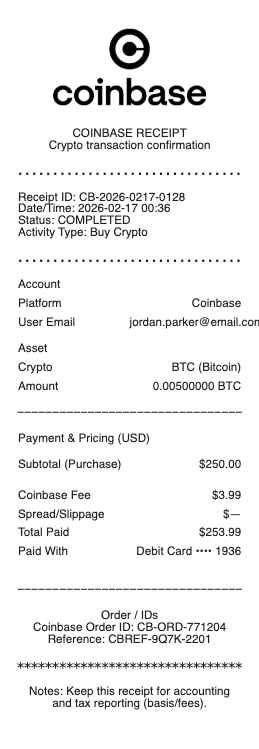
What’s on a Coinbase Receipt
Transaction type — buy, sell, convert, send, receive, or withdraw
The asset and amount — the crypto and the USD value at the time
Coinbase fee and the spread built into the price
The exchange rate applied at execution
Date, time, and a transaction ID
For withdrawals/sends, the destination wallet address and the on-chain network fee
Payment method — bank, card, or Coinbase USD balance
Fees and the Spread — Reading the Real Cost
Coinbase’s cost is not one number, and the receipt shows both parts. There is the visible transaction fee, and there is the spread — a margin built into the buy/sell price itself — so the effective cost is higher than the fee line alone suggests. Trading on Coinbase Advanced (the pro interface) uses lower maker/taker fees instead, and a Coinbase One subscription waives trading fees for a monthly cost — the receipt reflects whichever applied. For anyone tracking cost basis, the fee and spread matter because they are part of what you paid, which affects the gain or loss when you later sell. Reading both lines is how you know the true price of a trade, not just the headline amount.
Taxes: 1099 Forms and Your Transaction History
This is where Coinbase receipts earn their keep. Crypto is property for US tax purposes, so every sale, conversion, or spend is a taxable event with a gain or loss, and Coinbase reports to the IRS — historically on 1099 forms, with 1099-DA digital-asset reporting phasing in. Your own records must reconcile against what Coinbase files, and a single trade’s receipt shows the asset, amount, USD value, and fee that establish cost basis and proceeds. Coinbase provides downloadable transaction history and gain/loss reports for the year, which are the practical documents for a tax return — but the per-transaction receipt is the granular proof behind them. Keep the annual history; it is the crypto equivalent of a brokerage 1099.
Withdrawals, Sends, and Getting a Copy
Sending crypto off Coinbase to an external wallet adds an on-chain network fee and a destination address to the receipt, and — as with any blockchain transfer — the transaction is verifiable on a block explorer by its hash, which is stronger proof than the receipt PDF alone. Everything lives in your Coinbase account: the transaction history is downloadable anytime as a statement or CSV, so a lost receipt is never a real problem — export the record for the period. For business or accounting use, that export is the document, since it separates asset, USD value, fee, and spread that a bank line cannot. Coinbase, being regulated and account-based, retains the authoritative record; the receipt is your legible copy of it.
Related exchange records: for another major US exchange’s fee and statement model see our Kraken receipt guide, and for moving coins off the platform to self-custody see the crypto exchange withdrawal receipt guide.
Create a Coinbase-Style Receipt
Our generator rebuilds an exchange-transaction receipt in the Coinbase style — transaction type, asset and USD value, fee and spread, rate, and any wallet address — as a clean PDF for records or a tax file when you want a legible copy.
Use it responsibly: recreate only transactions that actually occurred, with their real amounts. Fabricating exchange receipts to misstate crypto gains, losses, or holdings on a tax return or loan application is fraud — Coinbase’s own transaction history and 1099 reporting are the authoritative records the IRS receives. Coinbase is a trademark of its owner; this tool is not affiliated with it.
Trade on more than one exchange? The Binance receipt covers the same kind of record for trades and transfers on Binance.
Frequently asked questions
Everything you need to know about the product and billing.
What does a Coinbase receipt show?
The transaction type (buy, sell, convert, send, withdraw), the asset and its USD value, the Coinbase fee and spread, the rate, the date and transaction ID, and — for withdrawals — the destination wallet and network fee.
What is the spread on a Coinbase transaction?
A margin built into the buy/sell price on top of the visible fee, so the real cost is higher than the fee line alone. Coinbase Advanced uses lower maker/taker fees instead, and a Coinbase One subscription waives trading fees.
Does Coinbase report to the IRS?
Yes — crypto is property for tax purposes, every sale or conversion is a taxable event, and Coinbase reports to the IRS, historically on 1099 forms with 1099-DA phasing in. Your records must reconcile with what it files.
How do I get my Coinbase transaction history for taxes?
Download the transaction history or gain/loss report for the year from your account as a statement or CSV — the practical document for a return. Per-transaction receipts are the granular proof behind it.
How do I get a receipt for a Coinbase withdrawal?
It is in your transaction history with the asset, USD value, fee, destination wallet, and network fee. The on-chain transfer is also verifiable on a block explorer by its hash, which is stronger proof than a PDF.
Why do fees matter on a Coinbase receipt for taxes?
The fee and spread are part of what you paid, so they affect the cost basis and the gain or loss when you sell. Reading both lines gives the true cost of a trade for accurate tax reporting.