A DeFi yield receipt records income earned in decentralized finance — interest from lending, fees from providing liquidity, or rewards from yield farming — with no bank or exchange in the middle. It’s among the hardest crypto activity to document, because yield accrues continuously, each claim is a taxable event, and gas is paid on every action. This page explains what a DeFi yield record should capture and the risks and taxes behind it.
DeFi Yield Receipt
Add custom logo
Edit line items
Choose payment method
Add/remove elements
Customize business information
Choose font
What’s on a DeFi Yield Record
The protocol — e.g. Aave, Compound, Uniswap, or a yield vault
The activity — lending interest, liquidity-pool fees, or farmed reward tokens
The reward asset and amount, and the claim date
The USD value at the time received
The transaction hash and gas paid to claim/harvest
LP tokens received or redeemed, if providing liquidity
The APY the yield reflects (variable)
Lending, Liquidity Pools, and Yield Farming
DeFi yield comes from a few distinct activities, and the record differs for each. Lending — depositing assets into a protocol like Aave or Compound — earns variable interest, and you typically receive a token representing your deposit that grows in value or balance. Providing liquidity to a decentralized exchange like Uniswap earns a share of trading fees, and you receive LP tokens representing your position in the pool. Yield farming goes a step further: staking those LP tokens into a protocol to earn additional reward tokens (often governance tokens), sometimes auto-compounded by a vault. Each activity produces yield differently — accruing interest, accumulated fees, or claimable reward tokens — so a clean record notes which protocol and which mechanism generated the income. That’s the starting point for valuing it and, as the next sections cover, for handling both the risk and the tax.
Impermanent Loss and Gas on Every Action
Two realities shape DeFi returns and belong in your records. First, impermanent loss: when you provide liquidity to a pool, if the two assets’ prices diverge, the value of your position can end up less than simply holding the assets would have — the fees you earn are meant to offset it, but not always fully. It’s “impermanent” because it can reverse if prices return, but it’s real if you withdraw at the wrong time, and it means your LP fee income has to be weighed against it. Second, gas: because DeFi runs on smart contracts, every action costs a network fee — depositing, claiming rewards, harvesting, and withdrawing all pay gas. On a busy chain, frequent harvesting can eat a meaningful share of small yields. Tracking the gas paid against the yield earned is how you see your net return, not just the headline APY.
The Messy Tax Side and Keeping Records
DeFi is where crypto taxes get genuinely complicated, which is exactly why records matter. As a general principle, yield you receive is ordinary income at its fair-market value when you gain control of it — each interest accrual or reward claim is an income event valued in USD at that moment, and later selling those tokens is a separate capital gain or loss. Beyond that, treatments get contested: entering or exiting a liquidity pool, or receiving an interest-bearing token, may or may not be a disposal depending on interpretation, and guidance is still evolving. Because there’s no intermediary issuing a 1099, the responsibility to reconstruct it all falls on you — from on-chain data. Crypto tax tools import wallet activity to estimate this, but the raw material is your transaction history: protocol, asset, amount, USD value, and date for every yield event. Keeping that record is the only way to file DeFi accurately.
Related crypto receipts: see also our staking reward receipt guide and our Ethereum receipt guide.
Create a DeFi Yield Receipt
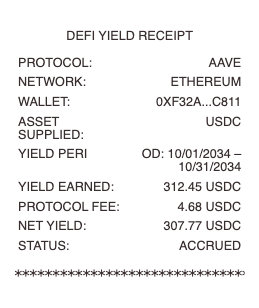
Our generator produces a clean DeFi yield record — protocol, activity, reward asset and amount, USD value at receipt, gas, and any LP tokens — as a readable PDF for your income records or a crypto tax file when you want a legible summary of a yield event.
Use it responsibly: recreate only real yield actually received, with its true amounts and values. Fabricating DeFi receipts to misstate crypto income, invent yield, or manufacture a cost basis is tax fraud — every DeFi transaction is recorded on a public blockchain and can be reconstructed and verified. The on-chain record is the authoritative source; this tool is for legitimate record-keeping only.
Frequently asked questions
Everything you need to know about the product and billing.
What does a DeFi yield record show?
The protocol (Aave, Compound, Uniswap, or a vault), the activity (lending interest, liquidity-pool fees, or farmed reward tokens), the reward asset and amount, the claim date, the USD value at receipt, the transaction hash and gas paid, any LP tokens, and the variable APY.
What are the main ways to earn yield in DeFi?
Lending assets to a protocol like Aave or Compound for interest, providing liquidity to a decentralized exchange like Uniswap for a share of trading fees (receiving LP tokens), and yield farming — staking LP tokens for additional reward tokens, sometimes auto-compounded by a vault.
What is impermanent loss?
When you provide liquidity to a pool and the two assets’ prices diverge, your position can be worth less than simply holding the assets would have been. Trading fees are meant to offset it, and it can reverse if prices return — but it’s a real risk that weighs against LP income.
Why does DeFi yield cost gas to claim?
Because DeFi runs on smart contracts, every action — depositing, claiming rewards, harvesting, withdrawing — pays a network gas fee. On a busy chain, frequent harvesting can eat a meaningful share of small yields, so tracking gas against yield shows your true net return.
How is DeFi yield taxed?
Generally, yield received is ordinary income at its fair-market value when you gain control, and later selling those tokens is a separate capital gain or loss. Some events, like entering or exiting a pool, may be disposals depending on interpretation, and guidance is still evolving.
Who reports my DeFi income to the IRS?
No one — there’s no intermediary issuing a 1099, so reconstructing it from on-chain data is your responsibility. Crypto tax tools import wallet activity to estimate it, but the raw material is your own transaction history: protocol, asset, amount, USD value, and date per event.