A DHL receipt documents an international shipment through the world’s leading cross-border express courier. It reads differently from a domestic FedEx or UPS receipt because DHL’s strength is international — so its paperwork centers on the waybill number, customs, and duties that come with moving a parcel between countries. This page explains what a DHL receipt shows, how customs charges work, and why the waybill is the key detail.
DHL Receipt
Add custom logo
Edit line items
Choose payment method
Add/remove elements
Customize business information
Choose font
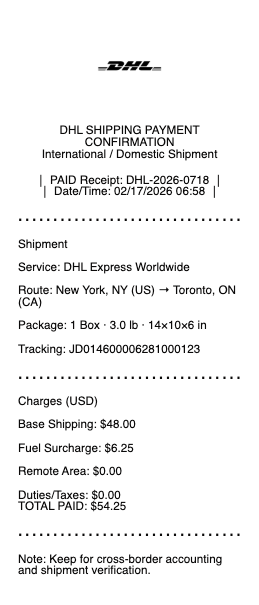
What’s on a DHL Receipt
The DHL service — e.g. DHL Express Worldwide — and the ship date
Sender and recipient, with origin and destination countries
The waybill (tracking) number — DHL Express uses a 10-digit number
Weight and number of pieces, and dimensions
The shipping charge, plus any fuel or surcharge
Customs information — declared value and contents, for international parcels
Any duties, taxes, or clearance fees, and who pays them
The Waybill Number and Tracking
The heart of a DHL shipment is the waybill number — the 10-digit tracking number DHL Express assigns, which follows the parcel end to end and is what you (and the recipient) use to track it on DHL’s site. It appears on the shipping receipt and the label, and it’s the reference for everything: tracking, proof of shipment, a claim for a lost or damaged parcel, or a customs query. Because DHL specializes in international express, a shipment often crosses several countries and handoffs, and the waybill is the single thread tying that journey together. If you’re shipping for business or need proof of dispatch, the receipt with the waybill is the document that establishes when and what you sent. Keeping it (and the number) is essential — without the waybill, tracking a fast-moving international parcel or filing a claim becomes very difficult.
Customs, Duties, and Who Pays
The part of a DHL shipment that surprises people is customs charges. When a parcel crosses a border, the destination country may levy import duties and taxes, and DHL — as the clearing agent — often pays these to customs on your behalf and then bills the recipient, sometimes adding a clearance or “advancement” fee for fronting the money. That’s why a recipient can get a bill from DHL after delivery, or be asked to pay before release. Alternatively, the sender can choose DDP (Delivered Duty Paid) to cover duties up front, so the recipient owes nothing — the shipping receipt reflects which arrangement applies. Understanding this prevents a common shock: the DHL shipping charge on your receipt is for transport, and any duties and taxes are a separate matter set by the destination country, not DHL. The receipt’s customs section and duty terms are where you confirm who’s responsible.
DHL’s Services, Proof, and Getting a Copy
DHL isn’t one service. DHL Express handles time-sensitive international parcels (the 10-digit waybill), DHL eCommerce moves higher volumes of standard parcels, and DHL Global Forwarding handles air and ocean freight — each generates different documentation. For most senders, the Express shipping receipt is the relevant one. It serves as proof of shipment for a business record, a marketplace seller’s dispatch evidence, or a claim, and the declared value on it matters if a parcel is lost (claims are limited to declared/insured value, so under-declaring to save on customs can cost you in a claim). To get a copy, DHL’s online account or the confirmation email stores your shipment and receipt, retrievable by waybill number. For expenses or customs records, keep the itemized receipt showing the service, waybill, charge, and any duties — it’s the reference for any question about the shipment.
Related shipping & courier receipts: see also our FedEx receipt guide and our courier receipt guide.
Related shipping and courier receipts: see also our FedEx receipt guide and our courier receipt guide.
Create a DHL Receipt
Our generator reproduces a DHL-style shipping receipt — service, sender and recipient, waybill number, weight, charge, and customs details — as a clean PDF when you need a legible copy for proof of shipment, a business expense, or your own records.
Use it responsibly: recreate only real shipments you actually sent, with their true details. Fabricating a DHL receipt to fake a shipment, misrepresent a parcel’s value or contents to customs, or support a false delivery or insurance claim is fraud — and customs misdeclaration carries legal penalties. DHL’s own shipment records, tied to the waybill, are authoritative and verifiable. DHL is a trademark of its owner; this tool is not affiliated with it and is for legitimate record-keeping only.
Frequently asked questions
Everything you need to know about the product and billing.
What does a DHL receipt show?
The DHL service (e.g. Express Worldwide) and ship date, the sender and recipient with origin and destination countries, the waybill/tracking number, the weight and pieces, the shipping charge plus any surcharge, customs information (declared value and contents), and any duties, taxes, or clearance fees and who pays them.
What is a DHL waybill number?
The tracking number DHL assigns to a shipment — DHL Express uses a 10-digit number — that follows the parcel end to end. It’s on the receipt and label, and it’s the reference for tracking, proof of shipment, and any lost, damaged, or customs claim.
Why did DHL bill me for customs after delivery?
When a parcel crosses a border, the destination country may charge import duties and taxes. DHL often pays these to customs on your behalf and then bills the recipient, sometimes adding a clearance or advancement fee. Alternatively, a sender can choose DDP to cover duties up front.
Is the DHL shipping charge the same as customs duties?
No. The shipping charge on your receipt is for transport. Any import duties and taxes are separate, set by the destination country, not DHL — though DHL often collects them as the clearing agent. The receipt’s customs section shows which arrangement applies and who is responsible.
What’s the difference between DHL Express and DHL eCommerce?
DHL Express handles time-sensitive international parcels with the 10-digit waybill; DHL eCommerce moves higher volumes of standard parcels; and DHL Global Forwarding handles air and ocean freight. Each generates different documentation — for most senders, the Express shipping receipt is the relevant one.
How do I get a copy of a DHL receipt?
DHL’s online account or the confirmation email stores your shipment and receipt, retrievable by waybill number. For expenses or customs records, keep the itemized receipt showing the service, waybill, charge, and any duties — and note that claims are limited to the declared value.