A donation receipt is the written acknowledgment a charity gives a donor as proof of a tax-deductible gift. The IRS has specific rules for what makes one valid — especially the $250 threshold, the “no goods or services” statement, and how non-cash and in-kind gifts are documented. This guide covers exactly what a 501(c)(3) donation receipt must include, how Goodwill and Salvation Army receipts work, and the template language nonprofits use to issue compliant acknowledgments.
Donation Receipt
Add custom logo
Edit line items
Choose payment method
Add/remove elements
Customize business information
Choose font
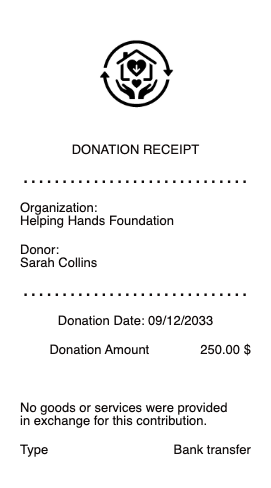
What's on a valid donation receipt
For a donor to claim a deduction, a charitable donation receipt should contain the details the IRS looks for in a written acknowledgment:
Organization name and EIN — the charity's legal name and, ideally, its Employer Identification Number so the donor can confirm 501(c)(3) status.
Donor name and date — who gave and the date the gift was received.
Amount (cash) or description (non-cash) — the dollar amount for money gifts, or a description of donated goods. The charity describes non-cash items but does not assign them a dollar value — that's the donor's responsibility.
The “goods or services” statement — a line stating whether the donor received anything in return, and if so a description and good-faith estimate of its value.
Tax-deductible / 501(c)(3) language — confirmation that the organization is a qualified tax-exempt charity.
The IRS $250 rule and written acknowledgment
The documentation the IRS requires scales with the size of the gift. For any monetary donation, a donor needs at least a bank record or written communication from the charity. But once a single gift reaches $250 or more, the donor must obtain a contemporaneous written acknowledgment — a receipt or letter from the charity, dated on or before the tax-filing deadline, stating the amount and whether any goods or services were provided in exchange. A canceled check alone is not enough at the $250 level. For quid pro quo contributions over $75 — where the donor gets something back, such as a gala dinner or event ticket — the charity must give a written statement showing the deductible portion (the gift minus the fair-market value of what the donor received).
Goodwill, Salvation Army, and non-cash donation receipts
When you drop off clothing or household goods at Goodwill or the Salvation Army, the attendant hands you a receipt — often a blank or partially blank slip. It's your job to list the items and assign each a fair-market value (what the used item would sell for), using the organization's donation valuation guide as a reference, and to keep that itemized list with the receipt. The IRS adds steps for larger non-cash gifts: total non-cash donations over $500 in a year require Form 8283 filed with your return, and any single item or group valued over $5,000 generally needs a qualified appraisal. For in-kind donations (donated goods or services), the receipt describes what was given but leaves the valuation to the donor.
How nonprofits issue donation receipts (with template language)
If you run a 501(c)(3), prompt and correct receipts protect your donors' deductions and build trust. Best practice is to acknowledge every gift — many nonprofits send an immediate receipt for online donations and a year-end summary letter each January. A compliant nonprofit donation receipt includes your organization's name and EIN, the donor's name, the date and amount (or item description), and the required goods-or-services line — commonly “No goods or services were provided in exchange for this contribution.” For recurring or in-kind gifts, note the frequency or describe the donated item. A reusable donation receipt template, in PDF or Word, lets you issue consistent, audit-ready acknowledgments without rewriting the language each time.
Related donation receipts: see also our Church Donation receipt guide and our Goodwill Donation receipt guide.
Create a donation receipt template
Our donation receipt generator and templates help charities, churches, PTAs, and small nonprofits produce clean, printable acknowledgments that carry the IRS-recommended language — organization name and EIN, donor and date, amount or in-kind description, and the goods-or-services statement — so donors have exactly what they need at tax time. Use them for cash gifts, in-kind donations, and year-end giving summaries.
This page is general information, not tax advice. Only genuine gifts to qualified organizations are deductible, and receipts should reflect real donations actually received. Donors claiming larger or non-cash deductions should confirm current IRS thresholds or consult a tax professional, as rules and dollar limits can change.
Congregations have their own acknowledgment rules — covered on the church donation receipt page.
Donors who want to check what their receipt must say can compare the charity donation receipt example, which covers IRS thresholds such as the $250 written acknowledgment.
Frequently asked questions
Everything you need to know about the product and billing.
What does the IRS require on a donation receipt?
For gifts of $250 or more, the IRS requires a contemporaneous written acknowledgment from the charity showing the amount (or a description of non-cash items), the date, and a statement of whether any goods or services were provided in exchange. The charity's name — and ideally its EIN — should appear on it.
Do I need a receipt for donations under $250?
You still need proof, but it can be a bank record (canceled check, card, or bank statement) or a written communication from the charity. A formal written acknowledgment is specifically required once a single gift reaches $250.
How do I value items donated to Goodwill or the Salvation Army?
You assign each item its fair-market value — what a buyer would pay for it used — typically using the organization's published valuation guide. The charity's receipt confirms the donation happened; determining the dollar value is the donor's responsibility.
Does a donation receipt need the charity's EIN?
It isn't strictly mandatory on every receipt, but including the Employer Identification Number is best practice. It lets the donor verify the organization's 501(c)(3) status and strengthens the record if the IRS ever asks.
When do I need IRS Form 8283?
When your total non-cash (property) donations for the year exceed $500. A single item or group of similar items valued over $5,000 generally also requires a qualified appraisal attached to your return.
What is the “no goods or services” statement?
It's the line confirming the donor received nothing of value in return for the gift, so the full amount is deductible. If the donor did receive something (like an event ticket), the receipt must describe it and give a good-faith estimate of its value, which reduces the deductible amount.