A church donation receipt is the written acknowledgment a congregation gives its givers — the document that turns tithes, offerings, and gifts into records the IRS accepts. For churches it is a weekly obligation handled through envelopes, software, or letters; for donors it is what makes December generosity deductible in April.
Church Donation Receipt
Add custom logo
Edit line items
Choose payment method
Add/remove elements
Customize business information
Choose font
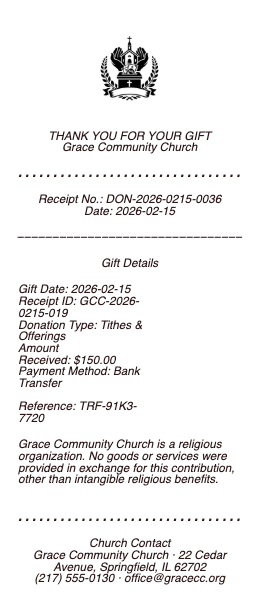
What’s on a Church Donation Receipt
The church’s legal name and address
Donor’s name
Date and amount of each cash gift — or a description (not value) of donated property
The goods-and-services statement — either that nothing was provided in return, or that only intangible religious benefits were
Date the receipt was issued and the name or signature of the person issuing it
For annual statements, the list of gifts through the year with their dates and a total
The Letter for Tax Purposes: What the IRS Wants Said
The reason church receipts carry oddly formal wording is the substantiation rule: for any single contribution of $250 or more, the donor needs a contemporaneous written acknowledgment from the church — received by the time the tax return is filed — stating the amount and whether the church provided goods or services in return. For ordinary worship, the accepted phrase is that the donor received only intangible religious benefits. Without that letter, the deduction fails even when the gift genuinely happened; with it, one page settles the question. That is the whole job of a church donation receipt letter for tax purposes.
Plate Cash, Envelopes, and Annual Giving Statements
Loose cash in the plate is generous and — for tax purposes — invisible: a cash donation to a church without a receipt or bank record cannot be deducted, whatever the amount. Numbered giving envelopes solve this: the counting team records the envelope, and the gift lands in the donor’s ledger. Most churches then issue an annual giving statement each January listing every recorded gift, which serves as the receipt for the entire year. Checks and online giving leave their own trails, but the January statement remains the document donors actually file with their returns.
Templates and Software for Church Receipts
Small congregations manage fine with a church donation receipt template — the fields above, filled per gift or per year — while growing ones outgrow the spreadsheet fast, which is where church management software earns its keep: it tracks givers, generates year-end statements in bulk, and keeps the goods-and-services wording consistent. Whichever route a church takes, the discipline is identical: record every gift when it arrives, acknowledge promptly, and keep copies, because donors will ask for reprints years later and audits give no credit for good intentions.
Reprints deserve one habit of their own: mark them as duplicates with the reissue date, so the donor’s file and the church ledger never hold two competing “originals” an auditor has to reconcile.
Related donation receipts: see also our Goodwill Donation receipt guide and our Donation receipt guide.
Create a Church Donation Receipt
Our generator builds a church donation receipt in a minute — church and donor blocks, the gift date and amount, the goods-and-services statement, and an issuer line — as a clean PDF that works for single gifts or as a model for a year-end letter.
Use it responsibly: receipts document gifts that were actually made, in their real amounts. Fabricating donation receipts for deductions is tax fraud for the donor and jeopardizes the church’s standing — a congregation’s books deserve better on both counts.
The general nonprofit version lives on the donation receipt page, and cash gifts pair with the cash payment receipt example.
For gifts to other charities, the charity donation receipt example explains the IRS written-acknowledgment and quid pro quo thresholds.
Frequently asked questions
Everything you need to know about the product and billing.
What must a church donation receipt include for the IRS?
The church’s name, the donor, the date and amount of the gift, and a statement that no goods or services were provided — or that only intangible religious benefits were. For single gifts of $250 or more this written acknowledgment is required for the deduction.
What does “intangible religious benefits” mean on my receipt?
It is the IRS-accepted phrase for what worship provides — services, sacraments, teaching. It confirms the church gave nothing of commercial value in exchange, so the full gift remains deductible.
Can I deduct cash I put in the offering plate without a receipt?
No. Cash gifts need a bank record or a written acknowledgment from the church, whatever the amount. Numbered giving envelopes or online giving are what make plate generosity deductible.
What is an annual giving statement?
A year-end letter — typically issued each January — listing every recorded gift with dates and a total, plus the goods-and-services statement. It serves as the receipt for the whole year.
Does a church have to give donation receipts?
Churches are not fined for skipping them, but donors cannot claim gifts of $250+ without a written acknowledgment — so consistent receipts are part of caring for the congregation. Most issue them for every recorded gift.
How should a church receipt a non-cash donation?
Describe the donated property and the date, but do not state a value — assigning the value is the donor’s responsibility, and larger property gifts have their own IRS appraisal rules.