A duplicate receipt is a second copy of an original receipt — the same transaction, reproduced when you’ve lost the first or need an extra for warranty, expenses, or taxes. It’s a normal, legitimate document, but it usually carries a mark distinguishing it from the original for a reason: to stop the same purchase being used twice for a return or refund. This page explains what a duplicate receipt is, how to get one, and how to use it properly.
Duplicate Receipt
Add custom logo
Edit line items
Choose payment method
Add/remove elements
Customize business information
Choose font
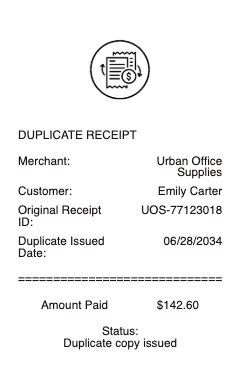
What’s on a Duplicate Receipt
The same transaction details as the original — merchant, date, items, total
The original transaction or reference number
A “DUPLICATE” or “COPY” marking, on many reprints
The reprint date, if it was generated later
The payment method and authorization from the original sale
Store and cashier/terminal identifiers
Everything needed to match it to the original purchase
Where Duplicate Receipts Come From
Duplicates arise a few ways. The oldest is the carbon-copy receipt book: a two-part (or three-part) form where writing the receipt automatically creates a duplicate — the customer takes one copy, the business keeps the other, so both hold an identical record. Modern POS systems produce duplicates on demand: because every sale is stored, a merchant can reprint a receipt by date, card, or amount, often stamped “DUPLICATE.” And digital receipts are inherently duplicable — you can re-download or re-email an order confirmation any number of times. So getting a duplicate is usually straightforward: ask the merchant to reprint the transaction, check your online account or email, or look at the merchant’s copy from a carbon book. The duplicate carries the same details as the original, which is what makes it valid — it’s a faithful reproduction of a real transaction, not a new one.
Why Duplicates Are Marked — and the Anti-Fraud Reason
The “DUPLICATE” or “COPY” label isn’t decoration; it exists to prevent a specific abuse. If duplicates were indistinguishable from originals, someone could use the same receipt twice — returning an item for a refund, then using a second “original” to return it again elsewhere, or double-claiming an expense reimbursement. Marking the reprint as a duplicate lets a merchant or an employer’s finance team see it’s a copy of an existing transaction, not a fresh proof of a separate purchase. This is why a duplicate is fully valid for legitimate purposes — proving you bought something — but is flagged so it can’t be used to claim the same purchase twice. Understanding that distinction matters: a duplicate is honest documentation, and the marking protects everyone by tying the copy back to the one real sale it represents.
Legitimate Uses and Getting a Copy
A duplicate receipt does real work when the original is gone. For a warranty claim, a return (where the store allows a reprint as proof), an expense report, an insurance claim, or tax records, a duplicate showing the same merchant, date, items, and amount is generally accepted proof of purchase. To get one: ask the merchant to reprint from their POS (most can, given the date and card or amount), retrieve it from your online account or confirmation email, or — for a service — request a copy from the provider’s records. Your bank or card statement can serve as secondary proof of the payment, though it’s not itemized. Keep the duplicate with the same care as an original once you have it. Because it reproduces a genuine transaction, a duplicate is the normal, above-board way to replace a lost receipt.
Related transaction receipts: see also our Return receipt guide and our Voided receipt guide.
Create a Duplicate Receipt
Our generator can reproduce a duplicate of a receipt — the same merchant, date, items, and total, clearly a copy of the original transaction — as a clean PDF when you’ve lost the original and need a legible copy for a warranty, expense, or record.
Use it responsibly: recreate only a real transaction that actually occurred, with its true details, and use a duplicate only to represent that one purchase. Creating a “duplicate” to claim the same purchase twice — a double refund or double expense reimbursement — or to fabricate a purchase that never happened is fraud. A genuine duplicate faithfully mirrors one real sale that the merchant’s records can verify. This tool is for legitimate record-keeping only.
Frequently asked questions
Everything you need to know about the product and billing.
What is a duplicate receipt?
A second copy of an original receipt — the same transaction reproduced, showing the same merchant, date, items, and total, usually with the original reference number and often a “DUPLICATE” or “COPY” marking. It’s a legitimate reproduction of one real sale, not a new transaction.
How do I get a duplicate of a lost receipt?
Ask the merchant to reprint it from their POS — most can, given the date and card or amount — or retrieve it from your online account or confirmation email. For a service, request a copy from the provider’s records. A bank or card statement can be secondary proof of the payment.
Why is a duplicate receipt marked “DUPLICATE”?
To prevent the same purchase being used twice — for a double refund or a double expense claim. The marking lets a merchant or finance team see it’s a copy of an existing transaction rather than fresh proof of a separate purchase, which is why it’s valid but flagged.
Is a duplicate receipt valid for a warranty or return?
Generally yes for a warranty claim, expense report, insurance claim, or tax record, since it shows the same merchant, date, items, and amount as the original. Some stores accept a reprint for returns too, though return policies vary and may require the original.
What’s the difference between a duplicate and the merchant copy?
A carbon-copy receipt book creates two identical parts at once — the customer copy and the merchant copy — so the merchant’s copy is effectively a duplicate held by the business. A reprinted “DUPLICATE” is a later copy of that same stored transaction.
Can I use a bank statement instead of a duplicate receipt?
It can serve as secondary proof that a payment happened, but it isn’t itemized, so it won’t show what you bought. For warranty, returns, or detailed expenses, an itemized duplicate receipt from the merchant is stronger — use the statement only to corroborate the charge.