An electricity receipt confirms payment of an electric bill — and the bill behind it is a document with its own vocabulary: kilowatt-hours, supply versus delivery, tiered and time-of-use rates. Understanding those lines is how you know whether a high bill means high usage, a rate change, or an estimated reading. This page explains what an electricity bill and receipt show and how the electric-specific pricing actually works.
Electricity Receipt
Add custom logo
Edit line items
Choose payment method
Add/remove elements
Customize business information
Choose font
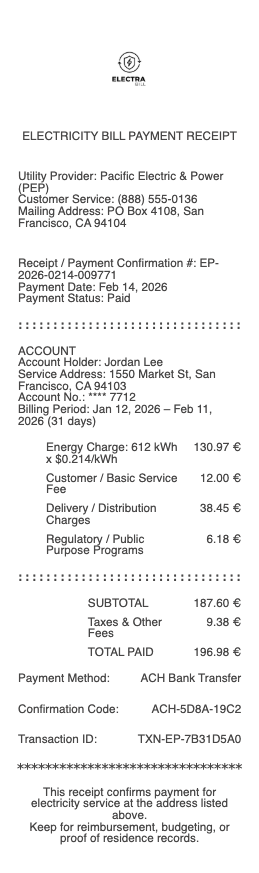
What’s on an Electricity Bill and Receipt
The utility and account number, with the service address
The billing period and the meter readings — previous and current
Usage in kilowatt-hours (kWh)
Supply/generation charges — the energy itself, priced per kWh
Delivery/distribution charges — the wires and grid
Fixed customer charges, taxes, and riders
The total, due date — and on the receipt, the payment confirmation
kWh and the Two Halves of the Bill
Electricity is billed by the kilowatt-hour — one kWh is a 1,000-watt load running for an hour (a space heater for sixty minutes, roughly). The meter’s previous and current readings set the period’s usage, and the charges split into two halves. Supply (or generation) is the energy itself, priced per kWh — and in deregulated states you can choose your supplier, which is why a bill may name a different supply company than the utility. Delivery (or distribution) is the local utility’s wires, poles, and meters — a regulated charge you can’t shop around. Add a fixed customer charge that exists even at zero usage, plus taxes and riders, and that’s the anatomy. Reading supply and delivery separately matters: a jump in the supply rate is a market or contract change, while delivery changes come from the regulator — two different problems with two different fixes.
Tiered Rates, Time-of-Use, and Net Metering
The per-kWh price often isn’t flat. Tiered rates charge more as usage climbs through blocks — the first few hundred kWh cheap, the next block higher — so heavy months cost disproportionately more. Time-of-use (TOU) rates price by the clock: peak hours (typically late afternoon and evening) cost several times the overnight rate, which is why EV owners schedule charging after midnight and why shifting laundry and dishwashing off-peak genuinely trims a TOU bill. And for solar homes, net metering runs the meter both ways — exported surplus earns bill credits, and the receipt shows usage netted against generation, sometimes with a negative energy line in sunny months. The rate plan named on your bill decides which of these applies, and it’s worth checking: the same house, same usage, can bill very differently under tiered versus TOU, and utilities usually let you switch plans.
Spikes, Estimated Readings, and Records
When a bill jumps, the diagnostic order is: usage first (compare this period’s kWh to the same month last year — bills print the history), reading type second — an estimated reading (marked “E” on many bills) means the utility guessed from history and will true-up after the next actual read, which can make one bill artificially high and the next artificially low — and rate third (a supply-contract rollover or seasonal rate change). Air conditioning and electric heat dominate seasonal swings; a mystery year-round increase points at an appliance running constantly. For records: the itemized bill supports a home-office share or rental-property deduction, and the payment receipt proves the account stayed current. Bills and receipts both download from the utility’s portal — and for proof-of-address use, a recent bill in your name is the standard document.
Related utility receipts: see also our Gas Bill receipt guide and our Utility Bill receipt guide.
Create an Electricity Receipt
Our generator produces a clean electricity bill or payment receipt — utility and account, service address, kWh usage, supply and delivery charges, and total — as a PDF for an expense file, a landlord-tenant record, or a legible copy of a payment.
Use it responsibly: recreate only real bills and payments for service actually used, with true amounts. Fabricating an electricity bill to fake proof of address or residence, support a false expense claim, or misrepresent usage is fraud — the utility’s account records are the authoritative, verifiable source, and forged proof-of-address documents carry serious consequences. This tool is for legitimate record-keeping only.
Frequently asked questions
Everything you need to know about the product and billing.
What does an electricity bill show?
The utility and account with the service address, the billing period and meter readings, usage in kilowatt-hours, supply/generation charges (the energy per kWh), delivery/distribution charges (the wires), a fixed customer charge, taxes and riders, and the total and due date — with the receipt confirming payment.
What is a kilowatt-hour?
The billing unit of electricity: a 1,000-watt load running for one hour — roughly a space heater for sixty minutes. Your meter’s previous and current readings set the period’s kWh, and both the supply and delivery halves of the bill price against it.
What’s the difference between supply and delivery charges?
Supply (generation) is the energy itself, priced per kWh — and shoppable in deregulated states, which is why a different supplier may be named on the bill. Delivery (distribution) is the local utility’s regulated charge for wires, poles, and meters, which you can’t shop around.
What are time-of-use electricity rates?
Pricing by the clock: peak hours (late afternoon and evening) cost several times the overnight rate. EV owners schedule charging after midnight for exactly this reason, and shifting laundry or dishwashing off-peak genuinely reduces a TOU bill.
Why did my electricity bill suddenly spike?
Check three things in order: usage (compare kWh to the same month last year — bills print history), the reading type (an estimated read trues-up later and can inflate one bill), and the rate (a supply-contract rollover or seasonal change). AC and electric heat dominate seasonal swings.
What is net metering on an electricity bill?
The arrangement for solar homes where the meter runs both ways — exported surplus earns bill credits, and the bill shows usage netted against generation, sometimes with a negative energy line in sunny months. The rate plan on the bill says whether it applies.