A gas bill receipt confirms payment for natural gas — the most seasonal utility a household has. Gas is measured in units most people never learn (CCF and therms), its price rides a commodity market, and a January bill can be several times July’s. This page explains what a gas bill and receipt show, how the therm math works, and why winter is the season the paperwork matters most.
Gas Bill Receipt
Add custom logo
Edit line items
Choose payment method
Add/remove elements
Customize business information
Choose font
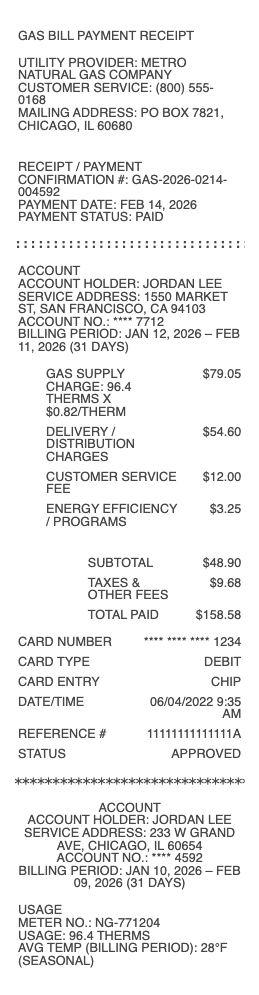
What’s on a Gas Bill and Receipt
The gas utility and account, with the service address
The billing period and meter readings
Usage in CCF and its conversion to therms
The gas supply/commodity charge — priced per therm
Delivery charges — the pipes and service
A fixed customer charge, taxes, and any rider
The total, due date — and the payment confirmation on the receipt
CCF, Therms, and the Commodity Price
Your gas meter measures volume — a CCF is one hundred cubic feet — but you’re billed for heat content, in therms, so the bill applies a conversion factor (a CCF is roughly one therm, adjusted slightly for the gas’s energy content that month). The per-therm price then splits the familiar way: the supply/commodity charge is the gas itself, and it moves with the wholesale market — utilities typically pass it through at cost, which is why the same usage can cost noticeably more one winter than the last. Delivery covers the utility’s pipes and service, regulated and steadier. A fixed customer charge applies even in months you barely use gas. Reading the therm count against the per-therm rate tells you whether a painful bill came from a cold month (usage) or an expensive market (rate) — different causes, different remedies.
The Winter Spike — Seasonality and Budget Billing
Gas usage is the most seasonal number in household budgeting because heating dominates it: a home that burns a handful of therms in July for hot water and cooking can burn twenty times that in January. That swing is why budget (level) billing is especially popular for gas — the utility averages your expected year into a flat monthly amount and trues-up periodically, smoothing the winter cliff. It’s also why comparing a bill to the same month last year (not last month) is the honest check, and why utilities print weather-adjusted comparisons. Two winter-specific notes: estimated readings are more common when meters are snowbound, and they self-correct at the next actual read; and the summer bill is your baseline — roughly the water heater and stove — so anything far above it in warm months hints at a leak or an appliance problem worth checking.
Appliances, Assistance Programs, and Records
What actually burns the gas: the furnace or boiler (the overwhelming winter driver), the water heater (the steady year-round base), then the stove and dryer (small). That hierarchy makes efficiency money go where the therms are — insulation and heating first. On the paperwork side, gas bills and receipts do familiar jobs: a recent bill is standard proof of address; a home office or rental property claims its share of gas costs with the itemized bill as substantiation; and landlords and tenants match the account name to who owes it. One gas-specific use: energy assistance programs — LIHEAP and utility hardship funds — ask for recent bills and payment records to establish eligibility, and winter shut-off protections in many states turn on documented account status. The utility portal stores bills and payment history; the receipt proves the account stayed current through the expensive months.
Related utility receipts: see also our Electricity receipt guide and our Utility Bill receipt guide.
Create a Gas Bill Receipt
Our generator produces a clean gas bill or payment receipt — utility and account, service address, CCF/therm usage, supply and delivery charges, and total — as a PDF for an expense file, a landlord-tenant record, or a legible copy of a payment.
Use it responsibly: recreate only real bills and payments for service actually used, with true amounts. Fabricating a gas bill to fake proof of address, qualify for assistance you’re not eligible for, or support a false expense claim is fraud — the utility’s account records are the authoritative source, and assistance programs verify directly with utilities. This tool is for legitimate record-keeping only.
Frequently asked questions
Everything you need to know about the product and billing.
What does a gas bill show?
The utility and account with the service address, the billing period and meter readings, usage in CCF converted to therms, the supply/commodity charge per therm, delivery charges, a fixed customer charge, taxes, and the total and due date — with the receipt confirming the payment.
What’s the difference between CCF and therms?
The meter measures volume — a CCF is one hundred cubic feet — but billing is by heat content, in therms, via a conversion factor (a CCF is roughly one therm, adjusted for that month’s gas energy content). The per-therm rate is what prices your usage.
Why did my gas bill jump this winter?
Two separate causes: usage (a colder month burns more therms — compare to the same month last year, not last month) or rate (the supply/commodity charge rides the wholesale market and passes through at cost). The therm count versus the per-therm rate tells you which.
What is budget billing for gas?
The utility averages your expected annual usage into a flat monthly amount with periodic true-ups — especially popular for gas because heating makes winter bills several times summer’s. It smooths the January cliff without changing what you ultimately pay.
What uses the most gas in a home?
The furnace or boiler dominates winter usage; the water heater is the steady year-round base (roughly your summer bill); the stove and dryer are small. That’s why summer usage far above baseline hints at a problem worth checking, and why efficiency money goes to heating first.
Why keep gas bills and payment receipts?
Proof of address, home-office or rental expense substantiation, and — gas-specifically — energy assistance: LIHEAP and utility hardship funds ask for recent bills and payment records for eligibility, and winter shut-off protections turn on documented account status.