An Etsy receipt documents a purchase from an independent seller on the handmade, vintage, and craft marketplace — and because every Etsy shop sets its own rules, the receipt sits within a more varied return landscape than a single-retailer slip. This page covers what it shows, why seller policies and personalised items matter, and how Etsy’s Purchase Protection backs an order.
Etsy Receipt
Add custom logo
Edit line items
Choose payment method
Add/remove elements
Customize business information
Choose font
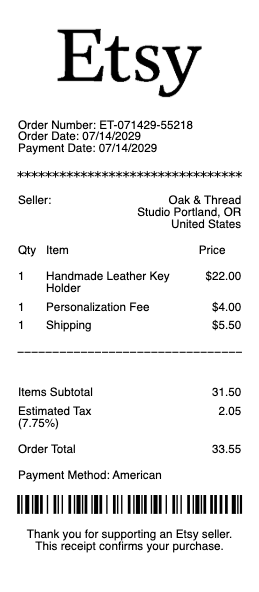
What’s on an Etsy Receipt
Order number and the date
The shop name — each order is with an independent seller, and one cart can span several shops
Each item with its listing title, variations, and any personalisation notes
Discounts or shop coupons applied
Shipping and any sales tax/VAT Etsy collected at checkout
Order total and payment method, plus the shipping address
Getting Your Etsy Receipt (Digital, Downloadable)
Etsy is fully digital, so the receipt lives in You → Purchases and reviews on the app or Etsy.com. Open any order to see the itemised breakdown, and Etsy lets you download or print a receipt/invoice PDF directly — genuinely useful for expenses, unlike marketplaces that only show an order page. A confirmation email arrives per shop as well. The multi-seller structure creates the usual wrinkle: a cart with items from different shops becomes separate orders with separate receipts, each fulfilled and potentially refunded independently, so reconcile by order number rather than the card charge.
Digital downloads are a special case: instant-download files carry their own receipt in Purchases but generally cannot be returned once accessed, so the receipt there is purely a record, not a return ticket.
Returns Vary by Seller — and Personalised Items Are Special
This is the key difference from a big-box receipt: Etsy does not set one return policy — each shop does. Some sellers accept returns and exchanges within a stated window, others sell final-sale, and the individual listing and shop policies (shown on the order) govern what is possible. Custom and personalised items are frequently non-returnable, since they were made to order — a critical thing to check before buying, because the receipt confirms what you ordered but cannot override a no-returns policy. When a shop does accept returns, you arrange it with the seller, and the order receipt is the reference for the whole exchange.
The custom order listing is Etsy's contract mechanism: for commissioned work, the seller creates a private listing capturing what was agreed — dimensions, materials, wording, deadline — and purchasing it locks the specification into the order record. Agreements that live only in the message thread are harder to enforce; the message thread plus a matching custom listing is the pair disputes get decided on.
Purchase Protection, Disputes, and Expenses
Etsy backs buyers with a Purchase Protection programme: for qualifying orders that arrive damaged, not as described, or never at all, Etsy may refund the buyer even when the seller cannot resolve it — a claim filed against the order, with the receipt as the evidence of what was bought and paid. Start with the seller through Etsy Messages, then escalate to a case if needed. For business buyers — resellers sourcing supplies, or anyone expensing a commissioned piece — the downloadable itemised receipt is the record, and because Etsy collects and shows sales tax or VAT on it, that receipt is also the document your bookkeeping needs for the tax lines a card statement omits.
Related online marketplace receipts: see also our Amazon receipt guide and our eBay receipt guide.
Sellers read the same paperwork from the other side: the order page doubles as the seller's record for income reporting, and the fee breakdown — transaction fees, payment processing, offsite-ads charges when they apply — lives in the seller dashboard, not on the buyer's receipt. Two parties, two documents, one order: each side files its own.
Create an Etsy-Style Receipt
Our generator rebuilds a marketplace order receipt in the Etsy style — order number, shop and itemised lines with personalisation, shipping, tax, and total — as a clean PDF when you need a legible copy for records.
Use it responsibly: recreate only orders you actually placed, at their real amounts. Fabricating receipts to claim Purchase Protection, force a return, or support a reimbursement is fraud — and Etsy’s own downloadable order records are the authoritative evidence. Etsy is a trademark of its owner; this tool is not affiliated with the company.
Frequently asked questions
Everything you need to know about the product and billing.
How do I get a receipt from Etsy?
Open You → Purchases and reviews on the app or Etsy.com, select the order, and download or print the receipt/invoice PDF directly. A confirmation email also arrives per shop.
Why did my Etsy order become several orders?
Each Etsy order is with an independent shop, so a cart spanning multiple sellers splits into separate orders with separate receipts, each fulfilled and refunded independently. Reconcile by order number.
What is Etsy’s return policy?
There isn’t one — each shop sets its own. Some accept returns within a window, others are final-sale. The listing and shop policies on your order govern what is possible.
Can I return a personalised Etsy item?
Often no — custom and personalised items are frequently non-returnable because they were made to order. Check the listing’s policy before buying; the receipt confirms your order but cannot override a no-returns rule. For commissioned work, insist the agreement lives in a custom order listing — the specification locked into the order record is what a dispute gets decided on.
What is Etsy Purchase Protection?
A programme under which Etsy may refund buyers for qualifying orders that arrive damaged, not as described, or never at all — filed against the order with the receipt as evidence. Start with the seller, then escalate to a case.
Does an Etsy receipt show sales tax or VAT?
Yes — Etsy collects and shows applicable sales tax or VAT on the receipt at checkout, which is why the downloadable itemised receipt is the document your bookkeeping needs, not the card statement line. Sellers see a different document entirely — the dashboard's fee breakdown for income reporting, which never appears on the buyer's receipt.