An EV charging receipt records a session at a public charger — the kilowatt-hours delivered, the rate, and often an idle fee — and it matters most to people who need to expense it: rideshare and delivery drivers, business EV users, and anyone reimbursed for charging. Because charging is priced in ways gas never was, the receipt reads differently. This page explains what it shows and how to use it for reimbursement.
EV Charging Receipt
Add custom logo
Edit line items
Choose payment method
Add/remove elements
Customize business information
Choose font
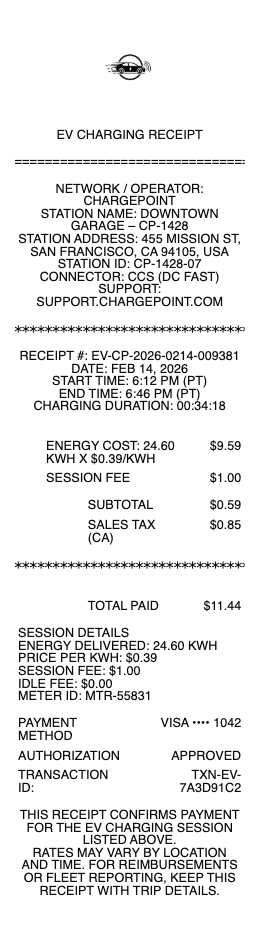
What’s on an EV Charging Receipt
The network and station — e.g. Tesla Supercharger, Electrify America, ChargePoint, EVgo — with location/station ID
Session start and end time, and duration
Energy delivered in kWh
The rate — per kWh or, on some networks, per minute
Any idle fee for staying plugged in after charging finished
Member vs guest pricing, and session or connection fees
Total cost and payment method
Per-kWh vs Per-Minute — and Idle Fees
EV charging is priced two ways, and the receipt shows which applied. Per-kWh billing charges for energy delivered — the fairer, increasingly standard model, and one several states now require. Per-minute billing charges for time connected, which means your cost depends on how fast your car accepts a charge (a slower-charging car pays more for the same energy), and some networks tier the per-minute rate by charging speed. Then there are idle fees: Tesla and Electrify America, among others, charge a per-minute penalty if you stay plugged in after your session completes, to free the stall for others. That’s a line people don’t expect, and the receipt is where it shows up. Reading whether you were billed by energy, by time, or hit an idle fee explains a cost that a gas pump never would.
Networks, Memberships, and What You Actually Paid
Rates swing based on network and membership. Guest or pay-as-you-go pricing is highest; a paid membership — Electrify America Pass+, an EVgo plan, and others — lowers the per-kWh rate for a monthly fee, while Tesla Superchargers bill through your account automatically. The same kWh can cost noticeably more or less depending on which network’s stall you pulled into and whether you’re a member, so the receipt’s rate line and member/guest flag explain price differences between two visually identical sessions. Some networks also add a session or connection fee. For anyone charging regularly, the receipt is how you track real cost per session and per kWh — useful for comparing networks and for the reimbursement math in the next section, where the kWh and rate are exactly what a claim needs.
Expensing and Reimbursing EV Charging
This is where the receipt earns its keep. Rideshare and delivery drivers, business EV owners, and employees on a company car need public-charging receipts to expense fuel — and unlike home charging (which is buried in your household electric bill and hard to isolate), a public session gives a clean, itemized receipt with kWh, rate, location, and total. Employers and platforms reimbursing charging want that document, not a card statement line. For taxes, business EV use can be deducted by actual cost — for which these receipts are the substantiation — or by the standard mileage rate, but not both. Keeping each session’s receipt builds the record either way. When home charging is part of a business claim, some drivers install a separate metered charger precisely so it produces the same kind of itemized proof a public station does.
Related vehicle receipts: see also our Car Maintenance receipt guide and our Vehicle Registration receipt guide.
Create an EV Charging Receipt
Our generator reproduces a public EV-charging receipt — network and station, session time, kWh delivered, the rate, any idle fee, and total — as a clean PDF when you need a legible copy for an expense report, a reimbursement claim, or your own cost tracking.
Use it responsibly: recreate only real charging sessions with their true energy and amounts. Fabricating charging receipts to inflate a fuel-expense claim or a reimbursement you’re not owed is fraud — charging networks keep session records tied to your account, and employers and platforms can verify them. The network’s own receipt is the authoritative document; this tool is for legitimate record-keeping only.
Frequently asked questions
Everything you need to know about the product and billing.
What does an EV charging receipt show?
The network and station with location/ID (Tesla Supercharger, Electrify America, ChargePoint, EVgo, etc.), the session start/end and duration, energy delivered in kWh, the rate (per kWh or per minute), any idle fee, member vs guest pricing, and the total cost and payment method.
Why is EV charging billed per minute instead of per kWh?
Some networks charge by time connected rather than energy delivered. That means your cost depends on how fast your car accepts a charge — a slower car pays more for the same energy. Per-kWh billing is fairer and increasingly standard, and several states now require it.
What is an idle fee on an EV charging receipt?
A per-minute penalty some networks (like Tesla and Electrify America) charge if you stay plugged in after your session finishes, to free the stall for others. It’s a line many drivers don’t expect, and the receipt is where it appears.
Why did the same amount of charging cost different amounts?
Rates vary by network and membership. Guest pricing is highest; a paid membership like Electrify America Pass+ or an EVgo plan lowers the per-kWh rate. The receipt’s rate line and member/guest flag explain price differences between two otherwise identical sessions.
How do I expense EV charging for work?
Use the public-session receipt — it itemizes kWh, rate, location, and total, which a card statement line doesn’t. Employers and rideshare platforms want that document. For taxes, business EV use is deducted by actual cost (these receipts substantiate it) or by standard mileage, not both.
Can I get a receipt for home EV charging?
Home charging is part of your household electric bill and hard to itemize on its own. For a business claim, some drivers install a separately metered charger so it produces an itemized record like a public station. Public-network sessions always generate their own receipt.