A vehicle registration receipt is your proof that you paid to register or renew a vehicle with the state — and it’s worth reading closely, because the total is usually several fees bundled together, and one part of it may be tax-deductible. This page explains what the receipt breaks down into, how it differs from the registration card you carry in the car, and which piece the IRS cares about.
Vehicle Registration Receipt
Add custom logo
Edit line items
Choose payment method
Add/remove elements
Customize business information
Choose font
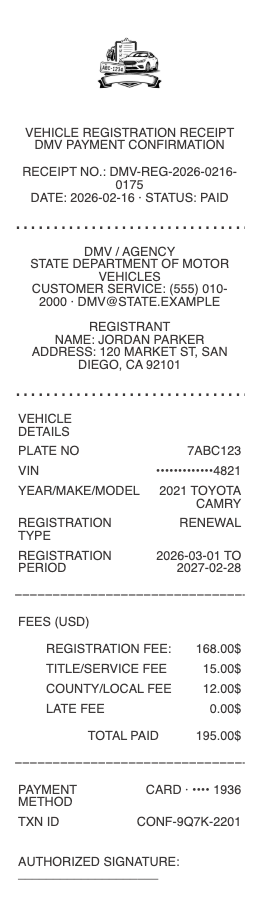
What’s on a Vehicle Registration Receipt
The DMV/state agency and the transaction date
Owner name and the vehicle — VIN, make, model, year
Plate number and the new expiration date
The fee breakdown — base registration, plate/license fee, title fee if applicable
A value-based fee or tax — e.g. a Vehicle License Fee or ad valorem tax tied to the car’s value
County or local add-ons, and any late penalty
Total paid and payment method
The Fee Breakdown — Why the Total Isn’t One Number
A registration charge is rarely a single flat fee, and the receipt itemizes the parts. There’s usually a base registration fee, a plate or license fee, and — on a first registration or transfer — a title fee. On top of those, many states add a value-based charge: California’s Vehicle License Fee (VLF), or an ad valorem tax elsewhere, calculated from the vehicle’s current value, which is why a new car costs more to register than an old one. Weight-based fees apply to trucks in some states. If you renewed late, a penalty line appears too. Reading the breakdown tells you what you actually paid for — and, as the next section explains, which slice of it might come back to you at tax time.
The Deductible Part — Value-Based Fees and Taxes
Here’s the reason to keep this receipt: the value-based portion of your registration may be deductible as a personal property tax on Schedule A, while the flat fees are not. The IRS allows the deduction only for the part of the fee charged on the vehicle’s value — California’s VLF is the textbook example, and several states have an equivalent line. The flat base-registration and plate fees don’t qualify. This is exactly why the itemized receipt matters: you need it to separate the deductible value-based amount from the non-deductible fees, since a lump “registration paid” figure won’t let you (or your tax software) isolate the right number. For a business vehicle, the whole registration is generally a deductible business expense instead — again, substantiated by this receipt.
Receipt vs Registration Card, Renewals, and Copies
Two documents come out of registering, and they’re not interchangeable. The registration card (or sticker/tab) is what you keep in the vehicle as legal proof it’s registered; the receipt is proof you paid, with the fee breakdown. You may need the receipt for a tax deduction, a business expense record, or to resolve a billing question — the card won’t show the money. Registration renews on a cycle (annual or biennial), and in many states you must pass inspection or emissions and show insurance before you can renew. Most DMVs now register online and email or display a printable receipt, and a lost one is usually re-downloadable from your state DMV account. When you need it for taxes, get the itemized version that lists the value-based fee separately.
Related vehicle receipts: see also our EV Charging receipt guide and our Fuel receipt guide.
Create a Vehicle Registration Receipt
Our generator reproduces a vehicle registration receipt — agency, owner and vehicle details, plate and expiration, the itemized fee breakdown, and total — as a clean PDF when you need a legible copy for a tax file, a business expense record, or your own files.
Use it responsibly: recreate only a registration you actually paid, with its true fees. Fabricating a registration receipt to claim a deduction you’re not entitled to, or to misrepresent a vehicle as registered, is fraud — and the state DMV’s records are the authoritative source any agency can verify against. This tool is for legitimate record-keeping only.
Frequently asked questions
Everything you need to know about the product and billing.
What does a vehicle registration receipt show?
The DMV or state agency and date, the owner and vehicle (VIN, make, model, year), the plate number and new expiration, an itemized fee breakdown — base registration, plate, title, and any value-based fee or tax — plus county add-ons, any late penalty, and the total paid.
Why is my registration fee broken into several parts?
Because it bundles a base registration fee, a plate/license fee, sometimes a title fee, and often a value-based charge (like California’s Vehicle License Fee or an ad valorem tax) calculated from the car’s value. That value-based part is why a newer car costs more to register.
Is any part of vehicle registration tax-deductible?
Often the value-based portion is — it can be deducted as a personal property tax on Schedule A, while the flat base and plate fees cannot. California’s VLF is the classic example. You need the itemized receipt to separate the deductible amount from the non-deductible fees.
Is the registration receipt the same as my registration card?
No. The registration card (or sticker) is what you keep in the vehicle as legal proof it’s registered. The receipt is proof you paid, with the fee breakdown. You need the receipt — not the card — for a tax deduction or a business expense record.
Do I need insurance or an inspection to renew registration?
In many states, yes — you must show current insurance and pass a safety or emissions inspection before you can renew. Requirements vary by state, so the registration receipt often follows those steps rather than being the first thing you obtain.
How do I get a copy of a registration receipt?
Most DMVs register online and email or display a printable receipt, and a lost one is usually re-downloadable from your state DMV account. If you need it for taxes, get the itemized version that lists the value-based fee as a separate line.