A Vestiaire Collective receipt documents a purchase or sale on one of the largest peer-to-peer luxury resale platforms — where individual sellers list pre-owned designer pieces and the platform adds the layer that makes strangers trust each other: authentication. For buyers the receipt pairs with that authentication as the item’s provenance; for sellers it’s the commission-and-payout record. This page explains what a Vestiaire order shows and how both sides’ paperwork works.
Vestiaire Collective Receipt
Add custom logo
Edit line items
Choose payment method
Add/remove elements
Customize business information
Choose font
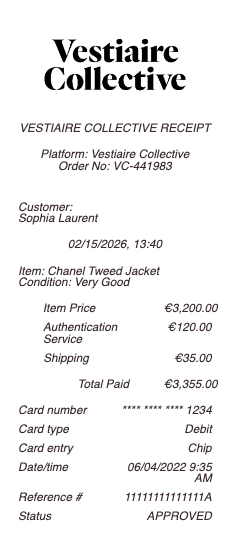
What’s on a Vestiaire Collective Receipt
The order number and date
The item — brand, model, and listed condition
The seller (an individual or professional) and the buyer
The price, plus buyer fees and shipping
The authentication path — expert check or direct shipping
Duties/taxes on cross-border orders, shown at checkout
For sellers — the commission taken and the net payout
Peer-to-Peer Resale With an Authentication Layer
Vestiaire’s model is marketplace, not store: the item you buy belongs to another member, often in another country, and the platform’s job is making that safe. Its signature step is authentication — for qualifying items, the piece ships first to Vestiaire, where in-house experts physically check it against the listing (authenticity, condition, description) before it continues to the buyer. Lower-priced eligible items can take direct shipping, seller to buyer, backed by digital checks and the platform’s guarantee instead of a physical inspection. The order confirmation records which path applied — worth noting, because an expert-checked purchase carries the platform’s physical verification while a direct-shipped one rests on its remote controls. Either way, the model is the point: peer-to-peer prices with a trust layer a private sale between strangers can’t offer, and paperwork that documents the check.
For Sellers — Commission, Payout, and the Paper Trail
Selling on Vestiaire runs a familiar consignment-like sequence: list the item, agree the sale, ship it in (or direct), pass the check, get paid. The platform takes a commission — structured by price band, with fees varying by item value and payment method — so the seller’s document that matters is the payout statement: sale price, commission and fees deducted, net proceeds. Keep those statements: sellers moving several pieces a year are running real money through the platform, and marketplaces may issue tax forms depending on local thresholds and volume. The usual tax comfort applies — personal items sold for less than you paid generally create no taxable gain — but the payout records are what let you show that if asked. For anyone clearing a closet of designer pieces, the sequence of payout statements is the ledger of the whole exercise.
For Buyers — Cross-Border Orders and Provenance
Because Vestiaire is a global platform with European roots, cross-border orders are routine: the checkout shows duties and import taxes for your destination on international purchases, so the receipt reflects the landed cost rather than a surprise customs bill. Returns are tighter than regular retail — this is peer-to-peer resale, so change-of-mind returns are limited, while an item that arrives not as described goes through the platform’s claim process, where the authentication record and listing photos decide. And a habit worth keeping: file the order confirmation together with the authentication documentation — for a pre-owned Chanel or Hermès piece, that pairing is the item’s provenance, the thing a future buyer, insurer, or consignment shop will ask about. On resale platforms, today’s receipt is literally part of tomorrow’s listing.
Related luxury retail receipts: see also our Fashionphile receipt guide and our Farfetch receipt guide.
Create a Vestiaire Collective Receipt
Our generator reproduces a resale-order receipt in the Vestiaire style — order number, item and condition, price and fees, authentication path, and totals — as a clean PDF for your records or a provenance file when the original confirmation is buried or lost.
Use it responsibly: recreate only real orders that actually occurred, with true details. Fabricating a resale receipt to legitimize a counterfeit, invent provenance, or support a false claim is fraud — Vestiaire’s order records and authentication logs are the authoritative source, and a receipt is never proof of authenticity; the platform’s check of the physical item is. Vestiaire Collective is a trademark of its owner; this tool is not affiliated with it and is for legitimate record-keeping only.
Frequently asked questions
Everything you need to know about the product and billing.
What does a Vestiaire Collective receipt show?
The order number and date, the item with brand, model, and listed condition, the seller and buyer, the price plus buyer fees and shipping, which authentication path applied (expert check or direct shipping), duties on cross-border orders, and — for sellers — the commission and net payout.
How does Vestiaire Collective authentication work?
For qualifying items, the piece ships to Vestiaire first, where in-house experts physically check authenticity, condition, and description before it continues to the buyer. Eligible lower-priced items can ship directly seller-to-buyer, backed by digital checks and the platform guarantee instead.
What fees does a Vestiaire seller pay?
A commission structured by price band, plus payment-processing fees — deducted from the sale so the payout statement shows sale price, fees, and net proceeds. Keep those statements: they’re the ledger of your selling, and platforms may issue tax forms depending on volume and local thresholds.
Are Vestiaire purchases returnable?
More tightly than regular retail — it’s peer-to-peer resale, so change-of-mind returns are limited. An item that arrives not as described goes through the platform’s claim process, where the authentication record and listing photos are the deciding evidence.
Do I pay customs duties on a Vestiaire order?
On international orders, duties and import taxes for your destination are shown at checkout and included in what you pay, so the receipt reflects the landed cost. Cross-border purchases are routine on the platform given its global, European-rooted seller base.
Why keep the receipt and authentication together?
Because for a pre-owned luxury piece that pairing is the provenance — what a future buyer, insurer, or consignment shop will ask for. On resale platforms, today’s order confirmation and authentication record become part of tomorrow’s listing.