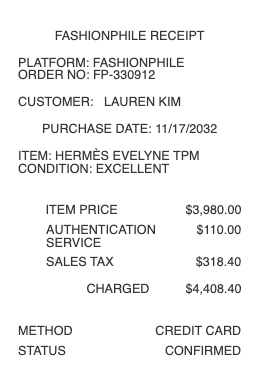
A Fashionphile receipt documents a purchase from a luxury-resale retailer — a company that buys pre-owned designer handbags and accessories outright, authenticates them in-house, and sells them as its own inventory. That model makes the paperwork simpler than a peer-to-peer marketplace: the buyer gets a store receipt from one merchant, and the seller gets an upfront buyout payment. This page explains what a Fashionphile receipt shows on both sides and why the model matters.
Fashionphile Receipt
Add custom logo
Edit line items
Choose payment method
Add/remove elements
Customize business information
Choose font
What’s on a Fashionphile Receipt
The order number and date
The item — brand, style, and Fashionphile’s condition grade
The price, tax, and shipping
Fashionphile as the seller of record — not an individual
Layaway details, if the purchase is paid in installments
For sellers — the buyout quote, item received, and payment issued
A reference for returns and service
A Retailer, Not a Marketplace
Fashionphile’s defining choice is that it owns what it sells. Sellers send items in against a quote, Fashionphile buys them outright (or takes select pieces on consignment), its specialists authenticate and grade each piece, and only then does it go on sale — from Fashionphile, as the merchant of record. For a buyer that changes the paperwork completely versus a peer-to-peer platform: your receipt is a store receipt from one company that has already inspected the item, not a marketplace order between strangers with a trust layer bolted on. Condition is stated as a grade on the listing and receipt — from giftable/like-new down through visible wear — so what you paid maps to a stated standard. The focus is ultra-luxury accessories: Hermès, Chanel, Louis Vuitton, and their peers, where inspection-before-listing is exactly what the price demands.
For Sellers — the Buyout Model and Upfront Payment
Selling to Fashionphile inverts the marketplace experience: instead of listing and waiting for a buyer, you submit photos, receive a quote, ship the item in, pass verification — and get paid, whether or not the piece ever sells onward. That upfront certainty is the model’s selling point (consignment alternatives exist for some items, paying more but later). The paper trail is the quote, the intake confirmation, and the payment record — your proceeds document. Tax-wise, the familiar comfort usually applies: a personal bag sold for less than you originally paid generally creates no taxable gain, but keep the payout records (and ideally the original purchase receipt) so you can show it — resale companies and platforms may issue tax forms at volume, and the paperwork is what separates decluttering from dealing. Fashionphile’s partnership with Neiman Marcus also lets sellers start the process at NM stores.
For Buyers — Layaway, Returns, and Provenance
Fashionphile’s buyer-side quirk is layaway: eligible purchases can be split into scheduled payments over a set period, with the item shipping once paid in full — each installment generating its own receipt against the balance, exactly like a classic layaway plan. Returns follow a defined window on eligible items (condition unchanged, tags/seals intact), which the receipt anchors. And the provenance habit matters doubly here: the Fashionphile receipt documents that a specific graded piece was bought from a company that authenticated it in-house — keep it with the item’s photos and any authentication documentation, because for a future resale, insurance schedule, or estate valuation, that receipt is the piece’s verifiable history. In luxury resale, a clean paper trail from a known authenticator is part of what the next buyer pays for.
Related luxury retail receipts: see also our Vestiaire Collective receipt guide and our Farfetch receipt guide.
Create a Fashionphile Receipt
Our generator reproduces a luxury-resale receipt in the Fashionphile style — order number, item with condition grade, price, layaway or payment details, and totals — as a clean PDF for your records, an insurance file, or a provenance folder when the original is lost.
Use it responsibly: recreate only real purchases or sales that actually occurred, with true details. Fabricating a resale receipt to legitimize a counterfeit, invent provenance or a buyout payment, or support a false claim is fraud — Fashionphile’s order and intake records are the authoritative source, and a receipt is never proof of authenticity; the company’s inspection of the physical item is. Fashionphile is a trademark of its owner; this tool is not affiliated with it and is for legitimate record-keeping only.
Frequently asked questions
Everything you need to know about the product and billing.
What does a Fashionphile receipt show?
The order number and date, the item with brand, style, and Fashionphile’s condition grade, the price, tax, and shipping, Fashionphile as the seller of record, layaway details if paying in installments, and — on the seller side — the buyout quote, intake confirmation, and payment issued.
How is Fashionphile different from a resale marketplace?
It owns its inventory: items are bought outright from sellers, authenticated and graded in-house, then sold by Fashionphile as the merchant of record. Your receipt is a store receipt from one company that already inspected the piece — not a peer-to-peer order between strangers.
How does selling to Fashionphile work?
Submit photos, receive a quote, ship the item in, pass verification, get paid — upfront, whether or not the piece sells onward. The paper trail is the quote, intake confirmation, and payment record; a partnership with Neiman Marcus also lets sellers start the process in NM stores.
Is money from selling a bag to Fashionphile taxable?
Usually not when a personal item sells for less than you originally paid — no gain, no tax. Keep the payout record and ideally your original purchase receipt to show it; resale companies may issue tax forms at volume, and paperwork is what separates decluttering from dealing.
How does Fashionphile layaway work?
Eligible purchases split into scheduled payments over a set period, with the item shipping once paid in full — each installment generating a receipt against the balance, like classic layaway. The final receipt closes the plan and becomes the item’s proof of purchase.
Why keep a Fashionphile receipt long-term?
It documents that a specific graded piece came from a company that authenticated it in-house — provenance a future resale, insurance schedule, or estate valuation will ask about. In luxury resale, a clean paper trail from a known authenticator is part of the item’s value.