A street food receipt is the one most travelers wish they had and often cannot get: markets, night stalls, and cart vendors run on cash and rarely print anything. Yet a documented street-food meal is exactly what a travel expense report or per-diem reconciliation asks for. This page covers the reality of street-vendor receipts and how to document a purchase when the stall won’t.
Street Food Receipt
Add custom logo
Edit line items
Choose payment method
Add/remove elements
Customize business information
Choose font
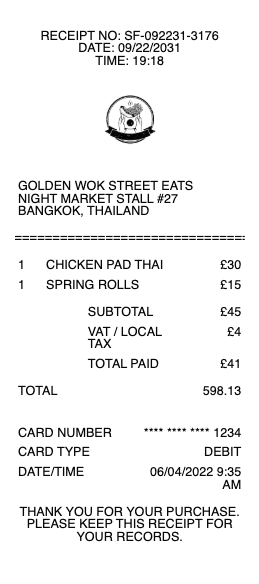
What a Street Food Receipt Looks Like (When One Exists)
Vendor or stall name — sometimes just a stall number at a market
Date and location — a market, festival, or street, not a fixed address
Item and price — often a single line for a simple order
Total, almost always cash, occasionally a mobile-wallet reference where those are common
Frequently handwritten, or no printed receipt at all
The Cash Reality: Why Street Vendors Rarely Give Receipts
Street food is a cash-first, high-volume, low-ticket trade, and most vendors have no register and no reason to print — the transaction is a handful of coins and a plate. In many countries a written receipt simply is not part of the exchange, and asking may get you a scrawled note on a scrap of paper at best. Where mobile wallets dominate (parts of Asia especially), a QR-code payment may leave a digital record in your wallet app that serves as proof, which is often the only trail that exists. The practical point: do not assume you can get a formal receipt from a stall, and plan documentation another way if the meal needs to be expensed.
Documenting Street Food for Travel Expenses and Per Diem
This is where the topic actually matters. Business travelers eat from stalls and then face an expense system that wants a receipt. Two paths work. First, per diem: many travel policies reimburse meals at a flat daily rate precisely because street food and small vendors can’t always provide receipts — under per diem you generally don’t need one, which is the cleanest solution for cash meals abroad. Second, where itemized receipts are required, keep a contemporaneous record — a photo of the stall and food, the amount, date, and location noted at the time — and pay by card or mobile wallet when possible so a transaction record exists. A reconstructed note made honestly at the moment of purchase is far stronger than one written from memory a week later.
Related dining receipts: see also our Food Truck receipt guide and our Ice Cream Shop receipt guide.
When You Need Proof and How to Create a Clean Copy
If your employer requires a document rather than a per-diem allowance, a legible reconstructed receipt of a real purchase — vendor, item, amount, date, location — is what makes the cash meal claimable, and it beats submitting nothing or an illegible scrap. Keep it honest and modest: street-food amounts are small, and inflating them is both obvious and fraud. Note the business purpose and, for a shared meal, who attended, the same as any expense. For frequent travelers, the reliable habit is to log cash meals daily against the per-diem rate rather than chase paper from vendors who don’t issue it.
Create a Street Food-Style Receipt
Our generator produces a clean, simple vendor-style receipt — stall or vendor name, location, item, and amount — as a legible PDF record of a genuine cash purchase when no printed slip was available.
Use it responsibly: recreate only meals you actually bought, at their true (small) amounts, and prefer your employer’s per-diem process where it exists. Fabricating or inflating receipts for reimbursement is fraud — the point of a reconstructed street-food receipt is to document a real cash purchase honestly, nothing more.
Frequently asked questions
Everything you need to know about the product and billing.
Do street food vendors give receipts?
Rarely — street food is a cash-first, low-ticket trade, and most vendors have no register. In many countries a written receipt isn’t part of the exchange; where mobile wallets are common, a QR payment may leave a digital record instead.
How do I expense street food with no receipt?
Two ways: per diem, where many policies reimburse meals at a flat daily rate without receipts — ideal for cash meals abroad — or, where receipts are required, a contemporaneous record (photo, amount, date, location) plus a card or mobile-wallet payment if possible.
What is per diem and why does it help with street food?
A flat daily meal allowance many travel policies pay precisely because small vendors and street stalls can’t always provide receipts. Under per diem you generally don’t need a receipt for each cash meal.
Can a mobile wallet payment serve as a street food receipt?
Often yes — where QR-code and mobile-wallet payments are common, the transaction record in your wallet app may be the only proof that exists, and it works as documentation of the purchase.
Is it OK to reconstruct a street food receipt?
To document a real cash purchase honestly — vendor, item, small amount, date, location — yes, and it beats submitting nothing. Inflating the amount or inventing a meal is fraud. Prefer per diem where your employer offers it.
Should I keep proof of street food purchases while traveling?
If you’re not on per diem, yes — note the amount, date, and location at the time, photograph the stall and food, and pay by card or wallet when you can so a record exists. A note made at the moment beats one written from memory later.