A gym membership receipt is proof you paid your fitness dues — a single monthly charge, an initiation fee, or a personal-training package. It looks simple, but people need it for surprisingly specific reasons: canceling cleanly, claiming an employer or insurer fitness reimbursement, or proving what a recurring charge on their card actually was. This page explains what the receipt shows and where it matters.
Gym Membership Receipt
Add custom logo
Edit line items
Choose payment method
Add/remove elements
Customize business information
Choose font
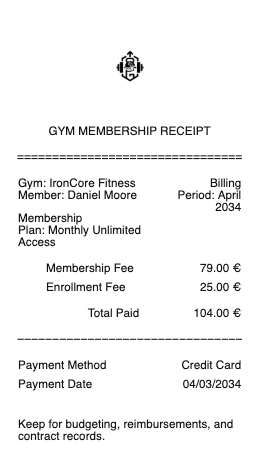
What’s on a Gym Membership Receipt
The gym’s name and location, and the billing date
Member name and account or agreement number
What was charged — monthly dues, an initiation/enrollment fee, or an annual maintenance fee
The membership tier — e.g. basic vs a premium/multi-club plan
Add-ons — personal training packages, classes, or a guest/day pass
Billing period the payment covers, and next billing date for recurring dues
Payment method and total paid
Recurring Dues, Initiation, and Annual Fees
Gym billing is rarely one flat number, and the receipt shows which piece you paid. Most memberships run on recurring monthly dues pulled automatically, often on top of a one-time initiation or enrollment fee at sign-up and a once-a-year annual maintenance fee — Planet Fitness’s annual fee is the best-known example, and it catches many members by surprise because it hits on a different date than the monthly charge. Premium tiers (a multi-club or “black card”–style plan) bill more, and personal training is usually a separate package billed apart from access dues. When an unexpected amount appears on your card, the receipt is what tells you whether it was the annual fee, a tier, or a training charge — which is exactly the detail you need before disputing anything.
Cancellation Proof and HSA/FSA Eligibility
Two situations make this receipt genuinely important. First, cancellation: gyms are notorious for requiring written notice and continuing to bill through a notice period, so keeping proof of your last payment and the cancellation date is your defense against charges that shouldn’t have happened. Second, tax-advantaged accounts: a general gym membership is not HSA- or FSA-eligible by default — it becomes eligible only when a doctor prescribes it for a specific diagnosed condition and provides a Letter of Medical Necessity. Without that letter, submitting gym dues to an HSA/FSA is a rejected (or disallowed) expense. The receipt is one half of that claim; the letter is the other. Knowing the rule prevents a common, avoidable reimbursement mistake.
Employer and Insurer Fitness Reimbursement
Many employers and health insurers run fitness reimbursement or wellness programs that pay back part of your gym cost — and they require a receipt showing the membership fee, the dates it covers, and proof it was paid, not just a bank line. Insurer programs and corporate wellness benefits typically reimbursement a set amount per year on submission of that proof. This is the most common legitimate reason members ask for an itemized gym receipt: the wellness portal needs to see it was a qualifying membership charge over a qualifying period. Keep the receipts that show consecutive months if your program requires proof of ongoing membership. For reimbursement, the receipt’s billing-period line does the work — it shows the coverage window the program is paying against.
Related medical receipts: see also our Vet receipt guide and our Health Insurance receipt guide.
Create a Gym Membership Receipt
Our generator produces a clean gym membership receipt — gym and member details, the dues, fees, or training package, the billing period, and the total — as a PDF when you need a legible copy for a wellness reimbursement, a cancellation record, or your own budget.
Use it responsibly: recreate only real payments you actually made, with their true amounts and dates. Fabricating a gym receipt to claim a reimbursement you’re not owed or to support a false HSA/FSA or expense claim is fraud — the gym’s billing records and your program administrator can verify what was paid. This tool is for legitimate record-keeping only.
Frequently asked questions
Everything you need to know about the product and billing.
What does a gym membership receipt show?
The gym’s name and location, the member and account number, what was charged (monthly dues, initiation fee, or annual maintenance fee), the membership tier, any add-ons like training, the billing period covered, the payment method, and the total paid.
Why was I charged an annual fee on top of my monthly gym dues?
Many gyms bill a once-a-year maintenance fee separate from monthly dues — Planet Fitness’s annual fee is the best-known example. It hits on a different date than the monthly charge, so the receipt is what confirms which fee an unexpected amount was.
Is a gym membership HSA or FSA eligible?
Not by default. A general membership becomes eligible only when a doctor prescribes it for a specific diagnosed condition and provides a Letter of Medical Necessity. Without that letter, submitting gym dues to an HSA or FSA is a disallowed expense.
How do I use a gym receipt for a fitness reimbursement?
Employer and insurer wellness programs reimburse part of your cost when you submit a receipt showing the membership fee, the dates it covers, and proof of payment. The billing-period line is the key detail — it shows the coverage window the program pays against.
Why should I keep my gym receipt when I cancel?
Gyms often require written notice and keep billing through a notice period. Keeping proof of your last payment and the cancellation date is your defense if you’re charged for months after you canceled.
Can I get a copy of an old gym receipt?
Usually yes — most gyms keep your billing history in your online account or member app, and the front desk can reprint a payment record. Ask for an itemized copy showing the fee type and billing period if you need it for reimbursement.