An ice cream shop receipt is a small, cheerful slip — a couple of scoops, a topping or two, often paid in cash by a family at the counter — but it has its own pricing logic worth understanding: sizes and scoops, add-ons, and the seasonal, cash-friendly nature of the business. This page covers what it shows and the few times you actually need to keep it.
Ice Cream Shop Receipt
Add custom logo
Edit line items
Choose payment method
Add/remove elements
Customize business information
Choose font
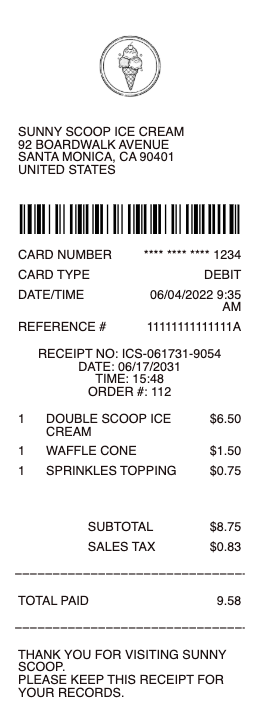
What’s on an Ice Cream Shop Receipt
Shop name and location, date, and time
Size or scoop count — single, double, triple, kiddie — the base price driver
The serving format — cup, sugar or waffle cone (often a small upcharge)
Add-ons — toppings, mix-ins, dips, whipped cream — as separate lines
Specialty items — sundaes, shakes, floats, banana splits — priced as combos
Subtotal, tax, any tip, and total, with payment method
Scoops, Sizes, and Add-On Pricing
Ice cream receipts read by size and count rather than by named dishes: the base line is the scoop size, and cones, toppings, and mix-ins stack on top as extras. That is why a simple order can total more than expected — a double scoop in a waffle cone with two toppings is really four priced lines. Specialty items like sundaes and shakes are usually fixed combos that bundle the scoops, sauce, and toppings into one price. Understanding this structure explains the total and matters for the rare business use: catering a scoop bar or ordering for an event, where the per-item breakdown is what an expense or a headcount reconciliation needs.
Cash, Tips, and Seasonal Shops
The ice cream trade has two traits that shape its receipts. It is cash-friendly and often cash-heavy — small tickets, families, kids paying — so a cash sale may produce only a short printed slip or none unless you ask, and if you need documentation, request the receipt or pay by card. Many counter shops also run a tip jar or a tip-screen prompt, which on card adds a tip line to the receipt. And many are seasonal, open spring through fall, which is worth knowing if you ever need a copy or a follow-up in the off-season, when the shop may be closed and unreachable for weeks. Capture the receipt when you buy if it matters.
When You Actually Need the Receipt
Most ice cream is an impulse buy nobody documents — but a few situations call for the slip. Team outings and events: treating a group or booking a scoop cart is an expense, and the itemized receipt is the reimbursement record. Pre-orders: ice cream cakes and packed pints ordered ahead sometimes take a deposit, and the receipt is the pickup proof and the record of what was ordered. Loyalty: shops with punch cards or app rewards use the receipt as proof of a visit where points don’t auto-credit. For any of these, keep the printed or emailed copy; for an everyday cone, it is genuinely fine to let it go.
Related dining receipts: see also our Street Food receipt guide and our Fast Food receipt guide.
Create an Ice Cream Shop-Style Receipt
Our generator rebuilds a scoop-shop receipt — shop header, size and scoop lines, cone and topping add-ons, any specialty combo, tax, and total — as a clean PDF for records when you need a legible copy.
Use it responsibly: recreate only purchases you actually made, at their real amounts. Fabricating receipts for reimbursement or rewards is fraud — for a genuine pre-order or event booking, the shop’s own record is the authoritative document.
Frequently asked questions
Everything you need to know about the product and billing.
Why is my ice cream shop total higher than expected?
Pricing stacks by size and extras: the scoop size is the base, and cones, toppings, and mix-ins each add a line. A double scoop in a waffle cone with two toppings is four priced items, not one.
How are specialty items like sundaes priced?
Usually as fixed combos that bundle the scoops, sauce, and toppings into a single price, rather than adding each component separately like a build-your-own order.
What if the ice cream shop only takes cash?
A cash sale may produce only a short slip or none unless you ask. If you need documentation, request the receipt or pay by card, and photograph any printed slip on the spot.
Do ice cream shops add a tip?
Many counter shops have a tip jar or a card-reader tip prompt; on card, a tip appears as its own line on the receipt. Cash tips go in the jar and are not itemized.
When do I need to keep an ice cream receipt?
For team outings or event bookings (expense record), pre-orders like cakes or packed pints (pickup proof and deposit), and loyalty programs where points don’t auto-credit. For an everyday cone, it’s fine to let it go.
Can I get a copy of an ice cream shop receipt later?
If you paid by card or ordered ahead, the shop’s POS or order record can help. Note that many shops are seasonal and may be closed for weeks off-season, so capture the receipt when it matters.