An insurance payment receipt confirms a premium was paid on a policy — life, renters, homeowners, umbrella, or any other coverage — and its quiet importance comes from what insurance does when payments stop: coverage lapses. Across every policy type, the receipt is the dated proof that keeps a lapse dispute winnable. This page explains what an insurance payment receipt shows, how payment frequency changes the price, and where grace periods and escrow fit.
Insurance Payment Receipt
Add custom logo
Edit line items
Choose payment method
Add/remove elements
Customize business information
Choose font
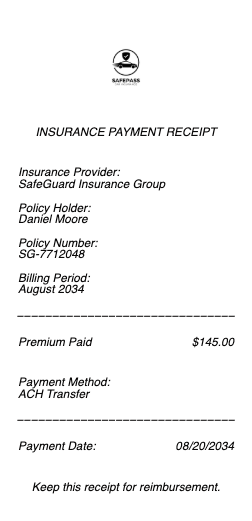
What’s on an Insurance Payment Receipt
The insurer and the policy number
The policyholder and the policy type — life, renters, homeowners, umbrella
The period the payment covers and the amount paid
The payment mode — annual, semi-annual, quarterly, or monthly
Any installment or service fee for paying in parts
The payment date, method, and a confirmation number
The next due date, and whether autopay is active
Payment Frequency — Why Monthly Costs More Than Annual
Most policies can be paid annually, semi-annually, quarterly, or monthly, and the choice isn’t free: insurers typically add an installment or service charge to each partial payment, so twelve monthly payments add up to more than the annual premium paid at once — pay-in-full is effectively discounted. Autopay often trims a little back. The receipt shows the mode and the period covered, which is what lets you see the loading: compare the sum of your installments against the quoted annual premium, and the difference is what the convenience costs. Households juggling several policies — life, renters or homeowners, umbrella — often stagger modes for cash-flow, and the receipts are how you track which policy is paid through when. It’s also the first thing to check when a bill looks wrong: a mode change (say, annual to monthly at renewal) changes every number on the schedule.
Grace Periods and Lapse — the Receipt as Evidence
Insurance has a hard edge most bills don’t: miss a payment beyond the grace period and the policy lapses — coverage ends. Grace periods vary by policy and state, but roughly a month is the common shape for life insurance, and other lines run their own windows. A lapse can be far more expensive than the missed premium: a life policy bought years ago at a younger age (and better health) may be irreplaceable at the old price, and reinstatement can require new underwriting and back premiums. That’s why the dated payment receipt matters — if an insurer’s records show a payment late or missing and yours show it made in time, the receipt with its confirmation number is the evidence that keeps the policy alive. Anyone paying by mail or on the grace-period boundary should keep every confirmation until the next one arrives; it’s cheap insurance on the insurance.
Escrow, Landlords, and Business Premiums
Who actually needs this receipt varies by policy. Homeowners premiums are often paid by the mortgage servicer from escrow — you fund escrow monthly and the servicer pays the insurer — so the “receipt” you check is the servicer’s disbursement, reconciled in the annual escrow analysis; keep it to confirm the insurer was actually paid. Renters policies are frequently required by landlords, who ask for proof of an active policy — usually a certificate or declarations page rather than the payment receipt, but the receipt is what proves the policy stayed paid. Business insurance premiums (liability, property, professional) are deductible operating expenses, substantiated by the payment receipts. And for life insurance, beneficiaries settling an estate sometimes need to show premiums were current. In each case the pattern repeats: policy documents prove coverage exists; the payment receipt proves it was kept in force.
Related insurance receipts: see also our Health Insurance receipt guide and our Car Insurance receipt guide.
Create an Insurance Payment Receipt
Our generator produces a clean insurance payment receipt — insurer, policy number and type, period covered, mode, amount, and confirmation — as a PDF for your records, an escrow reconciliation, a landlord’s file, or a business expense folder.
Use it responsibly: recreate only real premium payments you actually made, with true amounts and dates. Fabricating an insurance payment receipt to fake an active policy, dispute a legitimate lapse, or claim a deduction you’re not owed is fraud — the insurer’s payment ledger is the authoritative record, and misrepresenting coverage status can void claims entirely. This tool is for legitimate record-keeping only.
Frequently asked questions
Everything you need to know about the product and billing.
What does an insurance payment receipt show?
The insurer and policy number, the policyholder and policy type (life, renters, homeowners, umbrella), the period the payment covers, the amount, the payment mode (annual through monthly), any installment fee, the date, method, and confirmation number, and the next due date.
Why does paying insurance monthly cost more than annually?
Insurers add an installment or service charge to each partial payment, so twelve monthly payments total more than the annual premium paid at once — pay-in-full is effectively discounted. The receipt’s mode and period lines let you compare your installments against the quoted annual premium.
What is an insurance grace period?
A window after the due date — commonly around a month for life insurance, varying by line and state — during which coverage continues despite the missed payment. Pay within it and the policy stands; miss it and the policy lapses, which can be far costlier than the premium itself.
Why is a lapsed life insurance policy such a problem?
Because the policy was priced at your age and health when you bought it — a replacement years later costs more or may not be offered, and reinstatement can require new underwriting plus back premiums. A dated payment receipt is the evidence that prevents a wrongful lapse.
Who pays homeowners insurance if I have a mortgage?
Often the mortgage servicer, from your escrow account — you fund escrow monthly and the servicer disburses the premium. Check the servicer’s disbursement and annual escrow analysis to confirm the insurer was actually paid; that record stands in for a direct payment receipt.
Are insurance premiums tax-deductible?
Business insurance premiums — liability, property, professional — are deductible operating expenses, substantiated by payment receipts. Personal policies generally aren’t, with specific exceptions handled by their own rules (self-employed health premiums, for example, have a dedicated deduction).