An invoice payment receipt closes the loop an invoice opens: the invoice asks for money, the receipt confirms it arrived. It references the original invoice number, states what was paid and how, and shows any balance still due — the document that keeps accounts receivable, bookkeeping, and client records agreeing with each other.
Invoice Payment Receipt
Add custom logo
Edit line items
Choose payment method
Add/remove elements
Customize business information
Choose font
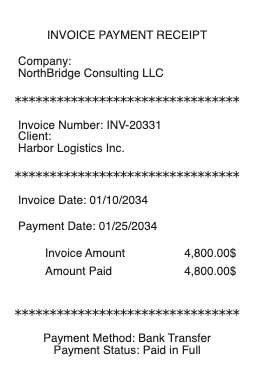
What’s on an Invoice Payment Receipt
Receipt number and date of payment
The invoice number being paid — the line that ties the receipt to the original bill
Seller and payer details
Invoice total, amount received, and payment method
Remaining balance — zero for payment in full, or the amount still open after a partial payment
Notes — early-payment discount applied, late fee collected, or currency used
Invoice vs. Payment Receipt: Two Documents, One Transaction
The invoice and the payment receipt are constantly conflated because they describe the same sale from opposite ends. The invoice is issued before money moves: it itemizes the work or goods, sets the price, and states the payment terms. The payment receipt is issued after: it confirms how much arrived, when, and against which invoice. A business that issues both leaves a complete audit trail — the ask and the answer — which is exactly what bookkeepers and auditors reconstruct when either document is missing.
The distinction also decides which document proves what: to show a debt exists, produce the invoice; to show it was settled, produce the receipt. Accountants treat the receipt, not the invoice, as evidence of the payment date — which determines the accounting period a payment falls into.
Business payers add a third document to the pair: the remittance advice — the payer's note saying which invoices a payment covers. When one transfer settles five invoices, the receipt proves money arrived, but the remittance advice is what lets the bookkeeper allocate it correctly. Payments without remittance detail become 'unapplied cash', the accounts-receivable purgatory where money sits while both sides email about it.
For a side-by-side comparison that adds proof of payment, see receipt vs invoice vs proof of payment.
What “Payment Due Upon Receipt” Means on an Invoice
The phrase trips people because “receipt” here means receiving the invoice, not a receipt document. “Payment is due upon receipt of invoice” means the clock starts the moment the invoice lands — pay now, not in 30 days. Freelancers and small businesses use the term to avoid net-30 waiting games; in practice, payment within a few business days is the accepted standard. An example line: “Terms: Due upon receipt. A 1.5% monthly late charge applies to balances open after 15 days.” Once the client pays, the invoice payment receipt is what confirms the term was met.
Partial Payments, Deposits, and Balance-Due Receipts
Not every invoice is settled in one transfer. When a client pays a deposit or an installment, issue a receipt for each payment showing the amount received, the running total paid, and the balance still due against the invoice — three numbers that prevent almost every payment dispute. The final receipt then marks the invoice paid in full. This trail matters most in services and trades, where deposits are standard, and in bookkeeping software, where each receipt maps to a payment record applied against the open invoice.
For recurring work the same pattern scales: number receipts sequentially and apply each to its invoice, and the open-invoice report stays trustworthy. If a client settles two invoices with one transfer, issue either one receipt per invoice or a combined receipt listing both invoice numbers with the amount applied to each.
Related payment receipts: see also our Deposit receipt guide and our Proof of Payment receipt guide.
Currency adds the last wrinkle: an invoice in one currency paid in another settles at a rate, and the receipt should record the amount received in the invoice's currency alongside what was actually paid — because 'paid in full' is a statement about the invoice currency, and exchange movements between issue and payment are how full payments arrive looking short.
Create an Invoice Payment Receipt
Our generator produces a clean invoice payment receipt — receipt and invoice numbers, both parties, amount received, method, and the balance line — as a downloadable PDF that matches the paper trail your accounting expects.
Use it responsibly: issue receipts only for payments actually received, in their real amounts. Fabricating payment receipts to fake settled invoices misleads counterparties and auditors and constitutes fraud.
The same trail continues on the proof of payment receipt, service receipt, and contractor receipt pages.
Frequently asked questions
Everything you need to know about the product and billing.
What is an invoice payment receipt?
The document a seller issues after receiving payment against an invoice. It references the invoice number and confirms the amount received, the date, the method, and any balance remaining. Cross-currency payments should state both amounts — paid in full is a claim about the invoice's currency, and exchange movement is how full payments arrive looking short.
What is the difference between an invoice and a payment receipt?
The invoice requests payment before money moves; the receipt confirms payment after. The invoice sets terms and itemizes the sale; the receipt records how and when it was settled.
What does “payment due upon receipt” mean?
It means payment is expected as soon as the invoice is received rather than on net-15 or net-30 terms. “Receipt” refers to receiving the invoice, not to a receipt document.
How do I write a receipt for a partial invoice payment?
Show the amount received, the invoice number it applies to, the total paid so far, and the balance still due. Issue one receipt per payment and a final receipt marking the invoice paid in full. For multi-invoice payments, add a remittance line saying which invoices the money covers — unallocated payments become unapplied cash that both sides then email about.
Should the receipt use the invoice number or its own number?
Both. The receipt carries its own sequential number for your records and references the invoice number it settles, so either document can locate the other.
Do businesses have to issue a receipt when an invoice is paid?
Requirements vary, but clients paying by cash, check, or bank transfer routinely need one for their own books — and issuing receipts consistently keeps your accounts receivable reconciled.