A service receipt is proof of payment for work performed rather than goods sold — a car service, a cleaning visit, a repair call, a consultation. Because there is no product changing hands, the receipt itself is often the only record of what was done, which makes its format matter more than most receipts.
Service Receipt
Add custom logo
Edit line items
Choose payment method
Add/remove elements
Customize business information
Choose font
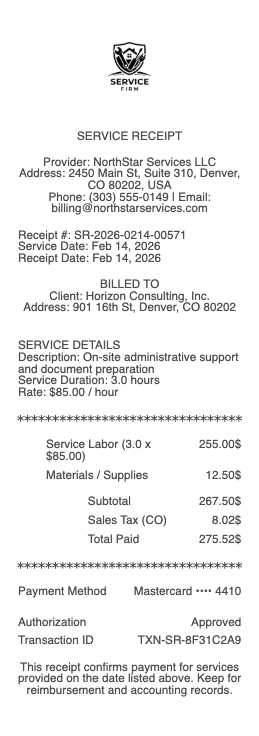
What’s on a Service Receipt
Provider’s business name and contact details
Customer name — and the service address if work happened on site
Date the service was performed
Description of the work — specific enough that a stranger could tell what was done
Labor — hours and rate, or a flat service price
Parts and materials used, each priced, when the job involved any
Service-call or trip fee, if charged
Tax, total, payment method, and amount received
Service Receipt Format: What Separates a Usable One
The format rule for a receipt for services is simple: describe the work, split the money. “Services rendered — $250” fails both halves; “AC diagnostic and capacitor replacement, 1.5 hrs labor @ $120, part $45” passes. Splitting labor from parts matters because reimbursements, warranties, and bookkeeping treat them differently, and a dated, itemized description is what turns a payment slip into proof of exactly what was purchased. Add the balance line — paid in full, or deposit received with the remainder due — and the same format covers one-off jobs and multi-visit work alike.
Numbering receipts sequentially and keeping the service address on every copy also future-proofs the record — service work is location-bound, and an address plus a date resolves most “which visit was this?” questions without a phone call.
The best service receipts state their own callback window: how long the work is warranted and what a return visit costs inside versus outside it. A receipt saying '30-day workmanship guarantee' converts the vaguest dispute — it stopped working again — into a scheduling question. Silence on the subject converts it into an argument.
Car Service and Cleaning Service Receipts
The two most-requested variants show why the anatomy matters. A car service receipt should name the vehicle (year, make, model, and ideally mileage) plus each operation performed — that mileage-stamped service trail directly supports warranty claims and resale value. A cleaning service receipt should state the property or unit, the visit date, and the scope (standard clean, deep clean, move-out clean), because landlords and property managers file these against deposits and turnovers. In both cases the receipt is doing evidence work, not just accounting work.
When You Need a Service Receipt Later
Service receipts get retrieved for three reasons: reimbursement (an employer or client repaying a service you paid for), disputes (proving work was paid for when quality or completion is contested), and taxes (a self-employed provider’s income record, or a customer’s deductible business expense). In each case the receipt only helps if it carries the date, the provider, the described work, and the amount — which is why a vague counter slip so often has to be replaced by asking the provider for a proper itemized copy.
A fourth scenario is warranty service: when a repair fails, the receipt showing the original service date and scope determines whether the redo falls under the provider’s workmanship guarantee. Providers benefit from copies too — a numbered trail of service receipts is the fastest way to reconstruct income at tax time or answer a client’s records request months later.
Related professional service receipts: see also our Contractor receipt guide and our Professional Services receipt guide.
Recurring service relationships deserve a running ledger over loose slips: the cleaner's twelfth visit is easier to price, dispute, and deduct when visits one through eleven sit in a dated list with amounts. Providers who bill this way get paid faster for the same reason customers prefer it — one page answers every question the year produces.
Create a Service Receipt
Our generator builds a service receipt template in a minute — provider and customer blocks, the work described line by line, labor and parts split, service-call fee, tax, and total — downloadable as a clean PDF for either side of the transaction.
Use it responsibly: document real services at their real prices. Creating receipts for services never performed — for reimbursements, disputes, or tax records — is fraud.
Specific service types have their own examples: the handyman receipt, car maintenance receipt, and invoice payment receipt.
Frequently asked questions
Everything you need to know about the product and billing.
What is a service receipt?
Proof of payment for work performed rather than goods sold — repairs, cleaning, maintenance, consultations. It records who did the work, what was done, when, and what was paid.
What is the correct format for a service receipt?
Provider and customer details, the service date, a specific description of the work, labor shown as hours × rate or a flat price, any parts priced separately, tax, and the total with payment method. State the callback terms too — a written workmanship window turns an it-broke-again dispute into a scheduling question instead of an argument.
What should a car service receipt include?
The vehicle’s year, make, model, and mileage, plus each operation performed with its price. A mileage-stamped service history supports both warranty claims and resale value.
What should a cleaning service receipt include?
The property or unit cleaned, the visit date, the scope of cleaning (standard, deep, or move-out), and the amount paid — the details landlords and property managers need for deposit and turnover records.
Is a service receipt the same as an invoice?
No. The invoice requests payment before it happens; the service receipt confirms payment after. Keeping both gives a complete audit trail for the job.
Why do reimbursements reject vague service receipts?
Because “services rendered” with one total proves nothing about what was purchased. Approvers want the work described and the labor, parts, and fees broken out — ask the provider for an itemized copy if yours is vague. Recurring services reject less when documented as a running ledger — dated visits with amounts on one page, rather than a year of loose slips.