A contractor receipt documents money actually paid on construction and renovation work — the deposit, each progress payment, and the final settlement. It sits alongside the estimate, the contract, and the invoice, but it is the receipt that homeowners produce for insurance, resale, and dispute purposes, and the record contractors keep to show what has been collected on a job.
Contractor Receipt
Add custom logo
Edit line items
Choose payment method
Add/remove elements
Customize business information
Choose font
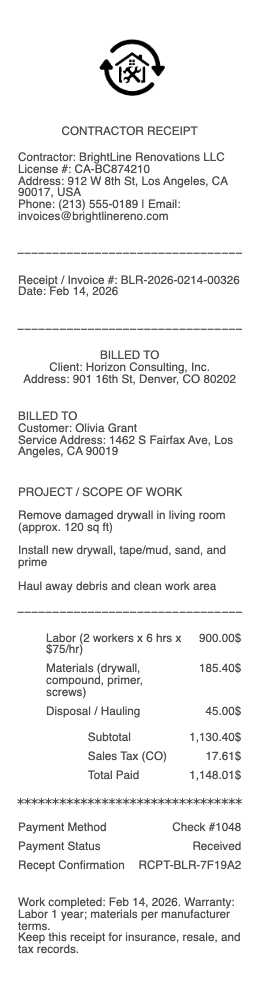
What’s on a Contractor Receipt
Contractor’s business name, license number (where licensing applies), and contact details
Customer name and project address
Date of payment — and the invoice or contract it applies to
What the payment covers — deposit, a named project phase, or final balance
Labor and materials, broken out when the payment maps to specific work
Amount received, payment method, and who accepted it
Running total — paid to date and balance remaining on the contract
Deposits, Progress Payments, and Paid-in-Full Receipts
Construction money moves in stages, and the receipts should too. The deposit receipt records the money that starts the job; each progress payment (draw) receipt names the phase it pays for — rough-in complete, drywall hung, punch list cleared; and the paid-in-full receipt closes the contract. On larger jobs the final receipt commonly travels with a lien waiver: the receipt proves the customer paid, the waiver confirms the contractor gives up lien rights for the amount received. Homeowners who keep this pair for every payment end a project with a complete defense file — and contractors who issue them end it with fewer collection arguments.
Wording matters on the last one: a receipt marked paid in full, with the contract amount, the date, and a signature, is the cleanest evidence a project closed with nothing owed. If a warranty or punch-list holdback remains, say so on the receipt instead — paid in full except the $500 holdback due when the punch list clears.
Cash Payments to Contractors: Put It in Writing
A receipt for a cash payment to a contractor is not optional paperwork — it is the only evidence the payment happened. Check and transfer payments leave a bank trail; cash leaves nothing unless a signed receipt says who paid whom, how much, for what work, on which date. Both sides benefit: the customer can prove the draw was paid, and the contractor can show the income matches the books. A cash receipt should carry a signature line and be issued at the moment of payment, not reconstructed at the end of the job from memory.
Independent Contractor Payment Receipts and Client Records
Businesses that pay independent contractors — freelancers, subs, specialists — need payment receipts for a different reason: the books. Each payment receipt substantiates an expense, supports year-end reporting to contractors, and answers audits with dates and amounts rather than estimates. On the contractor’s side, the same receipts reconcile income across clients. A contractor receipt template with the fields above covers this use unchanged; the only addition worth making is the payer’s business name exactly as it appears in its accounting system.
Keep the document chain consistent: estimate, contract, invoices, then a receipt for every payment against them. When the numbers across those documents agree, both tax season and disputes turn into paperwork exercises instead of arguments.
Related professional service receipts: see also our Monthly Service receipt guide and our Service receipt guide.
Create a Contractor Receipt
Our generator produces a contractor receipt template you can issue in a minute — license and contact block, project address, what the payment covers, labor and materials, amount received, and the paid-to-date line — downloadable as a clean PDF for the job file.
Use it responsibly: record real payments on real work. Fabricating contractor receipts — for an insurance claim, a tax deduction, or a dispute — is fraud, and on licensed work it can put the license itself at risk.
Related trade paperwork: the handyman receipt for small jobs, plus roofing receipt and landscaping receipt examples.
Frequently asked questions
Everything you need to know about the product and billing.
What should a contractor receipt include?
The contractor’s business details and license number where applicable, the customer and project address, the payment date, what the payment covers, the amount and method, and the running paid-to-date and balance figures.
Should I get a receipt for every progress payment?
Yes — one receipt per draw, each naming the phase it pays for. A deposit receipt, phase receipts, and a final paid-in-full receipt together document the whole contract.
What is a paid-in-full contractor receipt?
The receipt for the final payment, stating the contract balance is zero. On larger jobs it is commonly exchanged together with a final lien waiver releasing lien rights for the amounts paid.
How do I document a cash payment to a contractor?
With a signed, dated receipt naming both parties, the amount, and the work it applies to, issued when the cash changes hands. Without it, a cash payment is nearly impossible to prove later.
Do businesses need receipts for independent contractor payments?
Yes — payment receipts substantiate the expense, support year-end contractor reporting, and give audits exact dates and amounts. Contractors need the same records to reconcile their income.
Is a contractor receipt different from a handyman receipt?
Same idea, different scale. Handyman receipts cover small hourly or flat-rate jobs; contractor receipts track contract-based work with deposits, phased draws, license details, and lien paperwork.