A lawn care receipt records recurring maintenance of a lawn — mowing, and the fertilization and weed-control treatments that keep turf healthy — and it reads differently from a landscaping bill because lawn care is ongoing, not a one-time project. It’s often sold as a multi-visit program you prepay. This page explains what the receipt shows, how per-visit and program billing differ, and how it’s distinct from a landscaping install.
Lawn Care Receipt
Add custom logo
Edit line items
Choose payment method
Add/remove elements
Customize business information
Choose font
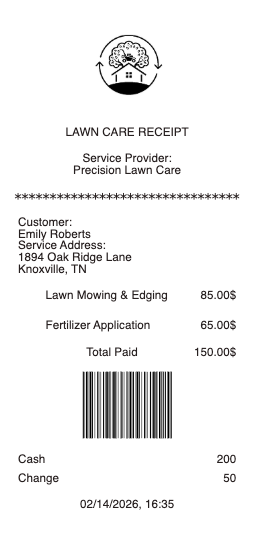
What’s on a Lawn Care Receipt
Provider and property address serviced, with the visit date
The service — mowing, fertilization, weed/grub control, aeration, overseeding
Whether it’s a single visit or one application in a season-long program
The program step — e.g. “treatment 3 of 7” — if on a plan
Per-visit price or the prepaid plan amount and what remains
Recurring schedule — weekly, biweekly, or per-application
Total, tax where applicable, and payment method
Per-Visit vs Season-Long Treatment Programs
Lawn care is billed two ways, and the receipt shows which. Mowing is usually per-visit or on a recurring weekly/biweekly charge through the growing season. Lawn treatment — fertilization, pre- and post-emergent weed control, grub and pest control — is typically sold as a multi-application program: a set number of visits across the year (commonly a six- or seven-step plan), which you can prepay for a discount or pay per application. TruGreen is the best-known national brand for these programs, and local companies run similar plans. That’s why a lawn-care receipt often reads “treatment 4 of 7” rather than a standalone charge — it’s one step in a subscription-like program. Reading whether you paid per-visit or into a prepaid plan tells you what a given charge covered and how many applications remain.
Lawn Care vs Landscaping — Maintenance vs Project
These get conflated, but the receipts document different things. Lawn care is recurring maintenance of existing turf — cutting, feeding, weed control — billed on a schedule or program. Landscaping is project work: design, planting, hardscape, installing a new lawn or beds, billed as a one-time job (often with a deposit and materials by the yard). A lawn-care receipt is a per-visit or per-application record that repeats; a landscaping receipt is a larger, one-off project invoice. Knowing which service you bought matters for records and taxes: recurring lawn maintenance on a rental property is an ongoing deductible expense, while a landscaping install may be a capital improvement treated differently. If your receipt lists a repeating treatment step or a mowing schedule, it’s lawn care; if it details a built or planted project, it’s landscaping.
Contracts, Property Records, and Getting a Copy
Regular lawn service often runs under a seasonal agreement, so keeping receipts builds a record of a continuous plan — useful if a prepaid program is interrupted or you dispute a missed visit. For rental or commercial property owners and HOAs, lawn-care receipts are deductible operating expenses and part of the property’s maintenance file, so itemized records of each visit or application matter at tax time. Homeowners keep them to track a program’s progress and prove prepaid applications were delivered. Providers typically keep your service history by address, so a copy is usually a quick reprint or an emailed statement, and program companies show each completed application in your online account. For a business or rental claim, get the receipt that names the property, the service, and the date clearly.
Related home service receipts: see also our Landscaping receipt guide and our Moving Company receipt guide.
Create a Lawn Care Receipt
Our generator produces a clean lawn care receipt — provider and property, the service or program step, per-visit or plan amount, schedule, and total — as a PDF when you need a legible copy for a rental-property expense file, a program record, or your own bookkeeping.
Use it responsibly: recreate only real visits or applications actually performed, with their true amounts. Fabricating lawn-care receipts to claim a rental-property deduction for work not done, or to invent a business expense, is fraud — the provider’s service history by address is the authoritative record and can be verified. This tool is for legitimate record-keeping only.
Frequently asked questions
Everything you need to know about the product and billing.
What does a lawn care receipt show?
The provider and property serviced with the date, the service (mowing, fertilization, weed or grub control, aeration), whether it’s a single visit or one step in a season-long program, the per-visit price or prepaid plan amount, the recurring schedule, and the total.
What’s the difference between per-visit and program lawn care billing?
Mowing is usually per-visit or a recurring seasonal charge. Lawn treatment is typically a multi-application program — a set number of visits across the year, often six or seven steps — that you prepay for a discount or pay per application. That’s why receipts read “treatment 4 of 7.”
How is lawn care different from landscaping?
Lawn care is recurring maintenance of existing turf — mowing, feeding, weed control — billed on a schedule or program. Landscaping is one-time project work: design, planting, hardscape, or installing a new lawn. A repeating treatment step means lawn care; a built or planted project means landscaping.
What is a lawn treatment program?
A season-long plan of fertilization and weed, grub, and pest control applied in a set number of visits across the year — commonly a six- or seven-step program. TruGreen is the best-known national provider, and local companies run similar plans you can prepay or pay per step.
Is lawn care tax-deductible?
For a rental or commercial property, recurring lawn maintenance is a deductible operating expense, and the receipts are part of the property’s maintenance file. For a personal residence it generally isn’t. Itemized receipts naming the property, service, and date support a business or rental claim.
How do I get a copy of a lawn care receipt?
Providers keep your service history by property address, so a copy is usually a quick reprint or an emailed statement, and program companies show each completed application in your online account. For a rental claim, get the version that clearly names the property, service, and date.