A landscaping receipt covers two very different kinds of work with one document: the recurring visit — mowing, edging, seasonal cleanups billed weekly or monthly — and the one-time project, where plants, pavers, and soil arrive by the yard and labor runs by the crew-day. A good template handles both, and this page shows how.
Landscaping Receipt
Add custom logo
Edit line items
Choose payment method
Add/remove elements
Customize business information
Choose font
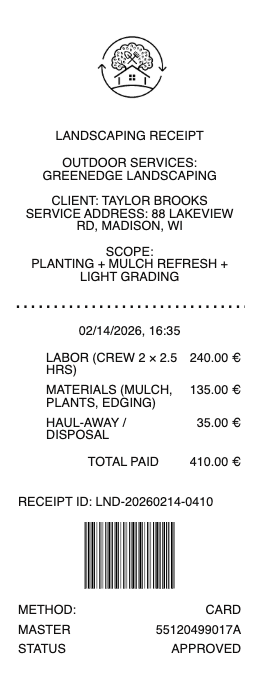
What’s on a Landscaping Receipt
Business name and contact details — with license number where states require one for landscape contracting
Customer name and property address — the work is tied to a specific yard
Service date or billing period for recurring plans
Work performed — mowing, edging, trimming, mulching, cleanup, or the project scope
Materials by quantity — mulch and soil by the cubic yard, plants by count and size, pavers by square foot
Labor — hourly, per-visit, or per-project
Green-waste disposal or haul-away fee
Tax, total, payment method, and any balance due
Recurring Lawn Care vs. One-Time Project Receipts
Recurring maintenance billing works best as one receipt per period: the month, the number of visits included, the per-visit or monthly rate, and any extras (a spring cleanup, a fertilization round) as separate lines. Project work — a new bed, sod installation, a paver walkway — reads more like a contractor receipt: deposit received, materials itemized, labor, disposal, and the balance. Mixing the two on one slip is how disputes start; a lawn company running both keeps maintenance and project receipts as two templates with the same header.
Seasonal prepay plans deserve one more line: when a customer pays the season up front, receipt the full payment when it lands, then note the visits consumed on each period statement — that running count is what lets a mid-season cancellation settle without argument.
Projects carry a documentation habit the trade's best operators already use: before and after photos attached to the invoice. For the customer they prove the transformation the money bought; for the landscaper they are the answer to a later damage claim — the sprinkler head was broken before, the photo is dated. Paper plus pictures is the file that ends arguments.
Materials, Yards, and Disposal Lines
Landscaping is one of the few services where materials routinely outweigh labor, so the receipt should quantify them the way suppliers sell them: mulch and topsoil in cubic yards, plants by count with pot size, stone and pavers by the square foot or pallet. The disposal line matters just as much — hauling brush, sod, and green waste costs real money at the transfer station, and a named haul-away fee on the receipt is far easier to defend than a padded labor number. Customers comparing quotes can then see exactly where the money goes.
Who Ends Up Needing a Landscaping Receipt
Landlords and property managers file them to document upkeep between tenants and to charge make-ready work correctly. Home sellers keep them as evidence of maintained grounds — and fresh landscaping receipts pair naturally with sale listings. Rental-property owners treat them as deductible maintenance expenses, with the receipt as substantiation. And the landscaper needs the same copies for income records and for the sales-tax treatment of materials, which varies by state. One well-itemized receipt serves every one of those files.
HOA boards and commercial properties add a fourth file: they typically want the license number and insurance certificate on record, and receipts that match the contract line for line are what make those relationships renew quietly.
Related home service receipts: see also our Pest Control receipt guide and our Lawn Care receipt guide.
Capital improvements versus maintenance is the tax line worth understanding: routine mowing and seasonal cleanups are current expenses for a rental property, while a new retaining wall, irrigation system, or major hardscape is a capital improvement that adds to the property's basis. The receipts sort the two — which is exactly why lumped invoices are worth asking to have split.
Create a Landscaping Receipt
Our generator builds a landscaping receipt template in a minute — business and property blocks, the period or project scope, work lines, materials by quantity, labor, disposal, and total — downloadable as a clean PDF for maintenance plans and projects alike.
Use it responsibly: document real work at real prices. Writing receipts for landscaping never performed — for a deposit claim, an expense file, or a tax deduction — is fraud.
Other yard and trade documents: the handyman receipt, contractor receipt, and pest control receipt examples.
Frequently asked questions
Everything you need to know about the product and billing.
What should a landscaping receipt include?
The business and property addresses, the service date or billing period, the work performed, materials quantified the way they are sold (yards, counts, square feet), labor, any disposal fee, tax, and the total with payment method.
How should recurring lawn care be billed on receipts?
One receipt per billing period showing the visits included and the per-visit or monthly rate, with extras like cleanups or fertilization as separate lines rather than folded into the base price.
What is a green-waste or haul-away fee?
The charge for removing brush, sod, and clippings to a transfer station or compost facility. Naming it as its own line keeps labor honest and shows customers where disposal costs come from.
Are landscaping receipts tax-deductible?
For rental and business properties, grounds maintenance is generally a deductible expense and the receipt is the substantiation. For a personal residence it typically is not — but receipts still support home-sale records. The split matters — maintenance expenses deduct currently for rentals, while hardscape and irrigation projects capitalize into the property's basis, so ask for separate invoices.
Should a landscaping project receipt show a deposit?
Yes — project receipts should track deposit received, materials, labor, disposal, and the balance remaining, the same pattern contractors use for phased work. Dated before-and-after photos attached to the invoice help both sides — proof of the work for the customer, protection against pre-existing-damage claims for the landscaper.
Do landscapers need to keep copies of their receipts?
Yes — they are the income record, and because the sales-tax treatment of materials versus labor varies by state, the itemized copies are what make tax filings defensible.